
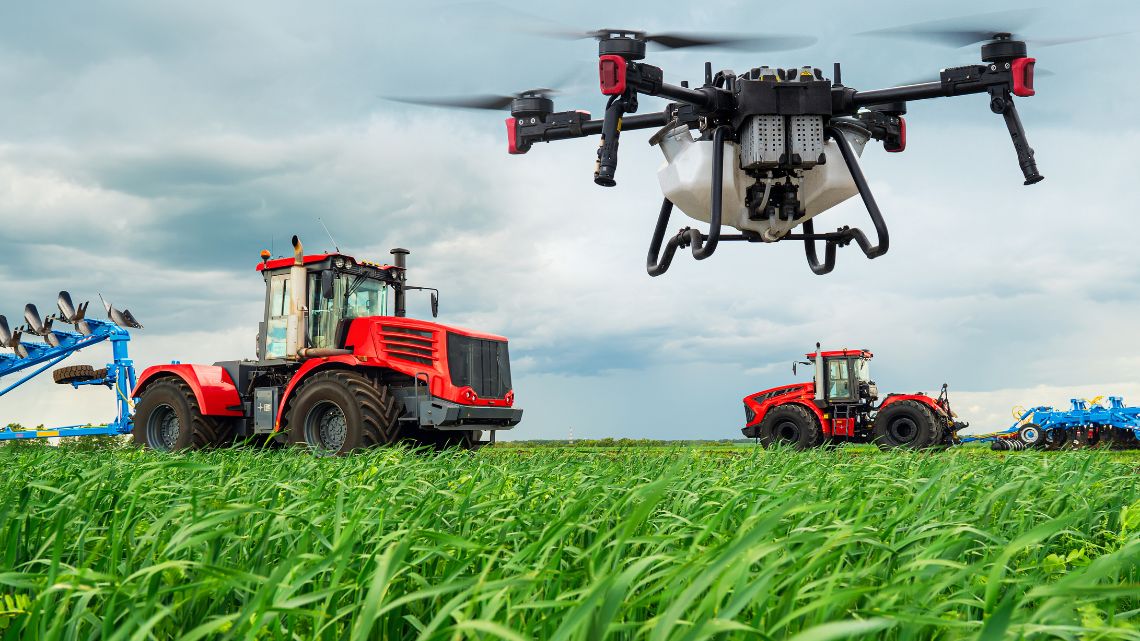
Across endless fields of green that once depended entirely on human labor and mechanical repetition, a new generation of intelligent machines now steers, plants, monitors, and harvests. In 2026, agricultural engineering has entered an era where artificial intelligence, robotics, and precision sensing come together to reshape the way food reaches our tables.
From Horsepower to Algorithmic Power
For well over a century, agricultural progress has moved in time with the use of bigger engines and more powerful tractors. Despite this, farming methods continue to face a different set of pressures. Farmers must feed a global population of 8.2 billion people alongside growing labor shortages, climate change, and operational costs. The United Nations states that the world’s population is likely to reach 9.8 billion people by 2050, straining agricultural productivity and efficiency even more than before.
Today, engineers see robots as a solution to this global dilemma. Robotic harvesters, autonomous tractors, and AI-driven monitoring systems now transform farming from a once labor-intensive activity into a smart industry 4.0.
When Tractors Learned to Drive Themselves …
Major farm machinery firms have already started integrating autonomy in farm equipment. In 2022, John Deere introduced a fully autonomous tractor equipped with advanced cameras, GPS guidance, and machine learning algorithms that can navigate fields without human drivers. This helped farmers to a great extent to monitor operations remotely through accessible mobile apps. According to John Deere, the system he introduced uses AI models and six pairs of stereo cameras to detect obstacles and guide operations in real time.
Other top industry leaders follow a similar path forward in the agriculture industry. For example, large companies like CNH Industrial have invested in autonomous tractor platforms, while startups in Europe, North America, and Asia design smaller, task-specific robotic units for weeding, planting, and fruit harvesting. These machines do not replace humans whatsoever; they simply keep a check on crop conditions, gather soil data, and improve efficiency across every square meter of farmland.
Machines That See What the Farmers Cannot
Agricultural robots now function as proximal sensing vehicles, built with satellite connectivity, multispectral imaging cameras, and Light Detection and Ranging – LiDAR. These machines help farmers monitor crop health in ways that the human eye cannot replicate. Research published by the Food and Agriculture Organization (FAO) reveals that smart farming technologies that combine automated machinery and sensors can significantly improve efficiency, helping farmers water and apply fertilizer and pesticides more precisely while reducing ecological effects.
Sensibly, this means robots can detect pest infestations before they spread, apply treatments in infected areas or whenever needed, and identify plant stress early. And so, engineers view these capabilities as critical tools for driving a sustainable agriculture practice.
The Engineering Behind Autonomous Fields
Building robots for agricultural purposes requires interdisciplinary collaboration. Mechanical engineers design strong machines capable of operating in dusty, muddy, and other extreme temperatures, while software engineers develop navigation algorithms that interpret terrain and obstacles. Agricultural engineers make sure that their machinery works as intended in various soil conditions, crops, and planting patterns. The result is an emerging, autonomous, non-stop, large-scale farming network.
Some robotic platforms work in coordinated groups today, where multiple machines come together to complete different tasks quickly. According to the International Federation of Robotics, agricultural robotics is seen as an up-and-coming market in automation, with accelerated funding in robotic field platforms and autonomous harvesting systems.
Humans Still Steer the Future of Farming
Despite the urbanity of technologies, agricultural robotics does not remove humans from farming roles, but merely changes them. Now, farmers gradually manage operations through AI-powered dashboards and analytics platforms rather than steering machinery directly in the field.
For instance, an agricultural engineer working with an autonomous tractor testing, described the shift by a statement: “We are not replacing farmers; we are only giving them better tools to understand their fields.” That perspective alone reflects the much broader transformation that’s presently underway in agricultural engineering.
The Next Era of Agricultural Farming
Autonomous farming is still in its early stages, yet the course it follows is evident. Engineers continue to improve navigation systems, reduce hardware costs, and integrate robotics with satellite data and farm management platforms. The next generation of agricultural systems has a bright future, as they will likely combine artificial intelligence, robotics, and climate-adaptive farming practices into one, unified functional system.
In the coming decades, there is absolutely no doubt that the world will still depend on soil, sunlight, and water to grow food. But the machines that guide the work of the land will steadily rely on algorithms, sensors—and primarily—the engineers who design them.