
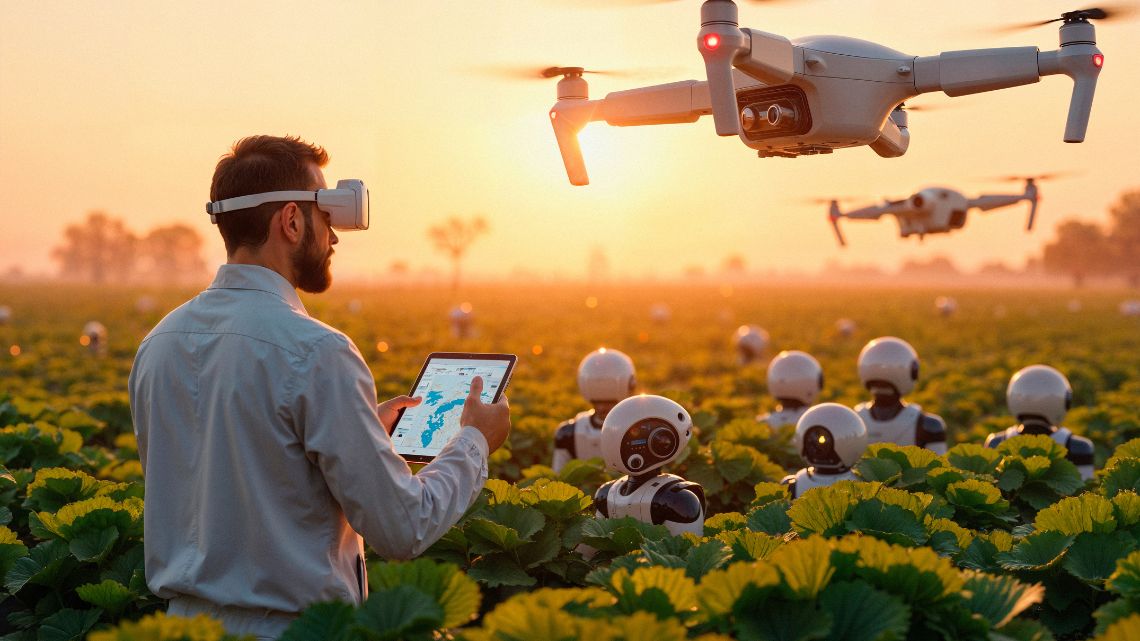
Walk through an automated farm in California or parts of Europe and you might see something that makes you pause: a low humming machine moving slowly between the rows, its cameras scanning each plant with quiet precision. When it detects a weed, a laser fires — a brief pulse of thermal energy and the machine moves on. No herbicide drifts across the field. No soil is disturbed. A weed is simply gone.
In 2026, this kind of technology is no longer confined to experimental trials. It is already operating on commercial farms, reflecting a broader transformation in modern agriculture. What makes these systems particularly significant is their ability to reduce chemical use without sacrificing efficiency. Some systems can cut pesticide or herbicide use by as much as 90 percent by treating only the plants that require attention. Others move autonomously through crop rows, using computer vision to identify weeds, disease, or pest damage before problems spread across an entire field. Together, these innovations are changing how modern farms approach crop protection and food production.
Precision Agriculture
Traditional farming methods often treat an entire field the same way, applying fertilizers or pesticides evenly across large areas regardless of the actual needs of individual plants. But fields are rarely uniform. Soil composition, moisture levels, nutrient availability, and pest pressure can vary significantly even within short distances. Precision agriculture addresses this challenge by employing digital technologies, sensors, satellite imagery, and data analytics to tailor farming practices to specific field and crop conditions. By allowing farmers to apply inputs only where they are needed and in the exact amounts required, precision agriculture improves efficiency while reducing waste, costs, and environmental impact.
The concept itself is not entirely new. Researchers began experimenting with GPS-guided fertilizer distribution in the United States during the 1980s. What has changed in recent years is the technology available to make it practical on a large scale. Autonomous robots, drones, and connected sensors are now turning that early concept into everyday farming practice. And the results can be striking. In some cases, targeted spraying systems can reduce herbicide use by as much as 90 percent.
Machines Designed for the Modern Farms
A growing number of agricultural robots are now available commercially, each approaching the challenge of crop management in a different way. One widely known example is See & Spray, a system developed by Blue River Technology and later acquired by John Deere. Equipped with cameras and computer vision software, the system scans plants in real time as equipment moves through a field. When it detects a weed, the sprayer activates only for that specific target. Instead of treating the entire field, chemicals are applied precisely where they are needed — a method that field trials suggest can reduce herbicide use by up to 90 percent.
Other companies are exploring completely chemical-free approaches. Carbon Robotics, for instance, has developed the LaserWeeder, a machine that identifies weeds using high-resolution cameras and then destroys them with focused thermal laser pulses. The system can reportedly eliminate as many as 200,000 weeds per hour while leaving surrounding crops untouched.
Swiss startup ecoRobotix has taken a different approach with its ARA robot. The lightweight machine runs primarily on solar energy and uses precision nozzles to deliver extremely small doses of herbicide directly to individual plants. Because it treats weeds one by one rather than spraying entire rows, the system significantly reduces chemical use while also avoiding the soil compaction caused by heavier machinery.
Meanwhile, in the United Kingdom, the Small Robot Company is experimenting with a team of specialized robots known as Tom, Dick, and Harry. Each robot performs a different task. One maps and analyses the field, another treats weeds, while a third plants crops. Together, they represent a shift toward what the company calls per-plant farming, where each plant is monitored and treated individually rather than as part of a uniform field.
Chemical-Free Crop Protection Technologies
While targeted spraying reduces chemical use, some technologies aim to eliminate pesticides altogether. Two technologies in particular are drawing attention for their ability to control pests and weeds without traditional chemicals. One is UV-C treatment where robots use short-wavelength ultraviolet radiation to disrupt the DNA of fungi and microorganisms responsible for plant diseases. The method is particularly useful in greenhouse environments, where diseases such as botrytis can spread quickly through crops like tomatoes or strawberries.
The other is laser weed removal, which has become one of the most talked-about developments in agricultural robotics. In this method, advanced computer vision systems identify weeds at an early stage of growth and target them with highly focused thermal lasers. Because the process destroys weeds individually, it avoids the broad environmental impact associated with traditional herbicide spraying.
Market Growth and Industry Investment
Market research estimates suggest that the global agricultural robotics sector reached a value of approximately $11.6 billion by the mid-2020s, with continued growth expected as more farms adopt precision systems. Several factors are driving this expansion. One is the increasing demand for more efficient food production as the global population continues to rise. The world’s population is projected to approach 9.6 billion people by 2050, increasing pressure on farmers to produce more food while using fewer resources.
Environmental regulations are also influencing the adoption of robotic systems. The European Union’s Farm to Fork Strategy, part of the European Green Deal, aims to reduce chemical pesticide use by 50 percent by 2030. Such policy initiatives have encouraged research and investment in alternative technologies, including robotic crop management systems. Countries such as France, the Netherlands, Switzerland and Denmark have already launched pilot programmes exploring the integration of robotics into precision farming practices.
What It Means for Farmers?
For farmers, the benefits are practical and immediate. One of the most noticeable advantages is the reduction in input costs. Because robotic systems apply chemicals only where they are needed, farmers no longer have to rely on large volumes of fertilizers or herbicides spread across entire fields.
Labor shortages are another growing challenge in agriculture. In many regions, farm workforces are aging, particularly in countries such as Japan and across parts of Europe, while younger workers increasingly move toward urban industries. Automation offers one way to address both challenges. Robots can operate continuously, often working day and night with minimal supervision. Meanwhile, targeted chemical application can lower costs and lessen environmental impact.
Autonomous systems can handle repetitive tasks such as weed detection, crop monitoring, and precision spraying with consistent accuracy. And less chemical runoff means cleaner groundwater and healthier ecosystems. Smaller robotic machines also tend to be lighter than conventional tractors, which helps preserve soil structure.
The Next Phase of Agricultural Robotics
Of course, these technologies are still evolving. Many robotic systems remain expensive, and not every farm has access to the infrastructure needed to support them. But as the technology improves and costs fall, agricultural robots could become a far more familiar part of modern farming. And the possibilities are just beginning. Researchers are already exploring ideas like per-plant farming, where every individual plant receives exactly the water, nutrients, and protection it needs. Others are developing swarms of small robots that can work together across fields instead of relying on one large machine. If these ideas continue to develop, farms may begin to operate in ways that look very different from today. Machines that once assisted farmers could eventually take on a much larger share of day-to-day field work. Will farms of the future run almost entirely under the guidance of intelligent machines? It’s still too early to say. But one thing is certain: technology is reshaping agriculture in ways that would have been hard to imagine just a decade ago.