
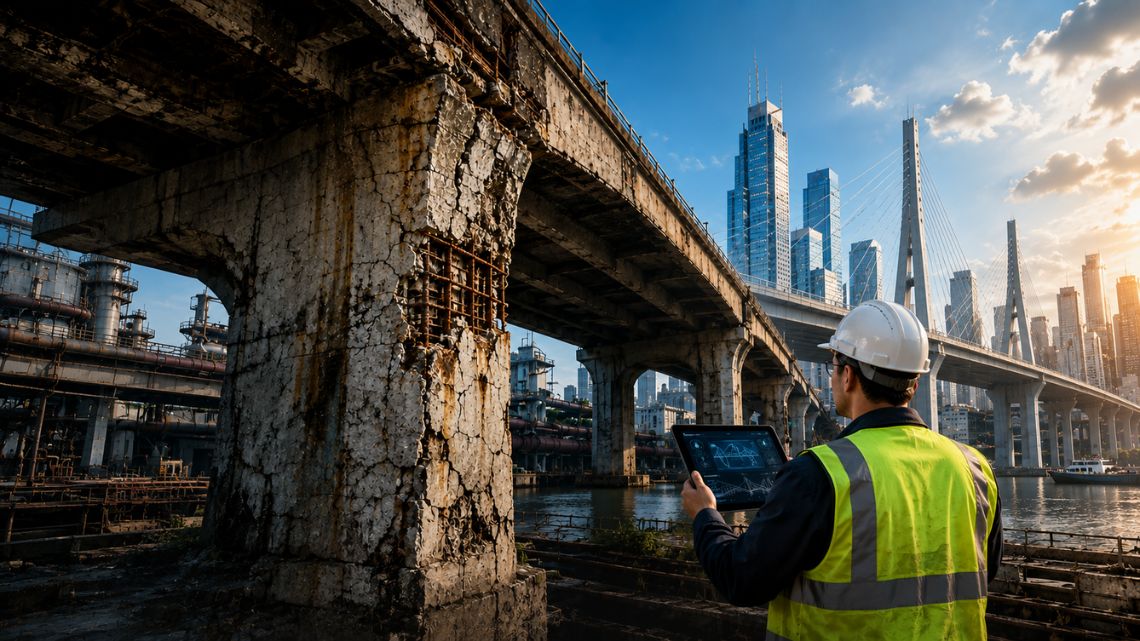
The engineering industry is investing heavily in the future, from autonomous transportation and AI-powered manufacturing to smart cities and next-generation energy systems. But underneath all of that innovation sits a much less glamorous problem: much of the infrastructure making modern life possible is getting old.
Bridges, roads, tunnels, water pipelines, electrical networks, rail systems, and dams were designed for another era. Many are still functioning, but they are increasingly being asked to handle heavier loads, larger populations, harsher weather, and technologies their original designers could never have anticipated. That makes aging infrastructure more than a maintenance headache. It is becoming a fundamental engineering constraint on the future.
The warning signs are already visible. The American Society of Civil Engineers (ASCE) gave U.S. infrastructure an overall grade of C in its 2025 Report Card—the highest overall grade since its assessments began in 1998. Yet nine of the 18 infrastructure categories remained in the D range, including energy, roads, aviation, dams, levees, wastewater, and transit. ASCE also estimates a $3.7 trillion investment gap between what is needed to bring U.S. infrastructure to a state of good repair and projected investment through 2033. The numbers are important, but the engineering problem goes deeper.
Infrastructure Was Designed for a Different World
A bridge built decades ago was designed around assumptions about traffic volumes, structural loads, materials, weather conditions, and patterns of use. A power network was designed around a different generation mix and a more predictable pattern of electricity demand. Water systems were built around population levels, consumption patterns, and rainfall conditions that may no longer reflect today’s operating environment.
Many of these systems are now facing conditions their original designs did not anticipate. Climate change is adding another layer of stress. Extreme heat can deform rail tracks and damage road surfaces, while intense rainfall can overwhelm drainage systems. Flooding, wildfires, and storms can expose vulnerabilities that may not become apparent during normal operation. As these risks grow, engineers are turning to new ways of monitoring and protecting infrastructure, including AI-enabled sensors, drones, heat-resistant materials, and reflective coatings designed to reduce the impact of extreme heat. The challenge is therefore not simply that infrastructure is deteriorating. It is that the operating environment is changing faster than the infrastructure itself.
The Hidden Condition of Aging Assets
Age is a useful indicator of infrastructure risk, but it says little on its own about an asset’s actual condition. Two bridges built in the same year can have very different remaining service lives because of differences in traffic loads, materials, corrosion, maintenance history, and environmental exposure. The same applies to pipelines, tunnels, substations, and industrial equipment. The difficulty is that some deterioration is not readily visible. Corrosion can develop inside structural components, pipelines can deteriorate underground, and fatigue can accumulate gradually. Maintenance records for older assets may also be incomplete, particularly where systems have been modified or changed ownership over the years.
Periodic inspections remain essential, but they provide a snapshot of an asset at a particular point in time. They may not reveal how the condition is changing between inspections. Structural health monitoring can add another layer by continuously measuring variables such as strain, vibration, displacement, tilt, and temperature. That distinction is important. Engineers need to know not only whether an asset has a defect, but whether its condition is stable, deteriorating gradually, or changing rapidly. For infrastructure owners, better condition data can also improve the timing of intervention. A deterioration trend identified early may allow a planned repair or rehabilitation. The same problem discovered after failure can become an emergency project with fewer technical and financial options.
Replacement Is Not Always the Answer
There is an obvious temptation when dealing with aging infrastructure: replace it. But replacing an entire asset is not always feasible. A city cannot shut down its water network while kilometres of new pipelines are installed, and a railway cannot remain out of service for years while bridges and tracks are rebuilt. Replacing a transmission network can also involve enormous capital costs, land requirements, permitting, and coordination. That is why rehabilitation, retrofitting, and life-extension engineering are becoming increasingly important.
Engineers can strengthen existing structures, replace deteriorated components, introduce more durable materials, upgrade electrical and mechanical systems, and add monitoring capabilities without replacing the entire asset. The World Bank has also highlighted the importance of lifecycle management and preventive maintenance. Timely intervention can extend an asset’s service life and delay the need for more costly rehabilitation, replacement, or reconstruction. The decision should not come down to whether rehabilitation is cheaper than replacement. Engineers also need to consider the asset’s remaining useful life, its importance to the wider system, future demand, and the conditions it will face. A rehabilitation project designed to extend service for another 20 or 30 years should address those future requirements rather than simply restore the asset to its original specification. The objective is not to make old infrastructure look new. It is to extend the service life of existing assets while improving their ability to meet current and future demands.
Maintenance and Asset Management
The scale of aging infrastructure makes maintenance strategy just as important as individual engineering interventions. Owners of large networks cannot give every asset the same level of attention, particularly when budgets and engineering resources are limited. This makes asset criticality an important part of maintenance planning. An older bridge carrying relatively little traffic may present less immediate risk than a structure that serves as a major freight or emergency route. A small defect in a critical electrical component may also deserve faster action than more extensive deterioration in an asset with redundancy. Condition, failure probability, service criticality, remaining useful life, and the consequences of failure can therefore be used together to establish maintenance priorities.
The World Bank has found that inadequate maintenance increases lifetime costs and that preventive maintenance is generally less expensive than allowing assets to deteriorate until major rehabilitation is required. For infrastructure owners, this means moving away from maintenance programmes based mainly on age or fixed schedules and toward decisions supported by actual asset condition and risk.
Digital Monitoring
Digital tools are becoming increasingly useful for assessing the condition of aging infrastructure and determining when maintenance, repair, or replacement may be needed. Sensors can track structural movement, vibration, temperature, and other indicators without requiring engineers to be physically present during every inspection. Drones can inspect difficult-to-access structures, while remote monitoring can provide continuous information from bridges, dams, tunnels, and other infrastructure. These systems give engineers a clearer picture of how an asset is performing between inspections and help them respond before a small problem becomes a larger one.
The Infrastructure Gap
Aging infrastructure becomes an even greater constraint when new technologies depend on it. The electricity sector provides a clear example. More renewable power projects, electric vehicles, data centers, battery storage, and electric industrial equipment are increasing the demand for electricity. But building or expanding the power grid takes time. In many cases, new power projects or large facilities are ready to operate before the transmission lines and other grid infrastructure needed to connect them are in place. The International Energy Agency (IEA) reports that more than 2,500 GW of renewable, storage, and large-load projects are currently stalled in grid connection queues worldwide. It estimates that annual grid investment will need to increase by roughly 50% by 2030 from today’s level of around $400 billion to meet projected electricity demand.
Engineers are therefore looking at ways to increase the capacity of existing networks as well as build new lines. Reconductoring, voltage uprating, dynamic line ratings, topology optimisation, and other grid-enhancing technologies can increase the amount of capacity available without waiting for entirely new transmission corridors to be completed. Similar principles apply across other sectors. New transport technologies still depend on roads and bridges. Smart water systems still rely on physical distribution networks. Automated factories still require reliable power, communications, and utilities. As technology advances, the infrastructure supporting it must evolve alongside it.
The Bottom Line
Aging infrastructure will require a combination of approaches rather than a single solution. Some assets will need replacement. Others can be strengthened, rehabilitated, monitored, or upgraded to support another phase of service. The key is having enough information to distinguish between them. For engineering teams, that means combining condition assessment with structural monitoring, lifecycle analysis, risk assessment, and future-demand modelling. For infrastructure owners, it means considering maintenance and rehabilitation alongside new capital projects rather than treating them as separate priorities.
The engineering industry is already developing many of the tools needed to manage this transition. The larger task is applying them systematically across infrastructure networks that may span decades of construction, ownership, and maintenance decisions. The infrastructure supporting the next generation of engineering innovation will not all be new. Much of it will be the same physical network that exists today, strengthened and adapted to do more. How effectively that transition is managed will determine whether aging infrastructure remains a constraint on innovation or becomes a reliable foundation for the next generation of engineering.
To Read More, Visit Engineering Realm.