
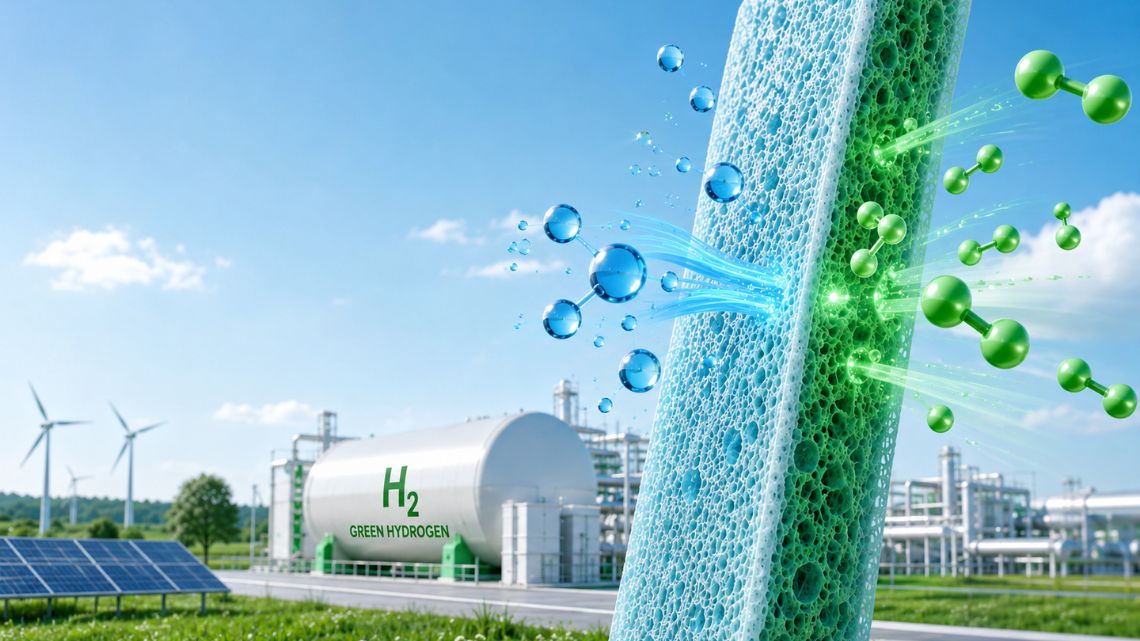
If you listen to the green energy evangelists tell it, the transition to a hydrogen economy is a simple matter of ambition and deployment. We just need to build a few thousand offshore wind turbines, hook them up to water-splitting machines called electrolyzers, and watch clean, zero-emission fuel pour into our heavy industries, cargo ships, and steel mills. It is a beautiful, frictionless vision of the future where the only byproduct is pure, sparkling water.
But if you talk to the chemical engineers who actually have to source the materials for those electrolyzers, they will tell you we are walking straight into a geopolitical and geological meat grinder.
For the last decade, the gold standard for high-efficiency, flexible hydrogen production has been Proton Exchange Membrane technology. These systems are marvels of modern engineering: compact, incredibly fast to start up, and able to ride the wild, unpredictable fluctuations of wind and solar grids like a seasoned surfer.
There is just one incredibly expensive catch: these machines are basically high-tech jewelry boxes.
Because they operate in a brutally acidic environment, the internal electrodes must be coated with some of the rarest and most expensive precious metals on Earth. Specifically, they require platinum and iridium. Iridium is a geological fluke—an ultra-rare element associated with the asteroid impact that wiped out the dinosaurs. We mine less than ten tons of it globally every year, and almost all of that supply is concentrated in a handful of politically volatile corners of the planet.
If we tried to scale green hydrogen to the gigawatt levels required to save the climate using this technology, we would literally run out of iridium before we even built our first dozen gigafactories. We are trying to build a global energy revolution on a material that is rarer than gold.
If green hydrogen is going to survive the transition from venture-backed slide decks to industrial reality, we have to throw out the precious metals. We need to stop fighting the acid, and start engineering the membrane.
The Bulky Ancestor and the Intermittent Grid
To understand why we are in this bottleneck, you have to look at the historical alternative: alkaline water electrolysis.
This is the industrial grandfather of hydrogen production. It’s been around for over a century, and it doesn’t use a single gram of iridium or platinum. Instead, it runs in a highly basic, liquid potassium hydroxide solution, which allows engineers to use inexpensive, abundant transition metals such as nickel and iron as catalysts.
But traditional alkaline systems are the mechanical equivalent of a steam locomotive. They are massive, slow-moving, and bulky. Most importantly, they are completely allergic to the modern renewable grid.
An alkaline electrolyzer requires a steady, predictable stream of electricity to keep its internal pressures balanced. If you feed it the erratic, spiky power of a wind farm on a gusty afternoon, the system struggles to keep up. If the power drops too fast, the gases inside can cross over and mix, creating a highly explosive hazard.
To run a traditional alkaline plant on wind and solar, you have to build a massive, expensive battery buffer to smooth out the electricity before it ever touches the water. You are essentially paying a double tax—once for the batteries, and once for the bulky chemical plant—just to keep your system from blowing itself up.
The Chemistry Hack: Switching the Ions
This is where chemical and materials engineers are staging a quiet revolution with a technology called Anion Exchange Membrane electrolysis.
The concept behind this technology is a beautifully elegant materials hack. Instead of using an acidic solid polymer membrane that requires precious metals to survive, or a liquid alkaline soup that is too slow to react, this system combines the best of both worlds. It uses a solid polymer membrane that conducts negatively charged hydroxide ions rather than positively charged protons.
By switching the ion, you completely rewrite the thermodynamics of the system.
Because the internal environment of the cell is alkaline rather than acidic, the destructive corrosive forces are neutralized. Suddenly, you don’t need iridium or platinum to protect your electrodes from dissolving into rust. You can use cheap, abundant transition metals like nickel, iron, and cobalt. According to materials science reports, this single substitution cuts catalyst costs by more than eighty percent.
At the same time, because you are still using a thin, solid polymer membrane rather than a liquid bath, you retain the compact, high-efficiency, and rapid-response characteristics of the premium systems. You can ramp the power up and down in seconds to match the passing of a cloud over a solar array. It is the ultimate holy grail: the cost profile of the old-school alkaline systems, combined with the high-octane agility of the modern space-age systems.
The Engineering Nightmare: The Hydroxide Meat Grinder
If the materials math of this membrane is so perfect, why isn’t every hydrogen startup already running on it? Because keeping that membrane alive in the real world is an absolute chemical horror show.
Hydroxide ions are incredibly aggressive chemical agents. While they are friendly to nickel and iron electrodes, they are absolutely murderous to the organic polymers that make up the solid membrane.
To conduct these ions efficiently, the polymer backbone of the membrane must be studded with positively charged chemical groups. But the hydroxide ions are constantly trying to attack and break those very same charged groups off the polymer chain. It is a tragic, self-destructive design loop: the more efficient the membrane is at moving the ions, the faster the ions try to shred the membrane from the inside out.
For years, early prototypes would degrade and fall apart after just a few hundred hours of operation. The membrane would literally dissolve into a useless, gooey plastic soup, halting the hydrogen flow and ruining the cell.
The race is now happening in the labs of advanced chemical companies and startups, where researchers are synthesizing entirely new polymer backbones. They are moving away from fragile, traditional plastics and engineering incredibly stable, rigid hydrocarbon structures. By shielding the vulnerable charged head groups behind bulky, defensive molecular rings, they are creating membranes that can survive the chemical meat grinder for tens of thousands of hours without losing a single percentage of their conductivity.
The Business Case: Erasing the Jewelry Tax
For the energy investor and the industrial strategist, the transition to this new membrane chemistry is the ultimate scalability play.
In the green hydrogen gold rush, capital expenditure is the absolute gatekeeper. Today, green hydrogen is twice as expensive as “gray” hydrogen made from natural gas. We cannot bridge that gap with moral persuasion or clever marketing; we have to wipe out the production costs.
By deploying these advanced membrane systems, you don’t just shave a few pennies off your utility bill; you completely restructure the economics of the factory.
- The CapEx Victory: By replacing precious metals with nickel and iron, you cut the upfront capital cost of the electrolyzer stack by up to forty percent. You are no longer tying up millions of dollars of precious capital in metals that are highly vulnerable to commodity market shocks.
- The Compressor Bypass: These solid membrane systems can produce hydrogen directly under high pressure. In traditional setups, you have to run your hydrogen through a massive, noisy, and power-hungry mechanical compressor to get it ready for storage. By letting the physics of the membrane do the compressing inside the cell, you eliminate a major mechanical point of failure and slash your energy footprint.
- The Chemical Freedom: Because the membrane does not require a highly corrosive liquid electrolyte to function, you can run the system on simple, pure water. This eliminates the need to handle, store, and dispose of tons of hazardous chemical liquids, turning your hydrogen facility from a toxic chemical plant into a clean, simple utility box.
Conclusion: Engineering the Plastic, Not the Mine
The tech world has spent too long acting as if the green transition is a software problem—as if we can solve the climate crisis with a cleaner routing algorithm, a better virtual power plant, or another carbon-tracking app. But the physical reality of the hydrogen economy is a cold reminder that the laws of chemistry do not care about your software’s valuations.
We cannot run a clean, global industrial civilization on a technology that relies on an ultra-rare asteroid metal mined from a handful of contested holes in the ground. The precious-metals bottleneck is the ultimate reality check for the clean-tech boom.
The hardware startups that will dominate the next era of energy are the ones abandoning the precious metals entirely, embracing the complex physics of polymer chemistry, and learning how to split water using the common elements of the earth.
Put away the iridium. Stop mining the asteroid scars. The future of green hydrogen isn’t in a precious-metal vault; it’s in a brilliantly engineered sheet of plastic.