
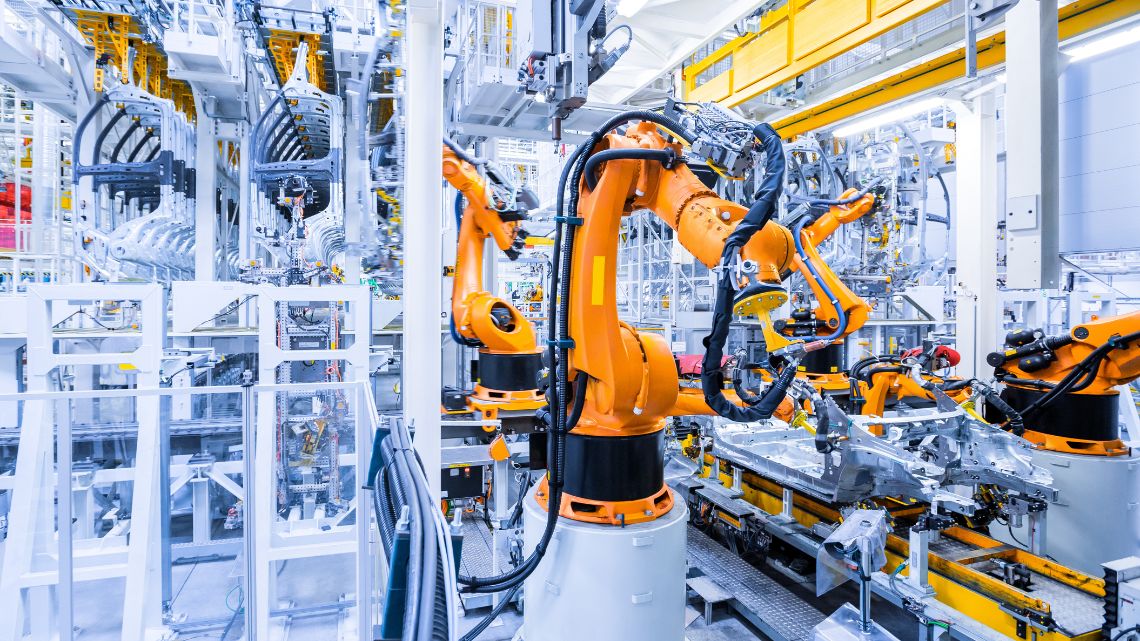
Whenever we heard the word automation, a cold, metallic echo of grinding, repetitive tasks used to dull our senses. It conjured up images of speed, and tireless processes—efficient yet almost without soul. The world relied on one truth: machines would do exactly as they were told. They didn’t improvise. They didn’t anticipate. They didn’t learn. They delivered output—steady, predictable, mechanical. Engineering was the science of control, precision, and repeatability.
Today, something exhilarating is happening.
We are no longer just automating tasks; we are awakening a mind within the machine.
And, machines began to observe, respond, and adapt.
Today, the industrial world stands on the threshold of a new era—one where steel learns to think.
The core mission of modern Automation Engineering has dramatically evolved, shifting from merely dictating movement to cultivating genuine machine cognition. We are transforming dense steel and intricate silicon into vibrant, collaborative partners capable of learning, predicting, and ceaselessly optimizing.
Yet at its heart, this revolution isn’t about the chilling thought of displacing human genius, but about amplifying it. It frees us from routine repairs and constant firefighting, allowing engineers to focus on complex challenges and stronger safety.
And what it means for entrepreneurs, engineers, and global leaders is far bigger than efficiency gains. It is redefining how value is created, how industries evolve, and how organizations transform.
The New Factory Floor: From Rigid Machines to Adaptive Intelligence
Step onto the new factory floor and feel the energy—the most grounded change is the shift from repetition to collaboration. The old, intimidating cages, those physical barriers designed to safeguard humans from unpredictable machines, are coming down. They are replaced by a “collaborative ecosystem,” where human and steel dance together in constant, safe interaction.
Modern Engineering no longer asks:
How do we make machines work better?
It plans:
How do we make machines work smarter?
The shift seems subtle, but its consequences are monumental.
Sensors now do more than detect—they interpret.
Robots no longer repeat—they collaborate.
Systems don’t just operate—they optimize.
The results?
The materials-handling unit doesn’t just blindly follow a pre-programmed track; it sees a human colleague, instantly calculates a safe, elegant vector, and communicates its intent. This integration elevates human work exponentially. The operator is no longer tied to monotonous repetition; they become the strategic supervisor, orchestrating the entire autonomous fleet, managing workflow, and focusing on the quality control that only nuanced human judgment can achieve. The system handles the back-breaking, time-consuming effort, freeing human capital for the pure joy of innovation.
Cognitive Understanding And Engineering
For decades, machines acted. Now they react.
The thrilling power of modern automation has introduced a kind of digital intuition, enabling systems to sense their environment, forecast the future, and make decisions in real time. Now they can understand context and anticipate failure even before it signals a warning.
For instance, let’s consider how asset maintenance has evolved in the past few years. Times back, we relied on fixed maintenance schedules or repairs that came after damage, both of which were costly and inefficient. Today, automation engineering employs digital twins: virtual replicas of physical assets that learn from real-time sensor data. Powered by Physics-Informed Neural Networks (PINNs), these models are guided by real physical laws, allowing systems to anticipate problems instead of merely reacting to them.
This predictive sight is electrifying. It allows the system to declare, with high-fidelity certainty, that a specific bearing will degrade significantly in $28$ days, or that a critical valve’s efficiency will drop within the week. This ability transforms the human role entirely, turning the maintenance team from desperate firefighters into confident, surgical strategic planners.
A robotic arm slows down when it detects human presence.
A conveyor reconfigures itself to prevent bottlenecks.
A manufacturing line recalibrates automatically as raw material quality varies.
This is the frontier where engineering meets cognition.
By engineering systems that self-diagnose and proactively recommend solutions, we slash costly downtime, sharpen resource allocation, and ensure continuous, resilient operation. It is the brilliant fusion of high-level intelligence with granular mechanical precision.
When steel learns to think, industries learn to evolve.
A New Bottom Line: Speed, Precision, and Insight
Automation is often mistaken for speed alone. But that’s only at the surface.
Automation engineering reshapes the bottom line by enabling systems to operate with precision and foresight. In industries where a single error can cost millions, accuracy becomes currency. Predictive systems reduce downtime. Intelligent workflows cut defects. Operations scale without scaling inefficiency.
Manufacturers see lower rejection rates. Energy plants gain stability and predictability. Logistics networks deliver with consistency, once considered unreachable.
This is not acceleration for its own sake.
It is engineering refined for control, clarity, and performance.
Ethical Clarity: Beyond the Metrics
As the world advances toward a green revolution, engineering excellence is no longer defined by performance alone. Sustainability has become an integral and inseparable component of engineering design, decision-making, and infrastructure development.
Automation enables sustainability by reducing waste, optimizing resources, and anticipating demand. Smarter grids stabilize renewable energy. Automated buildings regulate energy use in real time. Factories minimize material loss while protecting margins.
As systems begin to sense and decide, ethical clarity must be built in. Transparency, human oversight, and safety are no longer optional—they are design requirements.
Automation engineering is redefining progress—not through faster or more powerful systems, but through smarter, more accountable solutions. By creating intelligent machines designed to operate with precision and efficiency, automation engineering extends its impact well beyond traditional performance metrics.