
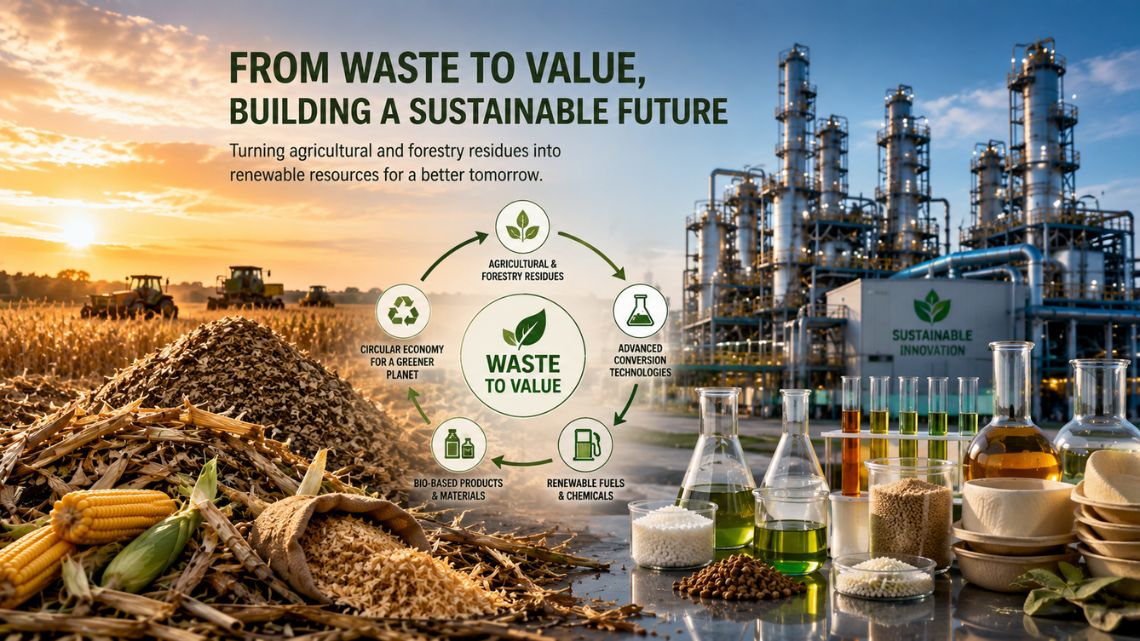
The end of a harvest marks the beginning of a different ritual altogether. Stalks are burned, husks are discarded, and sawdust is gathered in forgotten piles. Meanwhile, vast mountains of agricultural waste accumulate at the field’s edge, rooted in the assumption that once crops are harvested, their story ends.
Perhaps this cycle never stopped. In 2026, chemical engineers are transforming agricultural and forestry waste into valuable resources that people can use. Once merely seen as useless refuse, these carbon-dense materials—collected from corn stalks to rice husks—now present limitless possibilities.
Across laboratories and industrial biorefineries, engineers are discovering that tomorrow’s fuels, plastics, and chemicals won’t be pumped from underground oil reservoirs, but harvested from agricultural fields.
A Second Life for Agricultural and Forestry Waste
For over 100 years, petroleum has been the bedrock for countless industrial chemicals—everything from plastics to medicines. Yet, the industrial push for sustainability has driven engineers to develop new renewable solutions.
The International Energy Agency emphasizes that achieving global net-zero goals relies heavily on sustainable bio-based feedstocks, electrification, and recycling strategies. Rather than digging up new fossil fuels, chemical engineers are taking waste from farms and forests and turning them into useful carbon. This changes a huge trash problem into a continuous recycling loop.
Turning Plant Fibers into Useful Industrial Products
Contrary to crude oil, biomass is challenging to refine. Plant matters are composed of cellulose, hemicellulose, and lignin—requiring sophisticated chemical and biological treatments to become useful industrial products. Engineers today break down these materials into valuable chemical intermediates by combining a mix of catalysis, fermentation, enzymatic action, and thermochemical processes.
These renewable feedstocks are then transformed into commercially viable bioethanol, organic acids, bioplastics, sustainable aviation fuels, and speciality chemicals. For our chemical engineers, biomass has evolved from simple organic matter into a true alternative refinery.
Transforming One Industry’s Waste into Another’s Resource
One of the greatest values of biochemicals lies beyond just replacing petroleum; it also lies in helping industries rethink waste itself. Previously discarded farming and forestry by-products are now actively repurposed as primary industrial materials. Similarly, food-processing waste is being repurposed through biochemical conversion technologies, supplying industries with sustainable, renewable resources.
The United Nations Environment Programme reveals that rising circular economy initiatives will play a critical role in reducing raw resource extraction and industrial pollution over the coming decades. Instead of focusing solely on initial production, modern engineering is designing factories that transform one industry’s waste into the starting point for another.
From Lab to Industrial Reality
Despite rapid advancements, bio-based chemistry faces significant engineering roadblocks. Feedstock quality is, by nature, inconsistent due to environmental and geographic factors, and moving biomass remains far more challenging than transporting traditional petroleum.
Engineers, therefore, must focus not only on developing new conversion technologies but also on creating integrated biorefineries for year-round, multi-feedstock processing. In the long run, achieving success requires a balanced mastery of both chemical expertise and systems engineering.
The Chemistry of Tomorrow Begins in Yesterday’s Harvest
In 2026, engineers are quietly dismantling the classic belief that valuable chemicals must be sourced from fossil fuels. Nowadays, waste is just raw material in the wrong place, but in the right place, it can be truly something. By turning yesterday’s agricultural residue into tomorrow’s industrial chemistry, modern pioneers prove that the most valuable resource is often the one we almost throw away.