
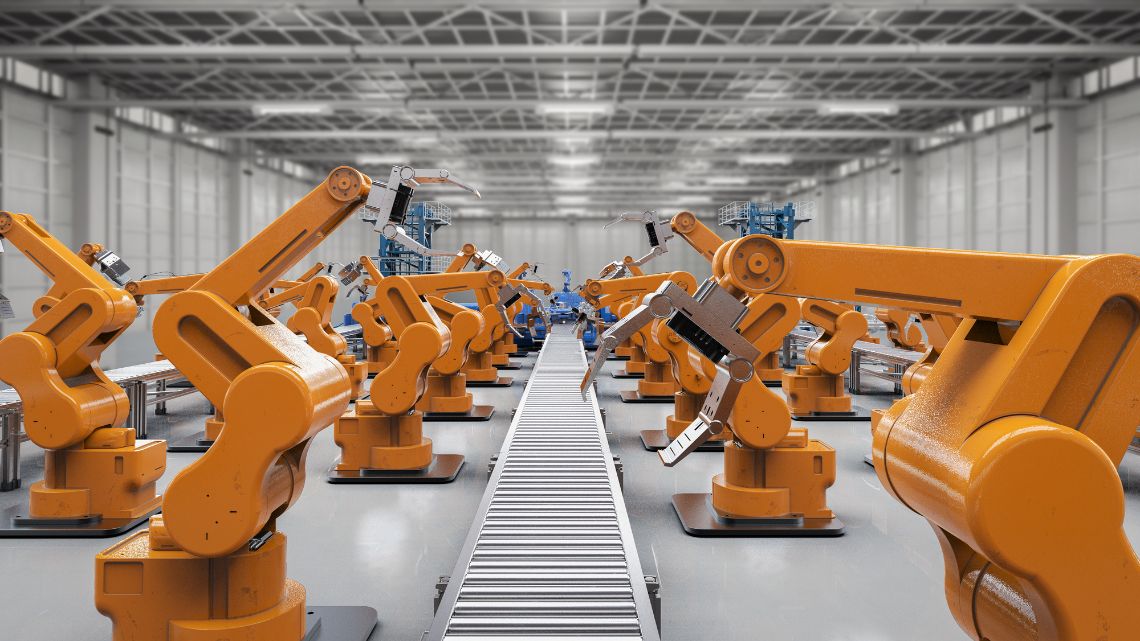
Before predictive technology ever made its appearance, factory floors were just a frantic, noisy place, moving in constant fear. A squeaking bearing or a halted conveyor belt was enough to get the maintenance crew up on their feet chasing repairs.
Mechanical engineering built that world as we know it, with steel, torque, and precision. But in 2026, it is building something unparalleled and far more powerful: machines that sense, predict, adapt, and think in many ways. However, this is not an article about some old automation story of replacing human hands with hardware; this is a piece about mechanical engineering rewriting itself from the inside out. Across manufacturing industries worldwide, machines are no longer just machines today.
As stated in their 2026 paper, the International Federation of Robotics reports that AI has taken center stage in industrial robotics, shifting its focus toward more autonomous, intelligent, and predictive systems rather than fixed programming. That shift has turned our mechanical engineers into people who are more than designers of moving parts; they are now the architects of responsive systems.
Engineering Beyond Hardware Components
One can take Magna International, a $42 billion automotive supplier operating across 28 countries, into consideration. Earlier this May 2026, Business Insider reported that Magna adopted AI use across energy use, safety, equipment maintenance, product quality, and production speed, creating a ‘unified factory.’
The significance here runs much deeper than a simple software adoption. Mechanical systems once depended on scheduled inspections and human thought and response. But with today’s vibration sensors, machine vision, and adaptive robotics brought to the table, microscopic defects are flagged, preventing them from causing major production losses. Much like gearboxes offer predictive warnings, today’s robotic arms are adaptive rather than merely repetitive.
As per Deloitte’s 2026 manufacturing outlook, cited by iFactory, the percentage of manufacturers planning on physical implementation of AI went up from from 9% to a good 22% in just the last two years alone. This reinforces that mechanical engineering has now entered its predictive age.
Factories That Improve Themselves
For example, Germany’s Schaeffler offers perhaps the clearest signal of where this movement is heading. Reuters reported today that British robotics firm Humanoid plans to deploy up to 2,000 humanoid robots across Schaeffler’s manufacturing sites by 2032, beginning with German facilities in late 2026.
For an industry built on repeatability, this marks a philosophical shift. Factories are moving from automation to autonomy, from machines that follow instructions to systems that optimize operations in real time. Mechanical engineering has evolved beyond physical components; professionals now build interconnected systems integrating sensors, digital twins, and AI into industrial machinery.
Just “CAD” on Resumes Will No Longer Suffice
For new mechanical engineering graduates starting in 2026 onwards, Computer-Aided Design or CAD is merely the entry fee; mastering interdisciplinary skills will define the next decade. The modern mechanical engineer works at the intersection of mechanics, AI, systems intelligence, and IoT.
The 2026 Roadmap on Artificial Intelligence and Machine Learning for Smart Manufacturing states that the future of smart manufacturing hinges on autonomous systems, explainable AI, and trustworthy integration. To put it simply, tomorrow’s engineer must understand not only how a machine moves but also how it learns.
The Loudest Change is the One That’s Silent
Autonomous manufacturing in 2026 rarely makes a dramatic entrance. Rather, it arrives in quieter victories, like fewer machine halts, lower wastes, safer shifts, and factories that continuously improve while it runs.
And that may be its most profound story. Mechanical engineering once mastered motion; now, it masters judgment. There is no doubt that manufacturing factories will still remain active, the gears will still turn, and the conveyor belts will still run. But now, beneath all that noisy machinery, there is a silent intelligence watching and adapting from within.