
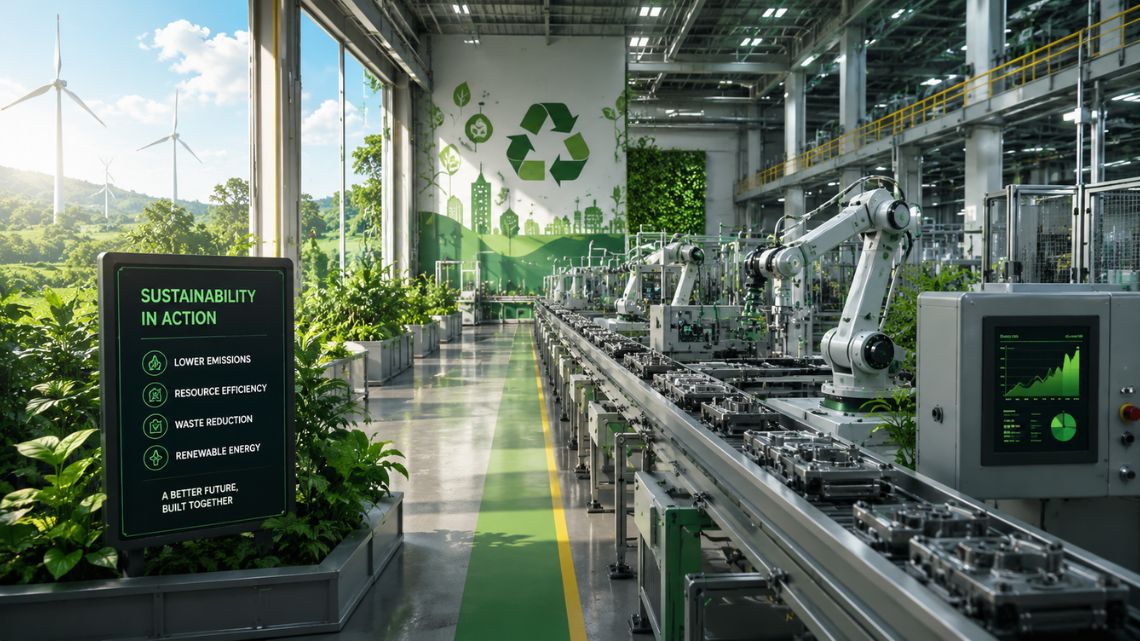
The most expensive thing a factory produces is often the thing it never intended to make. It is not a product, a component, or even a defective batch of something; it is WASTE.
Waste slips through production lines unnoticed. It hides in idle equipment, excess energy consumption, discarded materials, unnecessary transport movements, and processes that consume more resources than they truly need. For years now, industries have accepted much of this waste as the ‘unavoidable cost’ of doing business. After all, factories existed to maximize output, and everything else after it seemed secondary.
However, today, that assumption is quietly fading away. In 2026, one of the most significant transformations in industrial engineering is underway, largely outside the realm of corporate sustainability reports and environmental pledges. It is unfolding on factory floors, production lines, and manufacturing systems where engineers are turning sustainability into something far more practical: a measurable engineering objective.
Efficiency Finds a New Purpose
Industrial engineering has always been about efficiency. Long before sustainability became a global priority, engineers focused on maximizing productivity by removing bottlenecks and waste. What has truly changed is how we define ‘waste’ today.
The United Nations Environment Programme notes that manufacturing and industrial activity remain significant contributors to global resource consumption and emissions, placing growing pressure on industries to improve operational efficiency and environmental performance simultaneously.
Nowadays, engineers define success beyond mere output, integrating energy and efficiency, resource optimization, and emissions management into their evaluations. Today’s manufacturing facilities have evolved by a huge margin, treating ecological sustainability as a fundamental operational key performance indicator rather than a superficial public-relations exercise.
What Production Lines Were Missing
Many factories already operate efficiently by traditional standards. Yet industrial engineers continue discovering hidden opportunities buried inside everyday operations. A machine that remains powered during idle periods consumes energy without creating value, an inefficient production layout increases transport distances, and excess inventory requires additional storage, cooling, lighting, and handling. These tiny changes yield massive results over thousands of hours of operations.
The International Energy Agency stresses that improving industrial energy efficiency is a crucial global strategy for shrinking both power demand and carbon emissions. Now, engineers are utilizing sensors more and more, along with digital tracking and production analytics, to spot previously hidden inefficiencies. Often, sustainability gains begin not with massive capital investments, but simply through better operational visibility.
Quantifying Every Resource
Factory floors are becoming data-rich hubs in modern industries. Engineers use connected sensors to continuously monitor equipment, resource consumption, and efficiency. Meanwhile, digital twins allow manufacturers to virtually test operational changes before implementing them in the real world.
Instead of asking whether a process feels efficient, engineers can now quantify its performance with extraordinary precision. As per the World Economic Forum, digital technologies are more and more enabling manufacturers to improve productivity while reducing resource consumption and environmental impact through data-driven decision-making. Sustainability has therefore moved beyond ambition and entered the realm of engineering mathematics.
Engineering a Second Life for Materials
Industrial engineers are also rethinking what happens after production. Materials that once left facilities as waste have started re-entering manufacturing cycles as reusable resources. Scrap materials become feedstocks, heat generated during production finds secondary uses elsewhere in the facility, and even the water systems recycle and reuse valuable resources before discharge.
This change marks a shift toward circular production. Instead of the traditional linear path from raw material to waste disposal, our expert engineers now design systems to keep these materials in use for as long as possible. The core aim is to simply maximize the value extracted from every resource.
Building Better Systems Every Day for a Sustainable Future
The future of sustainable manufacturing will not arrive through a single breakthrough technology. Rather, it will be built through countless daily engineering decisions. Industrial engineers continuously improve workflows, modernize equipment, and drive sustainability by cutting waste and energy use across all operations.
Sustainability is no longer an objective; it is an engineering discipline. Factories are where we build products and engineer sustainable practices.