
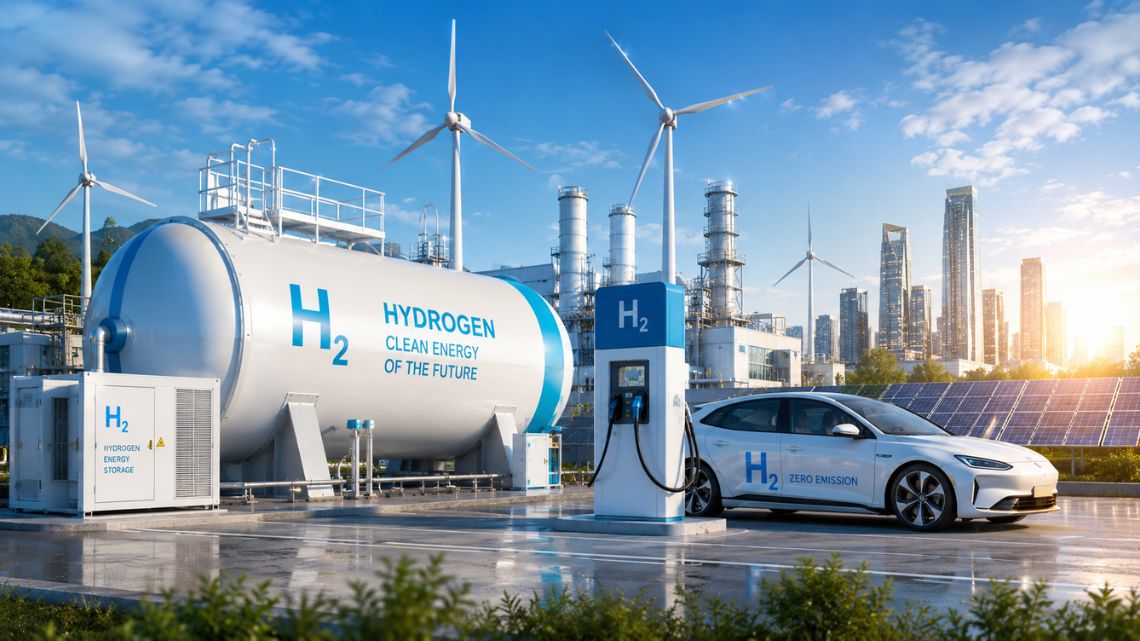
There are moments in history when humanity doesn’t discover a new resource; it rediscovers an old one through entirely different eyes.
Name of Chemical Element: Hydrogen. Chemical Symbol: H. Atomic Number: 1. Hydrogen is the lightest and most abundant element in our universe. In its natural form, it’s a diatomic molecule of two atoms called dihydrogen (H₂).
This element, hydrogen, is a fundamental part of our universe, found in stars, water, and more than a century of industrial work. Refineries, fertilizer factories, and chemical engineers have known and used its unique properties for a very long time. Yet for most of that time, producing hydrogen meant emitting carbon as well. But this article isn’t about to take a Chemistry Class, but rather, will delve into how chemical engineers scale hydrogen as the fuel of the future through green hydrogen plants.
Hydrogen now has a new mission. In 2026, engineers around the world are building clean-power water-splitting plants across Europe, the Middle East, and emerging hubs to replace fossil fuels. This delivers green fuel for tough-to-electrify industries. We are way past conducting lab tests; the real test now is scaling production fast, safely, and affordably to change global energy.
Turning Water Into Industrial Fuel
At the heart of every green hydrogen plant is a basic reaction driven by advanced engineering. Electrolyzers use electricity to break water (H₂O) down into hydrogen (H₂) and oxygen (O₂) through precise engineering. When that electricity comes from renewable sources such as solar or wind power, the resulting hydrogen carries almost no direct carbon emissions during production.
The International Energy Agency’s Global Hydrogen Review 2026 revealed that installed global hydrolysis capacity more than doubled during 2025 to exceed 4GW, with another 2.5HW already under construction for operation in 2026. Concurrently, Europe alone accounts for around 2GW of the committed projects currently moving toward completion.
Electrolysis is just the start for our chemical engineers. Despite fluctuating renewable electricity, scaling hydrogen requires complex plant integration, precise controls, advanced catalysts, water treatment systems, gas purification, and compression technologies. This makes it a demanding and lengthy endeavour altogether.
Why Electrolysis is Only the Beginning
Building an electrolyzer can be pretty simple, whereas operating an industrial hydrogen plant efficiently is considerably harder. Solar and wind produce electricity only when the sun shines and the wind blows. Whereas, electrolysis plants change output to match efficiency and protect equipment.
Chemical experts optimize the single largest operating cost inside most green hydrogen facilities: reaction temperatures, membrane performance, pressure conditions, water purity, and dynamic load management to maximize hydrogen production while minimizing electricity consumption. Modern plants nowadays function more and more as flexible chemical manufacturing systems rather than traditional processing plants.
Where Do We Put the Future?
Producing hydrogen brings another engineering question into the fold almost immediately: “Where do we put it?” Storing and moving hydrogen is much harder than handling natural gas or liquid fuels. To fix this, engineers either compress it, freeze it into a liquid, or turn it into ammonia.
Nevertheless, these solutions introduce downsides concerning expense, component fit, power use, and risk. Engineers know hydrogen’s success relies on storage and transport just as much as on its production itself. Designing an efficient plant now means improving the entire hydrogen value chain rather than simply maximizing output.
Europe and the Middle East are Building at Scale
Few places match the hydrogen push in Europe and the Middle East. Europe funds industrial zones to cut emissions in manufacturing, while the Middle East taps massive solar energy to supply clean hydrogen to the world.
One of the world’s largest commercial-scale green hydrogen facilities is in Saudi Arabia. The NEOM Green Hydrogen Project is built by ACWA Power, NEOM, and Air Products, using around 3.9GW of renewable energy to make 600 tonnes of green hydrogen every day when operational.
Additionally, a Financial Times article reports that Spain has also approved the first phase of its Andalusian Green Hydrogen Valley, representing more than €1 billion in investment and a 300MW electrolyzer, reflecting Europe’s continued commitment despite recent project delays. These facilities represent something far larger than individual plants; they serve as engineering labs where production methods, process integration, supply chains, and operating economies continue evolving simultaneously.
What’s Next for Green Hydrogen Engineering
The greatest misconception surrounding green hydrogen is that the industry’s biggest challenge is producing more hydrogen. Though in reality, science solved water splitting a long time ago. The actual barriers are designing plants that remain economically competitive, integrate seamlessly with renewable energy, consume water responsibly, operate safely at an industrial scale, and deliver hydrogen whenever industries need it.
Hydrogen engineering has therefore become a systems engineering challenge as much as a chemical one. As industries search for practical pathways toward lower emissions, green hydrogen is steadily moving beyond scientific promise into industrial reality. Every new electrolyzer, every optimized process, and every successfully commissioned hydrogen plant brings the world one step closer to proving that tomorrow’s cleanest fuel may begin with nothing more extraordinary than water, renewable electricity, and the engineers determined to connect them.
To Read More, Visit: https://engineeringrealm.com