The Maintenance Hangover (and How to Cure It)
We’ve all been there: the sudden, gut-wrenching halt of a major asset. The catastrophic failure. The scramble to find a technician and the one obscure spare part that lives only in a dusty corner of the warehouse. The cost of this unplanned downtime is not just irritating; it’s industrial kryptonite, potentially costing manufacturers millions per hour.
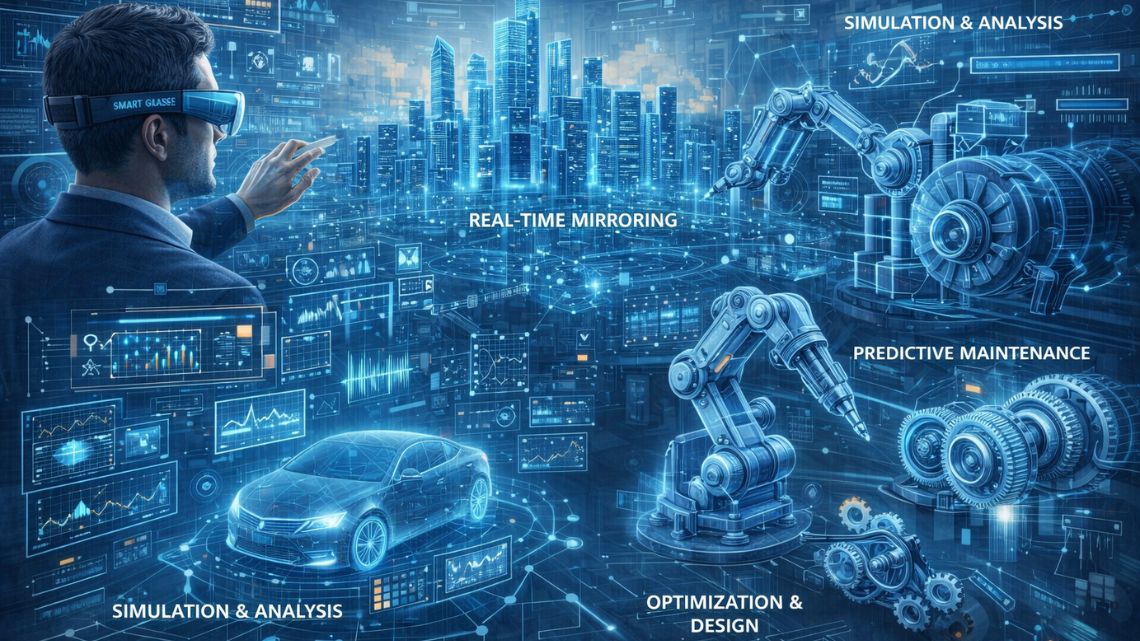
Enter the Digital Twin: Your Asset’s Ghost in the Machine (But, like, the helpful, predictive kind). This isn’t science fiction anymore. A Digital Twin is a sophisticated, virtual replica that lives and breathes (data) exactly like its physical counterpart—a pump, a turbine, an entire assembly line.
Traditionally, we’ve had two maintenance strategies: Reactive (it breaks, you fix it) and Preventive (you fix it every Tuesday, regardless of whether it’s happy or not). We are now attending the funeral for these methods. The new paradigm is Predictive Maintenance (PdM). Digital twins transform PdM by providing high-fidelity simulation and forecasting asset failure with unprecedented accuracy, moving maintenance from a necessary evil to a strategic advantage.
The Digital Twin Assembly Line: What Makes the Virtual Engine Hum?
Building a functioning Digital Twin isn’t just about sticking a sensor on something and calling it a day. It’s a multi-layered engineering effort.
The Physical Star & Its Nervous System (Sensors)
The physical asset needs to learn how to communicate its internal state. This is where the Industrial Internet of Things (IIoT) steps in. Sensors—measuring everything from vibration (is the bearing about to sing its last song?), temperature (is it running a fever?), and pressure to acoustic signatures—give voice to the machine’s inner grumbles.
Crucially, some of this data processing happens on the factory floor, not in the cloud. Edge Computing ensures that critical alerts are processed instantly, without the latency of sending the entire data scream back home.
Data Plumbing: Taming the Torrent of Information
Imagine trying to drink from a Big Data Firehose—that’s what the Twin faces. High-frequency sensor data arrives in overwhelming volumes. The plumbing needs to handle the velocity and volume to ensure the Twin doesn’t drown. This requires robust cloud infrastructure and smart middleware.
Before the Twin can use the data, it needs a Digital Soap Scrub. Data must be cleaned, normalized, and timestamped precisely. If the input data is messy, your prediction will be pure nonsense—a classic case of Garbage In, Garbage Out.
The Twin’s Brain: Physics, History, and a Little Bit of Magic
This is where the engineering discipline truly shines. The Twin’s brain is composed of two primary elements:
- Physics Modeling: This involves Translating Thermodynamics into Code. Engineers use mathematical models to simulate how the asset should behave under ideal conditions, modeling everything from fluid flow to mechanical stresses and heat transfer.
- Historical Memory: We give the Twin a memory by integrating years of maintenance records, failure logs, and operational history. This training material teaches the Twin not just how things work, but how things break.
The Digital Fortune Teller (AI/ML)
The final layer is the intelligence. Machine Learning (ML) algorithms are trained on the clean, historical, and real-time data. These models are designed to spot subtle anomalies—tiny wiggles in the vibration data or slight temperature drifts—that a human operator might miss. They are the Digital Fortune Tellers that extrapolate current degradation rates to predict the Remaining Useful Life (RUL) of a component.
Predictive Maintenance: The ‘Day in the Life’ of a Digital Twin Workflow
- The Always-On Mirror: The twin continuously runs alongside the physical asset, its status mirrored perfectly, 24/7.
- The Digital Frown: The AI spots a tiny deviation from the baseline model. It’s not a full-blown crisis, but the machine is “frowning.”
- Running the Doomsday Scenarios: Based on the current frown, the twin executes thousands of “what-if” simulations in its virtual environment. It predicts, for example, that the current stress load will cause the bearing to fail with 95% certainty in 16 days.
- The Order of Business: The system bypasses human intuition and generates a Non-Negotiable, Prescriptive Work Order: “Replace Bearing A on Pump 3 in 7 days (during scheduled downtime)—seriously, do it.” Maintenance is executed not because a calendar dictated it, but because the future demanded it.
The Twin’s Paycheck: ROI that Makes CFOs Smile
Why invest in this complex technology? Because the Return on Investment (ROI) is staggering and direct.
- No More Firefighting: The biggest win is the elimination of the chaos tax associated with unplanned downtime.
- Precision Scheduling: Maintenance crews become surgical. They only fix the things that are actively plotting against the factory, minimizing labor costs and wasted part lifespan.
- Defect Prevention: By catching machine grumpiness early, you prevent defects that result from degraded machine performance, improving overall product quality.
- Spare Parts Sanity: Better inventory control means you only order the one obscure part you actually need, reducing capital tied up in warehousing unnecessary inventory.
Reality Check: The Dragon You Must Slay for Implementation
Digital twins are powerful, but they are not plug-and-play. Companies must face three critical challenges:
- The Garbage In, Garbage Out Warning: The twin’s success hinges entirely on the quality, frequency, and accuracy of your sensor data. If your sensors are cheap or improperly calibrated, your twin is just an expensive digital hallucination.
- Building the Perfect Physics Sandpit: Modeling complexity can be intense. Accurately simulating the thermodynamics and fluid dynamics of a complex industrial process—why “simple” is rarely simple in industrial processes—requires serious domain expertise.
- The Big Wallet Moment: The initial costs for high-quality IIoT sensors, software licensing, cloud processing, and the engineering time required for deep integration are significant. It’s an investment, not a cheap gadget.
Implementation Tip: Don’t try to twin the entire factory on day one. Start with a Test Drive on your single most expensive, high-risk, or mission-critical asset to prove the ROI quickly.
Conclusion: The Intelligent Factory — Where Engineering Gets Smart
The Digital Twin is more than a tool; it is the ultimate industrial upgrade. It moves the factory beyond basic automation to true, informed intelligence. For engineering companies, mastering this technology is no longer optional—it is rapidly becoming the operating manual for competitive operational excellence in the intelligent factory of the future.