
In the grand tradition of engineering management, a leader’s value is often measured by their “Decisiveness Index”—that magical ability to bark a firm “Yes” or “No” while everyone else is still staring at a confusing Grafana dashboard. We’ve been trained to believe that “I don’t know” is a sign of weakness, and that “It depends” is the calling card of a consultant who is about to overcharge us.
But here’s the truth: as our systems get more complex, our dependencies more brittle, and AI starts writing half our pull requests, that “Go/No-Go” binary mindset isn’t just old-fashioned—it’s a massive liability.
Welcome to Bayesian Leadership: the art of treating every technical decision as a probabilistic bet that you are prepared to lose (but hopefully won’t).
1. The “Resulting” Trap (Or: Why Your Success Was Just Luck)
We all know that one Lead who migrated a legacy monolith to Kubernetes over a long weekend and was hailed as a tech deity. They got a promotion, a commemorative t-shirt, and a Slack channel named after them. But if the local power grid had failed that Sunday, or a single upstream dependency had updated its API, they’d have been labeled a reckless cowboy who nuked the production environment.
In the industry, we call this Resulting. It’s the logical fallacy where we judge a decision solely by its outcome.
A Bayesian Leader rejects this. They know that a “good” decision (based on data and risk mitigation) can lead to a “bad” outcome (a 1-in-a-million edge case), and a “terrible” decision (deploying a major database schema change at 4:55 PM on a Friday) can lead to a “good” outcome (nothing broke… this time). To scale an engineering team, you have to stop high-fiving the lucky gamblers and start rewarding the people with a solid, repeatable betting process.
2. The Three Pillars (No Calculus Required, Promise)
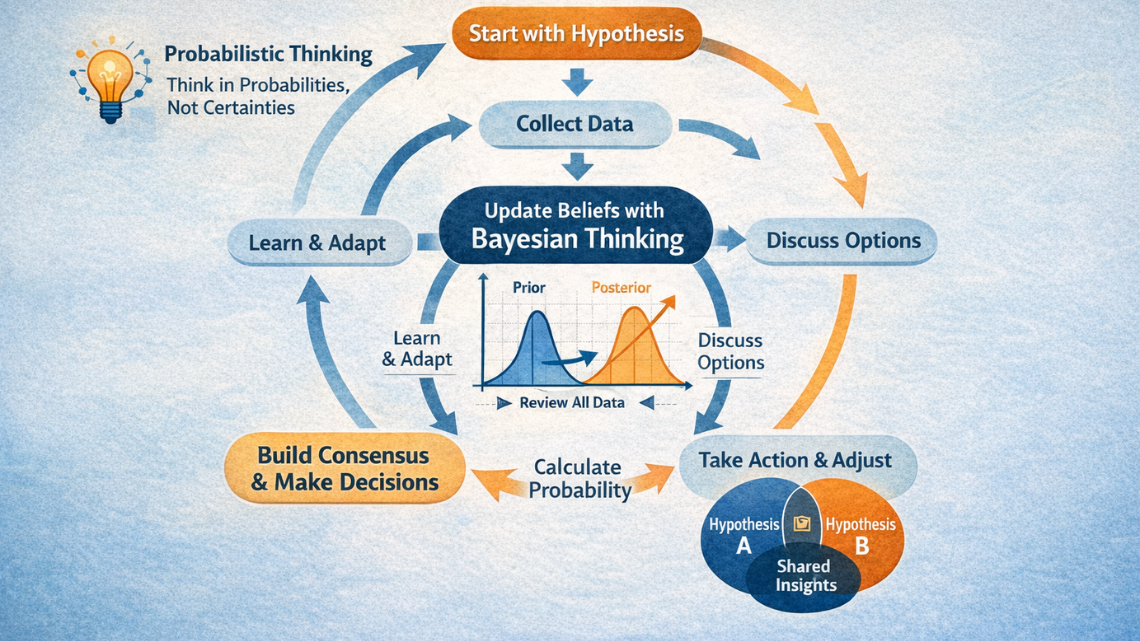
Bayesian thinking is simply a way of saying “Update your beliefs when new stuff happens.” Here is how it looks in a Jira-saturated world:
The “Prior”: Your Initial Hunch
In Bayesian math, you start with a “Prior”—your gut feeling based on the collective trauma and scar tissue you’ve accumulated over your career.
The Normal Way: “We’re using Rust because the internet said it’s fast and the compiler is a genius.”
The Bayesian Way: “Based on the fact that our team thinks ‘Memory Safety’ is a brand of organic pillow, I assign a 60% probability that a Rust migration will actually just result in us being 20% slower for the next six months while everyone learns what a ‘Borrow Checker’ is.”
The Evidence: The “Oh No” Factor
As the project starts, “evidence” arrives. Maybe the prototype is a dumpster fire, or your Lead Architect just quit to become a goat farmer in Vermont. A Bayesian Leader doesn’t ignore this to save face; they use it to update their confidence level. Changing your mind isn’t “flip-flopping”—it’s a CPU update for your organizational brain.
The Posterior: The “New Normal”
This is your updated belief. It’s the ability to say, “Hey, the data changed, so my 80% confidence is now a 30% confidence. Let’s pull the plug before we sink another $200k into this hole.”
3. The Architecture of a Bet: Technical Debt as a Payday Loan
Exceptional leaders treat technical debt not as a “shameful secret,” but as a high-interest payday loan. A Bayesian approach asks: “What is the probability that this shortcut will bankrupt us in six months?”
When a stakeholder asks for a “quick and dirty” fix, the Bayesian Leader maps the likelihood of that fix becoming “permanent and toxic.” If the probability of that fix surviving longer than two sprints is 90%, the leader treats it as a high-stakes bet and demands “collateral” (e.g., dedicated time in the next quarter for refactoring). You aren’t saying “No” to the business; you’re just showing them the odds of their own house burning down.
4. Your New Tactical Toolkit
I. The 90% Confidence Interval (The Death of the Deadline)
Stop asking for “Estimates.” Estimates are just lies wrapped in hope and caffeine. Start asking for ranges.
If an engineer says a feature will take “2 weeks,” they’re usually lying to make you happy or because they forgot about the 40 hours of meetings they have scheduled.
If they say, “I’m 90% sure it’ll take between 12 days and 3 months,” they are telling you the truth. That massive gap is a signal: the primary task isn’t coding; it’s discovery. It means they haven’t yet figured out why the legacy API is returning XML in 2024. Your job as a leader is to help them shrink that range, not to beat them over the head with the lower number.
II. The Pre-Mortem (Time Travel for Cynics)
Before you hit “Merge” on that massive refactor, gather the team and say: “It’s one year from now. This project was an unmitigated disaster. Our stock price is a meme, the CEO is crying in a Tesla, and we’re all looking for jobs. What happened?”
This gives your introverts and skeptics permission to tell you why your plan is actually a terrible idea without feeling like “naysayers.” It surfaces the hidden probabilities of failure that people are usually too polite to mention in a planning meeting.
III. The Decision Log (A Diary for Grown-Ups)
Every time you make a big call, write down:
What we decided.
How sure we were (e.g., “75% sure this won’t melt the load balancer”).
The “Kill Switch”: What specific data point would make us admit we were wrong? (e.g., “If p99 latency doesn’t drop by 10% in the first week, we revert to the old system.”)
5. Building a “Low-Ego” Engineering Culture
The hardest part of Bayesian Leadership isn’t the math—it’s the ego. To be a Bayesian Leader, you have to be okay with being wrong. You have to create a culture where “I was wrong” is met with “Great, what did the data say?” rather than a performance improvement plan.
When a leader says, “I am 60% sure about this,” it sends a powerful signal to the team: I am not a prophet, and I need your help to find the other 40%. It transforms the team from a group of “order-takers” into a group of “probability-checkers.” This is the foundation of true psychological safety.
6. Paying the “Certainty Tax”
Your CEO wants a date. Your Sales VP wants a promise they can use to close a deal in Dubai. This is the Certainty Tax.
Don’t tell them “it’s complicated.” They hate that. Instead, translate Bayesian concepts into “Business-Speak.”
Bad: “I’m 60% sure we’ll ship in Q3, but Bob might quit and the API is flaky.”
Good: “Our current probability for a Q3 launch is 60%. To get that to 95%, we need to de-risk these two technical hurdles by the end of the month. Would you like us to focus on hitting the date with fewer features, or keeping the features and being honest about the timeline variance?”
7. Embracing the Chaos
The shift to Bayesian Leadership is a move from being a “Truth-Seeker” to a “Probability-Mapper.” It’s an admission that software is a chaotic, screaming void of entropy and nobody—not even the guy who wrote the framework you’re using—actually knows exactly what’s going to happen when you hit “Deploy.”
The goal isn’t to be right; the goal is to be less wrong every single day. When you stop pretending to be a prophet and start acting like a data-driven gambler, you create a team that isn’t afraid to fail—they’re just afraid to fail without a log file to prove why.
Now, go forth, check your priors, and place some better bets.