
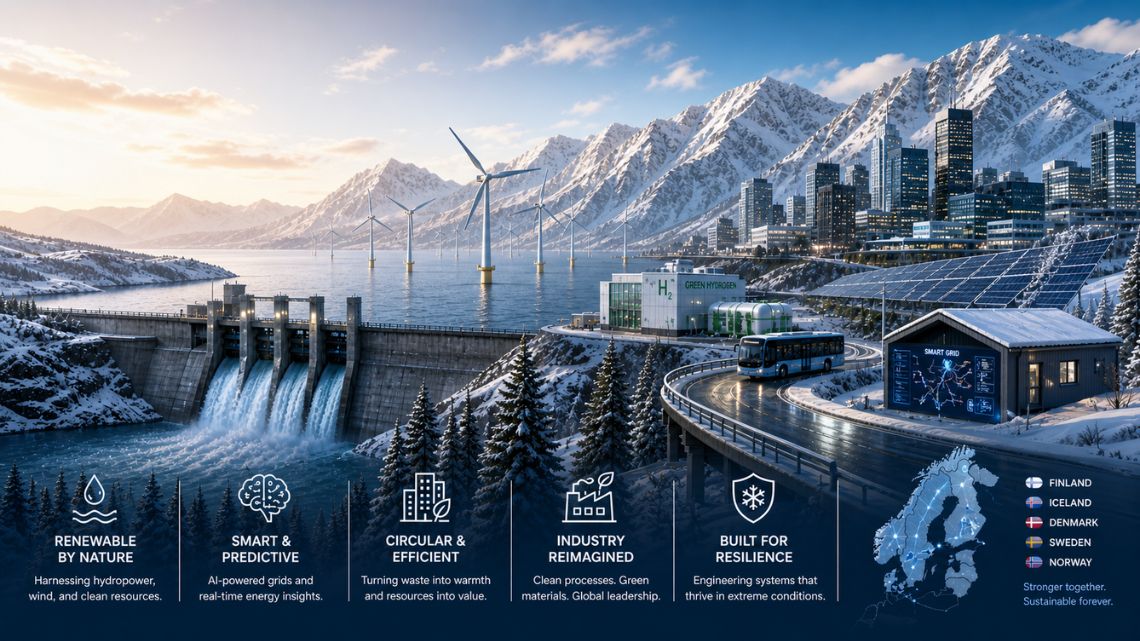
For a very, very long time, energy efficiency has been a survival instinct for the Nordic peoples, with advanced engineering systems predating even the modern corporate “net zero” mantra.
To preface why sustainability became foundational to Nordic engineering, one must first understand the region itself. The Nordic region comprises five countries in Northern Europe (Finland, Iceland, Denmark, Sweden, and Norway) and their associated territories (Greenland, Åland, and the Faroe Islands). Though it presents a pristine, white wonderland, the Nordics face long and dark winters, with temperatures reaching a biting –30℃. But the cold does not politely ask if the cities’ infrastructure is ready enough; it simply demands immediate resilience.
In the fields of technology and systems engineering, the winters in the Nordics put power systems to the test, alongwith housing, transportation networks, and industries, in the face of darkness, cold, and environmental impacts. It explains why, instead of adopting conventional sustainability goals, Finland, Iceland, Denmark, Sweden, and Norway introduce environmental concerns into their initial engineering design. Nordic engineering systems remain, as always, environmentally responsible and proactive in 2026.
Where Energy Systems Became Climate Strategy
In much of the world today, the challenge for energy systems is finding a balance between growth and decarbonization efforts. However, in the Nordics, engineers are building systems where both thrive together. Norway is a prime example, as it achieved nearly 98% renewable electricity in 2024 through hydropower, according to the International Energy Agency (IEA). Additionally, Denmark, too, is setting the pace with a holistic, connected approach to integrating offshore generation, storage, and transmission.
Meanwhile, Sweden keeps strengthening its grid stability by using intelligent systems to align nuclear, wind, and hydropower energy. The Swedish Energy Agency observes Sweden as one of Europe’s lowest-carbon power grids, proving that resilient infrastructure and sustainability go hand-in-hand. But generation alone does not define Nordic resilience; it is how these nations distribute, balance, and anticipate demand that shapes their engineering advantage.
The Predictive Grid
Nordic grids nowadays are evolving into an innovative, predictive ecosystem rather than a reactive one, using digital substations, AI forecasting, and demand-response systems to preemptively manage surge loads.
Finland’s grid operators, for example, are adopting smart metering and decentralized controls to help households and businesses optimize energy use on the fly. As per the European Commission, Finland ranks as the top digital energy system in Europe, with infrastructure designed for performance rather than retrofitted for it. This matters because Nordic engineering rarely begins with product-level fixes; it begins much before, with sustainable system architecture.
Nordic Cities as Circular Systems
That same philosophy extends beyond national grids and into the streets, buildings, and heating systems of everyday Nordic life. Intending to responsibly reduce environmental impacts, the countries here integrate district heating, implement waste-to-energy initiatives, and promote an electric-first transportation.
For instance, in Copenhagen, district heating serves as the primary heating source for most households, turning what many nations treat as thermal waste into an essential urban resource. This systemic, circular model, where one industry’s waste becomes another’s input, is what defines Nordic infrastructure thinking.
Industrial Nordic Systems Reengineered
This Nordic systems thinking does not stop at public infarsture though; it strives to define industrial competitiveness itself. For manufacturers, sustainability for the Nordics operates as an industrial strategy. Heavy industries in Sweden and Finland now invest in electrified processes, circular production systems, and green hydrogen pilots not simply for compliance’s sake, but for long-term competitiveness.
According to HYBRIT, Sweden’s fossil-free steel initiative positions industrial decarbonization as a systems-engineering challenge, integrating energy, materials science, and logistics into one coordinated framework.
The Real Nordic Lesson
After all, what truly sets Nordic engineering apart is not its perfection but its intentionality. Not to be mistaken, Nordic countries still face grid congestion, cost pressures, and industrial trade-offs today. Sustainability is built into their infrastructure’s DNA from day one, not tacked on later as an afterthought.
This distinction is crucial in 2026, where engineering sustainability pushes past environmental concerns. In the Nordics, it increasingly defines reliability, profitability, and national resilience. Whether it is from offshore wind corridors to smart urban heating and predictive power grids, Nordic engineering systems paint a much bigger picture: it shows that when sustainability is designed from the start, it becomes infrastructure’s most powerful advantage rather than a cost.