
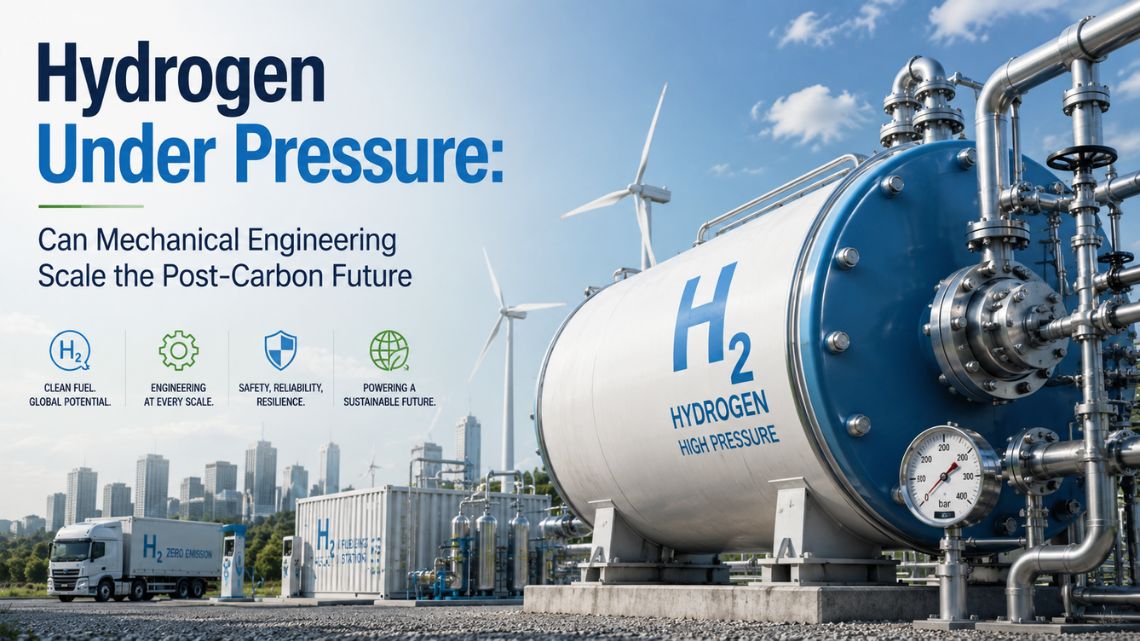
For over a century, the combustion engine ruled the industrial world with a kind of eternal confidence. It powered mines beneath massive mountains, ships across the deep oceans, trucks through continents, and factories that never slept. Then, all of a sudden, the world declared war on carbon—and many presumed the engine’s final chapter had finally come to an end. But when did humanity ever scrap a machine without trying to reinvent it first? We never do. That’s the very soul of mechanical engineering.
In 2026, hydrogen has become the industry’s boldest attempt at that reinvention—not merely as a clean energy source but as a mechanical philosophy promising heavy power without the heavy emissions. Yet, behind all the optimism lies a harder question quietly dividing engineers, manufacturers, and investors worldwide: “Is hydrogen truly scalable? And if so, is it still an expensive industrial dream in 2026?”
When Batteries Meet Their Limits …
Battery-electric systems conquered the passenger car market, but the heavy industry is a whole different beast. For example, a mining truck cannot stop for hours on end simply to recharge; a cargo vessel cannot afford a limited range in the middle of the Pacific Ocean; and a 40-ton freight truck loses profitability when its batteries cut into its payload capacity. That clearly explains why some of the world’s biggest industrial manufacturers are doubling down on going the hydrogen way.
In March 2026, Reuters reported that Toyota Motor Corporation is teaming up with Volvo Group and Daimler Truck on their hydrogen fuel-cell venture, Cellentric. This strategic alliance will cut development costs and fast-track zero-emission heavy transport. Ultimately, the report highlights that mechanical engineering is adapting—not abandoning—traditional engines for a post-carbon future.
Heavy Machines, New Fuel
Let’s forget about futuristic concept videos for a minute. The real push for hydrogen is happening right now on the factory floor as industrial machinery hits the pilot phase. FuelCellsWorks’ report in April 2026 states that hydrogen-powered heavy equipment is transitioning from pilot testing to frontline mining operations, particularly in sectors where diesel replacement is difficult.
Meanwhile, Loadermarket reported in April that commercial pilots for hydrogen-powered excavators, forklifts, loaders, and heavy-duty construction vehicles are expanding across North America, Europe, and Asia. It also notes how hydrogen-powered equipment achieves full-shift endurance with only 10–15 minutes of refueling time, a performance metric that heavy-duty battery systems have yet to reach.
But for mechanical engineers, this changes the design conversation completely. Today, hydrogen systems demand new approaches to thermal management, materials durability, fuel storage, pressure systems, and safety engineering. Even hydrogen brittlement—the gradual weakening of metals exposed to hydrogen—has become one of the field’s most discussed engineering challenges in 2026.
The Missing Pawn in Hydrogen’s Future
Still, hydrogen’s greatest obstacle has never been engineering alone; it has always been infrastructure. According to another Reuters report, Kawasaki Heavy Industries signed a deal with Japan Suiso Energy early in January this year to build the world’s largest liquefied hydrogen carrier, capable of transporting 40,000 cubic metres of hydrogen as countries race to establish global hydrogen supply chains.
At the same time, Europe is pouring money into hydrogen, but the math still doesn’t add up. Even with the ongoing investments highlighted at the Hydrogen & Fuel Cell Summit Europe in January, true market adoption is being held back by high production costs, a shortage of fueling stations, and strict government regulations. This captures the core hydrogen dilemma: the technology and ambition are there, but the infrastructure lags far behind.
Hydrogen: The New Age of Heavy Power
It could quite possibly explain why hydrogen holds such a magnetic pull for mechanical engineers in 2026. It’s more than a clean fuel; it’s a lifeline for hardware once deemed incompatible with a green future.
Traditional engines are not disappearing for good; it is just evolving under pressure. And somewhere between aspirations and scaling hydrogen, mechanical engineering finds itself doing what it has always done best: adapting the impossible into something operational.