
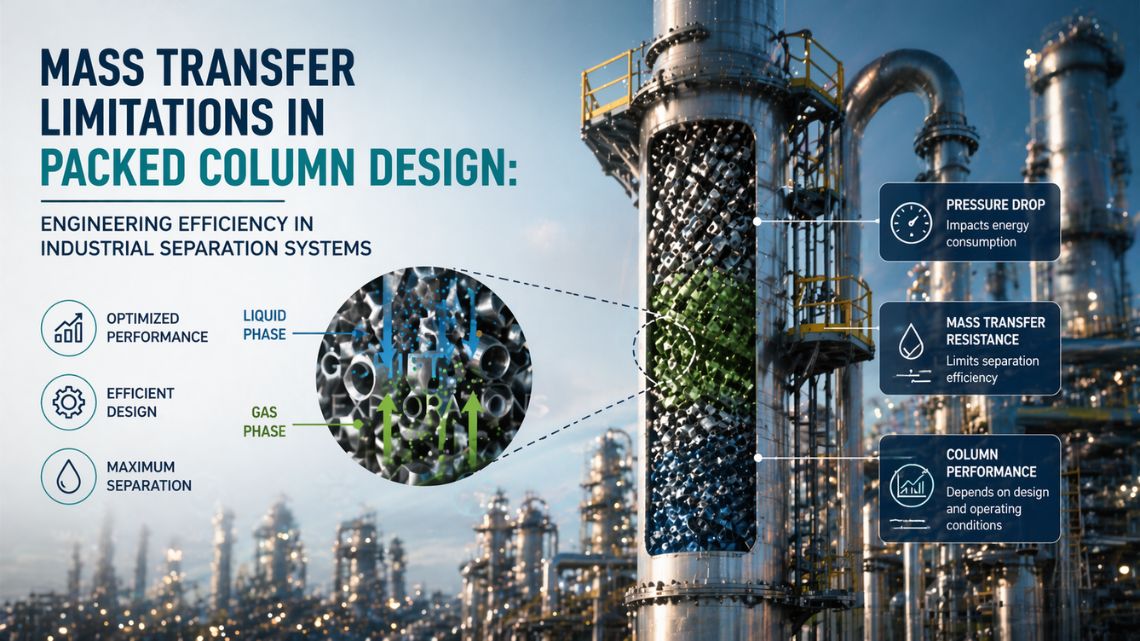
Separation processes sit at the core of chemical engineering. From refining hydrocarbons to purifying pharmaceuticals and treating industrial emissions, the ability to separate components efficiently defines both product quality and process viability. Among the most widely used systems for gas–liquid separation are packed columns, structures designed to maximize contact between phases and enable mass transfer.
At laboratory scale, separation efficiency is often assumed to be a function of equilibrium and ideal contact conditions. In industrial packed columns, however, performance is governed less by equilibrium potential and more by mass transfer limitations. The challenge is not whether separation can occur, but how effectively it can be sustained across large, complex systems.
Understanding Mass Transfer in Packed Columns
Packed columns operate by bringing a gas and a liquid into contact across a structured or random packing material. The packing provides a large surface area where the two phases interact. Mass transfer occurs when a component moves from one phase to another, driven by concentration differences.
In theory, increasing contact area improves separation efficiency. In practice, the rate of mass transfer depends on several interrelated factors: flow distribution, surface wetting, diffusion resistance, and fluid dynamics within the column. These factors are difficult to replicate uniformly at scale, which is why industrial performance often deviates from laboratory expectations.
The Role of Film Resistance
Mass transfer in packed columns is controlled by resistance on both the gas and liquid sides of the interface. Thin boundary layers, often referred to as films, form at the interface, and the rate at which molecules cross these films determines overall transfer efficiency.
In industrial systems, these films are influenced by flow conditions, fluid properties, and packing geometry. If liquid distribution is uneven, certain regions of the packing may be poorly wetted, increasing resistance to transfer. Similarly, gas flow patterns can create zones where mass transfer is less effective. Engineering design must therefore focus on minimizing these resistances, not just increasing contact area.
Flow Distribution and Maldistribution Effects
One of the most significant challenges in packed column design is achieving uniform flow distribution. At large scales, ensuring that liquid spreads evenly across the packing surface is difficult.
Maldistribution, where flow is concentrated in certain regions, reduces effective contact area and lowers overall efficiency. Some parts of the column may operate near optimal conditions, while others contribute little to separation. This issue becomes more pronounced as column diameter increases. Engineers must design distributors that maintain uniform flow across the entire cross-section, accounting for variations in fluid properties and operating conditions.
Packing Design and Selection
The choice of packing material and geometry plays a critical role in mass transfer performance. Random packings, such as rings or saddles, offer simplicity and robustness, while structured packings provide more predictable flow paths and higher efficiency.
Structured packings are increasingly used in modern systems due to their ability to improve mass transfer while reducing pressure drop. Their geometry promotes better distribution and consistent contact between phases. However, structured packings are more sensitive to installation quality and operating conditions. Small deviations can affect performance significantly, making design and maintenance more critical.
Interaction Between Mass Transfer and Pressure Drop
Improving mass transfer often involves increasing contact between phases, which can lead to higher pressure drop across the column. Excessive pressure drop increases energy consumption and can limit throughput.
Engineers must balance these competing objectives. A design that maximizes separation efficiency may not be practical if it introduces unacceptable operational costs. Conversely, minimizing pressure drop at the expense of mass transfer reduces overall process effectiveness. This trade-off is central to packed column design and requires careful evaluation of operating priorities.
Scaling Challenges in Industrial Systems
Scaling packed columns from pilot systems to full-scale operations introduces additional complexity. Fluid behavior changes with scale, affecting flow distribution, turbulence, and mass transfer coefficients.
Laboratory experiments often assume ideal flow conditions, which are difficult to achieve in large columns. As a result, empirical correlations and pilot testing remain essential for predicting industrial performance. Engineers must also consider mechanical constraints, such as column height, structural support, and maintenance access. These factors influence design choices and can limit theoretical optimization.
Process Integration and Operational Stability
Packed columns rarely operate in isolation. They are part of larger process systems where upstream and downstream conditions affect performance. Variations in feed composition, temperature, and flow rates can alter mass transfer behavior.
Maintaining stable operation requires integrating column design with overall process control strategies. Instrumentation, monitoring, and feedback systems are used to detect deviations and adjust operating conditions. Stability is not achieved solely through design, but through continuous management of system interactions.
Operational Relevance
Mass transfer limitations are increasingly important as industries push for higher efficiency and lower environmental impact. Processes such as carbon capture, gas purification, and solvent recovery rely heavily on packed column performance.
In these applications, even small improvements in mass transfer efficiency can lead to significant gains in productivity and cost reduction. Conversely, inefficiencies can limit process viability. Chemical engineers are therefore focused on refining design methods, improving materials, and enhancing control strategies to address these challenges.
System-Level Perspective
Packed column performance is defined by the interaction of multiple factors, fluid dynamics, material properties, geometry, and operating conditions. Mass transfer limitations emerge from these interactions rather than from a single constraint.
Engineering effective separation systems requires moving beyond idealized models and addressing real-world behavior at scale. This includes understanding how deviations from uniformity affect performance and designing systems that remain effective under varying conditions.
As chemical processes become more complex and performance requirements increase, the ability to manage mass transfer limitations will remain a central concern in chemical engineering. Efficiency is not determined by theoretical potential alone, but by how well that potential is realized in practice.