
In Japan, where the earth seldom remains still, engineers quickly understood early on that infrastructure cannot merely stand; it must bend, surrender, and persevere. That realization became a seed that now defines Japan’s engineering systems: precision where others tolerate uncertainty, automation where manpower used to once compensate, and resilience where nature tests every design. In 2026, these attributes redefine some of the world’s most advanced engineering systems in infrastructure, robotics, and transportation.
When Earthquakes Redefined Japan’s Infrastructure
It’s not uncommon that Japan’s location atop four converging tectonic plates makes seismic activity a constant reality. The nation registers thousands of earthquakes every year, and a percentage of which register significant shaking and devastating aftermaths. It’s one thing to design a building that stands, while it’s another to design and build infrastructures that move with the earth without collapsing. Instead of resisting tremors with breakable force every single time, Japanese civil engineering adopted shock-absorbing materials, flexible foundations, and dynamic damping systems that let structures move with seismic forces and then settle back without severe damage. Take Tokyo’s skyscrapers, for instance. These high-rises stand upright all thanks to their base isolation systems and dynamic shock absorbers that let them sway safely with tremors as they happen, reducing risk to occupants while protecting internal systems.
In recent decades, these methods evolved from being temporary fixes into standardized resilience factors that support subways, bridges, and towers nationally. This philosophy now extends into monitoring technologies that act before, not after, a failure occurs. Japan’s infrastructure monitoring market is predicted to reach USD 15.3 billion by 2033, with a CAGR of 8.5% from 2026 to 2033. Sensors, AI analytics, and automated testing tools give engineers a living view of the nation’s veins and joints, providing preventative steps long before visible symptoms begin to surface.
Together, such innovations merge Japan’s culture of Monozukuri—the art of making things with deep care and precision—with engineering systems designed not only to function, but also to survive the unpredictable forces of nature.
The Rise of Intelligent Labor
While earthquakes and weather shaped Japan’s civil systems, another force reshaped its labor landscape: demographics. Being one of the world’s oldest populations with a rapidly shrinking workforce, Japan dove deep into the world of automation and robotics as economic necessities over luxuries. The country’s industrial robotics market reflects this reorientation as it is projected to reach over USD 3 billion by 2033, driven by demand in advanced manufacturing sectors, agriculture, electronics, and automotive.
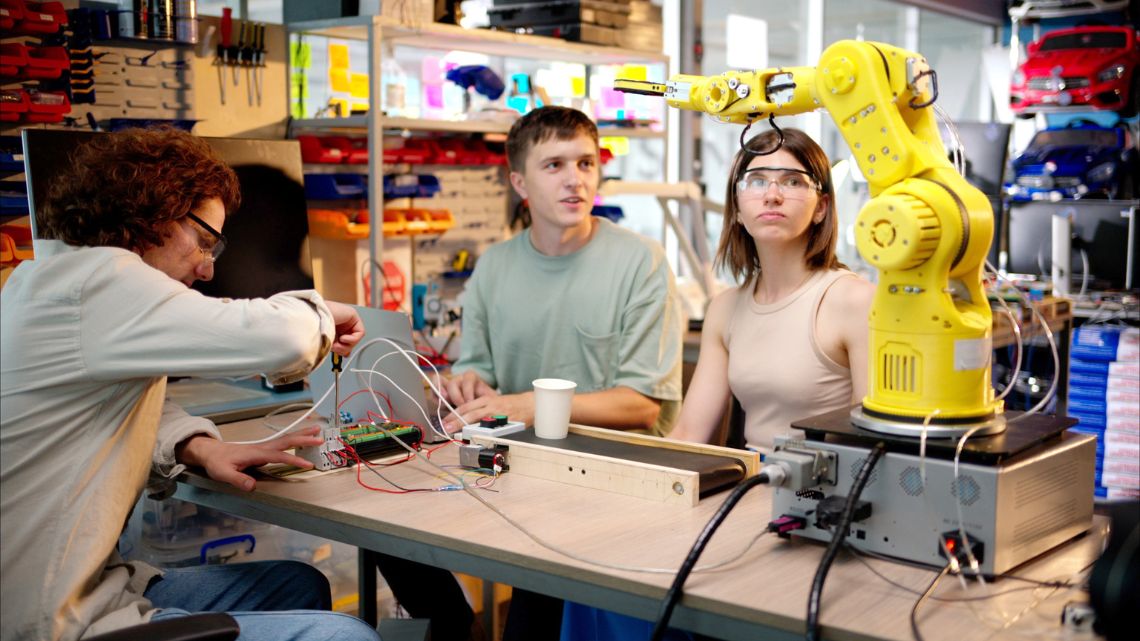
Once limited to performing simple, repetitive tasks, robots are now assuming more complex roles. Collaborative robots or cobots operate alongside humans on factory floors, and inspection bots scan narrow tunnels and bridges with high-speed imaging tools. In construction, innovative dual-arm systems automate the installation of structural parts in tight spaces. All of this work was once reserved for human experts to handle, but is now operated by robotic precision and sensor feedback.
At the end of the day, these machines are not just tools; they are strategic responses to the much broader socioeconomic shifts taking place. Once upon a time, human inspectors climbed steel lattice structures or crawled under bridges; now, robots gather visual data and feed it into predictive models that reduce human risk and extend infrastructure life.
High-Speed Rails: Engineering on the Move
Japan’s high-speed rail (HSR) isn’t just a mode of transportation to move about; it’s a case study in robust infrastructure engineering. Since the first Shinkansen line opened in 1964, the concept of earthquake-adaptive rail systems covered every new track and train design across the country. Today, networks use in-cab signaling and segmented track control that allow trains to adjust speeds instantly based on both real-time conditions and centralized commands. That system is now a replicated model around the world.
Looking ahead, Japan’s rail line—Chūō Shinkansen—is an $85 billion+ project representing a major milestone. The line uses advanced superconducting magnetic levitation (SCMAGLEV) technology to travel between Tokyo and Nagoya at speeds exceeding 500 km/h, reducing friction and enabling smoother acceleration and braking. Despite its launch plan shifting from 2027 to 2035, the engineering ambition remains unmistakable and anticipative.
Eyes on Aging Assets
Japan’s engineering challenge isn’t restricted to working on new technology entirely; it includes repairing century-old infrastructure as well. Beyond upgrading public works, existing tunnels, bridges, towers, and aging rail lines also require continuous monitoring.
Across the country, engineers set up smart monitoring technologies using sensors and automated analysis to track structural soundness. From vibration data to strain measurements, these systems allow maintenance teams to detect early signs of wear and proactively address them. Once again, Japan’s engineering systems prove that its infrastructure is seen and treated as a living system. But engineering challenges are not always on land. In deep-sea environments such as the world’s longest Seikan Tunnel rail spanning 54 kms, engineers continuously monitor conditions to maximize safety and longevity while managing costs and operational reliability.
Engineering Beyond Technology
Today, technology in Japan is a direct, living response to lived realities: the tremors beneath the feet, the empty factory floors, and the commuter’s expectation of safety and punctuality. Engineers don’t just install systems; they design them to be dependable companions in everyday life.
In 2026, Japan stands as a living case study in how engineering systems can be precise, resilient, and human-centric—evolving through continuous improvements within environmental and social constraints. From robots that maximize efficiency to infrastructure that quietly absorbs tremors and builds undersea rail lines, Japanese engineering teaches the world a simple lesson: when systems are designed with both precision and purpose, they don’t just deliver—they endure.