
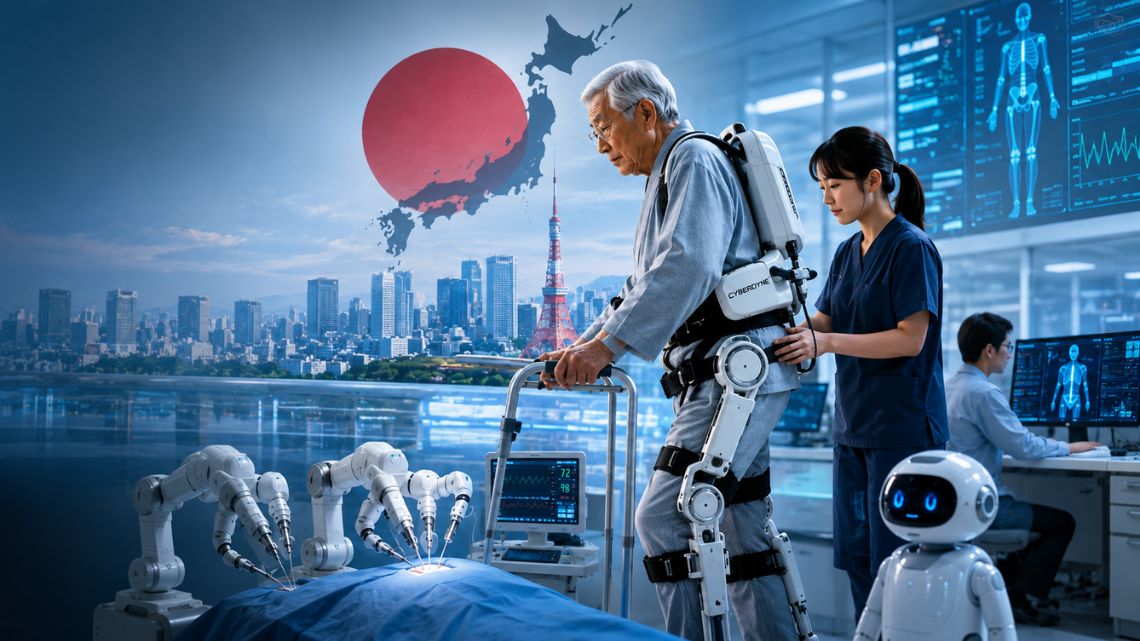
There comes a moment in every society when a problem stops being a statistical report and starts becoming deeply personal. In Japan, that moment arrived not through protest or panic, but through silence. With each passing year, schools empty out and rural homes hollow out, while overworked nurses in crowded hospitals rush to treat a growing tide of patients.
However, today, Japan no longer treats aging as a social issue alone; it now treats it as an engineering challenge. Japan’s 2025 Annual Report on the Aging Society states that people aged around 65 years and older now make up about 29.3% of the country’s population, with more than 36 million elderly citizens nationwide. The report also projects that by 2070, one in every 4 people in Japan will be over 75 years of age and older. That demographic pressure has pushed biomedical engineering from the sidelines of healthcare into the center of national planning.
This article will explore how Japan is using biomedical engineering today to respond to its super-aged population crisis.
Japan’s Newest Care Workers Don’t Need Sleep
In Japan, robotics has stepped out of the showroom and onto the floor in eldercare homes. And because of this, care facilities are rapidly implementing intelligent monitoring mats, lifting-assist systems, and rehabilitation robots out of pure necessity due to severe workforce shortages.
As per Reuters, Japan’s nursing sector faced only one applicant for every 4.25 available caregiving jobs in late 2024, far below the national average employment ratio. That pressure alone explains why projects like AIREC, a humanoid caregiving robot developed through Japanese university research programs, have drawn global attention. Engineers designed this system to assist with physically demanding tasks such as repositioning elderly patients to prevent bedsores and injuries. The robots are here only to help and support human caregivers.
In addition, the Japanese government has also accelerated its policy support. In 2024, Japan’s Ministry of Economy, Trade and Industry and Ministry of Health, Labour and Welfare updated their national technology priorities for long-term care, expanding support for AI systems, robotics, and digital caregiving infrastructure.
The Quiet Rise of Invisible Healthcare
Some of Japan’s most important biomedical engineering breakthroughs barely look like machines at all. Across hospitals and eldercare facilities, engineers are now adopting non-contact biosensor mats that can monitor respiration, heart rate, sleep movements, and bed exits without attaching wires or intrusive devices to elderly patients. For instance, systems such as Bio Silver’s remote monitoring platform enable caregivers to supervise multiple patients simultaneously, reducing the need for physical rounds at nighttime.
But the significance of this travels much deeper than simply making things easier for healthcare providers. Right now, Japan is designing its healthcare systems around dignity, as many elderly citizens want independence and not constant intervention. In response to this need, biomedical engineers are creating technologies that quietly monitor the elderly rather than aggressively control them. That philosophy now shapes everything from wearable blood-pressure monitors to remote rehabilitation systems. The Omron’s wearable HeartGuide device is yet another innovative technology that enables users to consistently track their blood pressure via a smartwatch that also evaluates sleep quality and physical activity.
Furthermore, remote diagnostics and home monitoring are no longer optional in rural Japan; they are vital infrastructure in areas facing shrinking healthcare access and rapidly aging populations.
How Japan is Rethinking the Meaning of Healthcare
Today, Japan’s biomedical engineering sector operates with an entirely different philosophy from many Western healthcare systems. The objective here no longer focuses only on curing illness; it focuses on extending functional independence. This, in turn, has created much demand for bionic suits, rehabilitation robotics, AI-supported mobility systems, and smart living environments designed specifically for senior citizens.
As an added effort, research institutions such as the National Center for Geriatrics and Gerontology have expanded programs that connect rehabilitation medicine directly with robotics engineering and national policy planning.
Japan’s true significance lies in its role as a massive testing ground. It offers a preview of the demographic and healthcare challenges, such as aging populations, shrinking workforces, and overwhelmed medical systems, that all developed nations will soon adopt as well. Japan’s engineers are not building gadgets for convenience anymore; they are redesigning the mechanics of aging itself.