
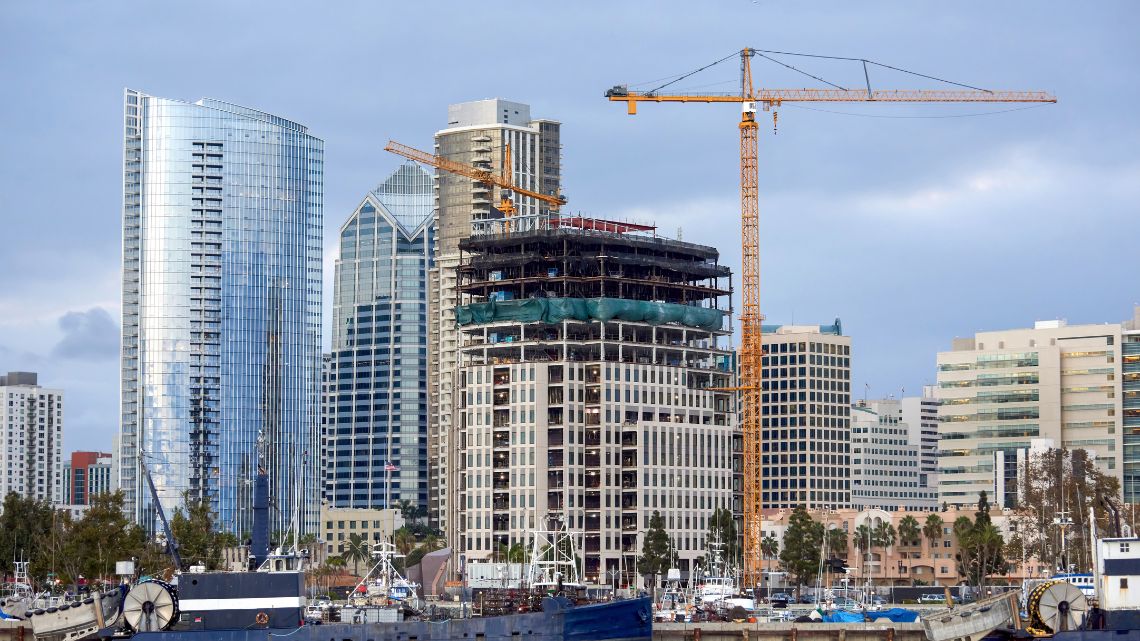
It sounds absurd. Deserts stretch to the horizon. Beaches line every continent. Sand is everywhere. So, how is the construction industry quietly choking on a shortage of it? The answer lies in a distinction most people never think about: not all sand is created equal. The soft, wind-smoothed grains of the Sahara may seem limitless, but they are largely unsuitable for making concrete. Construction demands rough, angular particles, the kind tumbled by rivers and waves, not wind, whose jagged edges lock together and bond with cement. And that specific type of sand, found in riverbeds, lake beds, and coastal shelves, is disappearing faster than the planet can make more.
The Numbers Are Staggering
The world consumes about 50 billion metric tons of sand each year, a volume the United Nations Environment Programme describes as enough to build a wall 27 meters wide and 27 meters high around the entire planet, every single year. The UN Environmental Programme also notes that sand extraction is rising roughly 6% annually. To put that in perspective, sand is now the second-most consumed natural resource on Earth after water, and yet it barely registers in public conversation about resource scarcity. The construction sector is by far the biggest driver. In the production of concrete, every tonne of cement requires roughly six to seven tonnes of sand and gravel. Multiply that by the scale of global urbanization, and the numbers become dizzying. From 2011 to 2013 alone, China used more concrete than the United States consumed throughout the entire 20th century. And China is far from alone — India, Southeast Asia, and cities across Africa are building at an extraordinary pace, consuming sand at rates that have no historical precedent.
A Crisis Hidden in Plain Sight
According to the UN’s World Urbanization Prospects 2025 report, cities are now home to 45% of the global population of 8.2 billion — more than double the share in 1950. The number of megacities has quadrupled from just eight in 1975 to 33 in 2025, with more than half located in Asia. Crucially, the UN projects that two-thirds of all global population growth between now and 2050 will take place in cities, most of it in Africa and Asia, where construction demand is already at its most intense. Every new skyline, every highway, every apartment block demands sand.
Yet the supply side of the equation is brutally constrained. Sand is effectively a finite resource on a human timescale. It takes thousands of years for rocks to erode into usable grains, and the world is consuming them far faster than nature can replace them. And unlike oil, there is no OPEC, no sanctions, and no summit meetings dedicated to sand. Despite being one of the world’s most consumed natural resources, global oversight remains limited, and reliable data on extraction volumes is often incomplete. In many developing countries, where much of the world’s sand mining takes place, regulations are weak, enforcement is inconsistent, and illegal extraction remains a persistent problem. As demand continues to grow, these challenges are drawing greater attention from policymakers, environmental organizations, and the construction industry.
The Rise of Illegal Sand Mining
Growing demand has also fuelled a darker side of the sand trade. Across India, Southeast Asia, and West Africa, unauthorised mining operations have quietly proliferated—rivers dredged without oversight, coastlines stripped, and local communities left to absorb the consequences. The problem has grown so large that the United Nations has identified illegal sand mining as a rapidly growing environmental crime, with significant impacts on ecosystems, local communities, and resource governance. The consequences extend beyond environmental damage. Illegal supply chains can undercut legitimate operators, distort material costs, and make it difficult to trace where construction aggregates actually originate. For engineers, contractors, and project developers, illegal extraction introduces additional risks around sourcing, compliance, and supplier accountability.
The Environmental and Economic Consequences
While sand mining plays a legitimate role in supplying construction materials, excessive or poorly regulated extraction can create significant environmental and economic consequences. UNEP has warned that unsustainable sand extraction contributes to riverbank erosion, biodiversity loss, groundwater disruption, and coastal degradation. In some regions, intensive mining has altered natural sediment flows that help maintain shorelines and protect communities from storm impacts.
The damage is already visible in many parts of the world. Along sections of the Mekong River in Vietnam and Cambodia, excessive extraction has accelerated riverbank collapses, threatening homes, farmland, and local communities. In Indonesia, sea sand mining contributed to the outright destruction of 26 islands in Riau Province, while coastal erosion and reef damage have been documented across other regions.
The damage doesn’t stop at the waterline. Stripping sand from riverbeds destabilizes the ground beneath critical infrastructure. In several countries, bridge failures have been directly linked to weakened sediment foundations caused by upstream extraction. Economically, the pressure is mounting too. As accessible sources are depleted or restricted, construction firms are being forced to source sand from ever-greater distances, pushing up material costs and adding complexity to project timelines. As supplies become harder to access, sand is becoming a factor that engineers, contractors, and policymakers can no longer afford to overlook.
Exploring Alternatives
The construction industry has begun to reckon with the fact that it cannot simply dig its way out of this problem. Attention is turning to alternative, and some are already gaining serious traction. Manufactured sand, or M-sand, is perhaps the most immediate solution. Produced by crushing hard rock into fine aggregate, it can substitute for natural sand across a wide range of applications and is estimated to account for more than 50% of the global aggregate mix by 2027, with China alone potentially reaching around 80%.
Recycled aggregates from demolished structures offer another practical route, giving old concrete a second life while easing demand on rivers and coastlines. Further along the spectrum, researchers are incorporating industrial by-products such as fly ash and steel slag into concrete formulations that require significantly less virgin sand. And at the frontier of material science, alternatives like hempcrete, mycelium composites, and mass timber are pointing toward construction methods that reduce sand dependency at a more fundamental level. No single solution will resolve the shortage overnight. The challenge lies in scaling these alternatives fast enough, at a cost that works, and in a form that meets the demanding performance standards of modern construction.
The Bottom Line
The global sand crisis is not about the world running out of sand entirely. It is about a construction industry and a rapidly urbanizing world that have become heavily dependent on a specific type of sand, one that takes thousands of years to form and is becoming increasingly difficult to source sustainably. Policymakers and industry leaders must recognize sand’s finite nature, establish clear regulations to protect rivers and coastal habitats, and invest in research and international cooperation to enforce sustainable trade practices. Every skyscraper, highway, and housing block being built today is a claim on a resource that future generations will have less of. The question is no longer whether the world can keep building. It is whether the construction industry can meet future demand while reducing pressure on the natural resources that make modern development possible.