
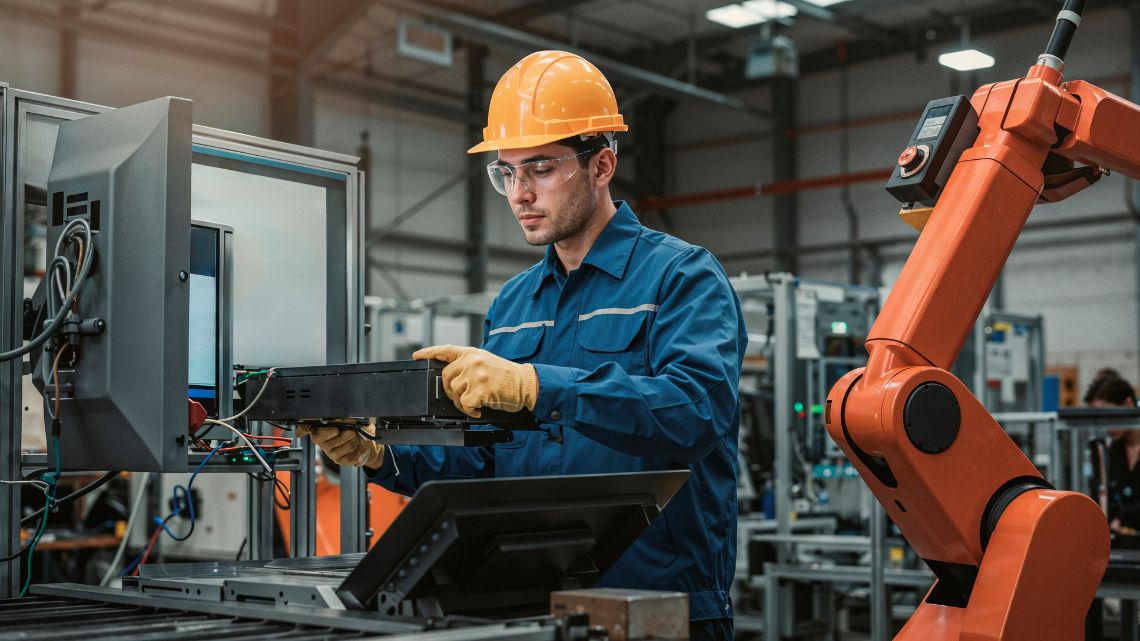
The idea of the “smart factory” is no longer aspirational. It is already embedded in modern manufacturing, from automated production lines and sensor-driven quality control to AI-assisted scheduling and predictive maintenance. What is changing now is not the availability of technology, but the capability required to use it effectively. As factories become more connected, autonomous, and data-driven, the role of the engineer is being redefined in ways that many organizations are only beginning to understand.
Industrial automation today is less about programming machines to repeat tasks and more about designing systems that can adapt, diagnose, and decide. This shift demands a new engineering skill set, one that blends traditional disciplines with systems thinking, digital fluency, and operational judgment.
From Automation to Autonomy
For decades, automation focused on consistency. Programmable logic controllers, industrial robots, and SCADA systems were introduced to reduce variability and human error. Engineers designed, validated, and optimized the fixed logic for efficiency. Once deployed, systems were expected to behave predictably for years.
Smart factories operate differently. They rely on real-time data, dynamic optimization, and increasingly autonomous decision-making. Production schedules adjust based on demand signals. Machines self-report degradation. Quality systems detect trends rather than isolated defects. Control logic is no longer static; it evolves with conditions. This evolution changes what engineering competence looks like. Knowing how to program a controller is no longer sufficient. Engineers must understand how decisions propagate across interconnected systems and how local optimization can create global instability if not managed carefully.
The Engineer as a Systems Integrator
One of the most important shifts in industrial automation is the rise of systems integration as a core engineering capability. Smart factories are built from layers, sensors, edge devices, control systems, enterprise software, and cloud platforms. Each layer may function well on its own, yet fail collectively if integration is poorly designed.
Modern automation engineers must understand how mechanical processes, electrical systems, control logic, and data architecture interact. A vibration anomaly detected by a sensor may trigger a maintenance alert, alter production flow, and affect supply commitments. Engineering decisions therefore have operational and business consequences beyond the factory floor. This requires engineers to think in terms of feedback loops, latency, data quality, and failure modes at the system level. The smartest automation is not the most complex, but the most coherent.
Data Literacy Is Now an Engineering Skill
Smart factories generate vast amounts of data, but data alone does not create insight. Engineers are increasingly expected to interpret trends, distinguish signal from noise, and translate analytics into physical action. This does not mean every engineer must become a data scientist. It does mean understanding how data is generated, filtered, and contextualized. Engineers need to know what a model can and cannot infer, how sensor placement affects interpretation, and when algorithmic recommendations should be trusted or challenged. In many factories, automation failures now stem from misinterpreted data rather than mechanical breakdown. The ability to ask the right questions of data has become as important as the ability to design machines.
Control Engineering in a Software-Defined Environment
Control systems remain central to industrial automation, but they are no longer isolated. Modern control architectures interact with IT systems, remote dashboards, and optimization engines. This convergence introduces new challenges around determinism, cybersecurity, and reliability. Engineers must design control strategies that remain stable even when higher-level systems change parameters dynamically. They must understand the limits of real-time control in software-defined environments and ensure that safety-critical functions remain protected from external variability. The skillset here is as much about restraint as capability. Not every process should be optimized continuously, and not every variable should be connected. Smart engineers know where autonomy adds value and where it introduces risk.
Human–Machine Collaboration, Not Replacement
Despite advances in automation, humans remain integral to manufacturing systems. What has changed is the nature of their involvement. Operators are less focused on manual execution and more on supervision, intervention, and exception handling.
This places new demands on engineers. Systems must be designed so that humans can understand system state quickly, trust automation appropriately, and intervene effectively when required. Poor interface design, opaque algorithms, or over-automation can reduce situational awareness and increase error during critical moments. Engineering judgment now includes anticipating how people will interact with intelligent systems under real operational pressure, not ideal conditions.
Continuous Learning as a Professional Requirement
One of the defining characteristics of smart factories is that they evolve. Software updates, new analytics models, and changing production requirements mean that systems rarely remain static. As a result, engineering competence can no longer be treated as something acquired once and applied indefinitely.
Engineers working in industrial automation today must continuously update their skills, not just in technology but in methodology. Understanding how to validate adaptive systems, manage version control in operational environments, and introduce change without disrupting production has become essential. Organizations that treat training as optional or secondary often struggle to realize the benefits of smart manufacturing, regardless of how advanced their technology stack appears.
Why This Matters Now
Global manufacturing is under pressure from multiple directions: supply chain volatility, workforce constraints, sustainability expectations, and cost competitiveness. Smart factories promise resilience and flexibility, but only if they are supported by engineers capable of managing complexity responsibly. The gap between what technology enables and what organizations can safely deploy is increasingly a human one. Tools are advancing faster than the skillsets required to use them well.
Engineering Maturity Defines Smart Manufacturing
Smart factories do not fail because sensors malfunction or algorithms underperform. They fail when systems are poorly understood, poorly integrated, or poorly governed. In this environment, the most valuable engineers are not those who know the most tools, but those who understand how systems behave over time.
The future of industrial automation will be shaped less by hardware innovation and more by engineering maturity. Smarter factories will demand smarter engineers, engineers who can combine technical depth with systems thinking, data awareness, and operational responsibility. Automation has always been about efficiency. In its next phase, it will be about judgment.