
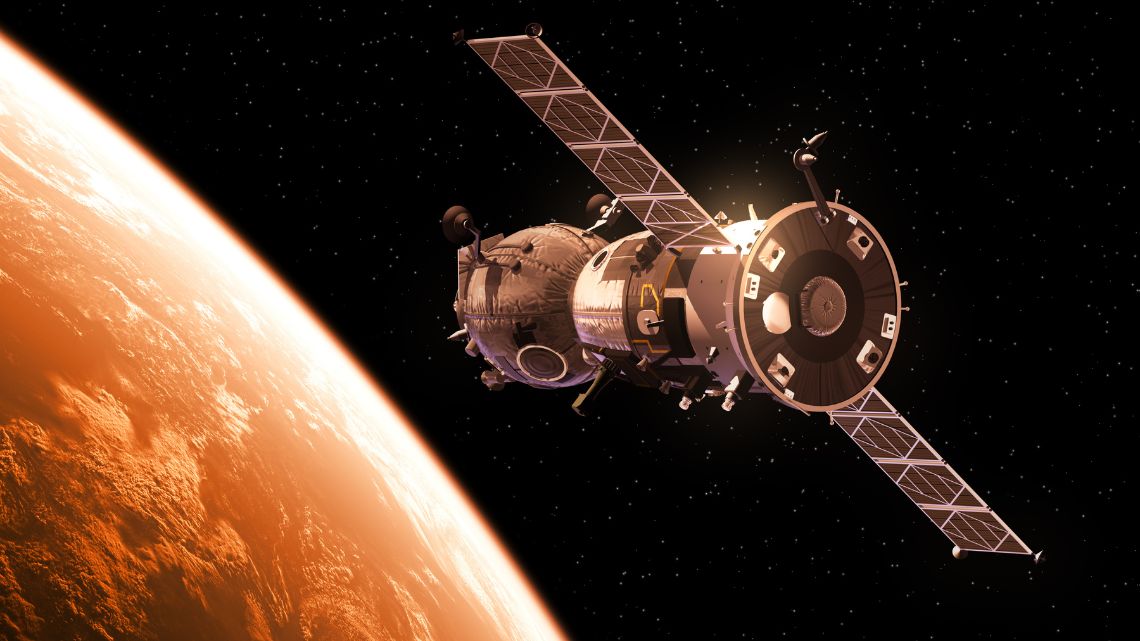
Before the first boot prints are made on Mars, our machines must master the art of surviving the absolute, silent solitude of the cosmic ocean. Deep space is no place for errors made by weak materials, fragile electronics, or imperfect systems, which are all recipes for disaster. A mission to Mars or beyond tests engineering every single day across millions of kilometers, and where repair crews cannot follow. For aerospace engineers, interstellar exploration in 2026 will delve less into reaching distant planets and more into building spacecraft that can last the journey.
Engineering for the Long Journey
Deep-space missions demand the kind of reliability on a scale that is rarely seen in other engineering fields. Spacecraft missions to Mars so far have operated autonomously for months or years without any human intervention. According to NASA, an ordinary crewed mission to Mars could require anywhere between six and nine months of transit time each way, as per orbital alignment and thrust mechanism. This longer timeline pushes engineers to design systems that continuously operate under extreme isolation.
But unlike satellites in the Earth’s orbit, deep-space vehicles must withstand micrometeoroid exposure, continuous radiation bombardment, and vast temperature changes. This is why engineers always assume that every component or part of the spacecraft will face stresses far beyond conventional aerospace environments, and so they design for a journey that lasts years.
Radiation: The Invisible Engineering Problem
Handling vast amounts of radiation remains to be one of the most difficult challenges faced in aerospace engineering. Beyond the Earth’s magnetosphere, spacecraft come across galactic cosmic rays and solar particle events that pose a risk to human health as well as degrade electronics. According to NASA’s Human Research Program, human astronauts on Mars missions could experience radiation exposure of levels touching or surpassing current safety standards, making shielding strategies essential to mission design.
For those reasons alone, aerospace engineers around the world test composite shielding materials, hydrogen-rich polymers, and layered structural designs that absorb radiation without adding excessive weight. As every kilogram added to shielding increases the launch cost, engineers constantly manage the tension between safety and speed.
Recycling Resources to Sustain Life Between Worlds
Space vehicles cannot rely on regular resupply missions. This is where engineers design life-support systems to continuously recycle air and water. As per NASA’s International Space Station (ISS) Program, the environmental and life-support system aboard the ISS already recovers up to 98% of water from humidity and wastewater. This shows the type of closed-loop systems required for any space missions, for that matter.
The electric propulsion systems, too, power many robotic space missions, supplying efficient, long-duration thrust. These technologies demonstrate how propulsion engineering increasingly blends material science, physics, and energy patterns.
When Help is Millions of Kilometers Away …
Aerospace engineers pre-program safety measures, developing fail-safe systems that handle the unknown. Be it through including fault-tolerant software, backup electronics, and self-diagnosing systems, engineers design spacecraft to continue operating despite component degradation. According to NASA’s Deep Space Network, engineers cannot depend on real-time control during emergencies at distances where radio signals can take at least 20 minutes to travel between Earth and Mars. During such times, a spacecraft identifies faults and responds automatically—a requirement that pushes aerospace engineering deeper into autonomy and systems integration.
The Human Side of Deep-Space Engineering
For many aerospace engineers, deep-space missions represent the ultimate systems challenge. One propulsion engineer, Frank Bernard, working on long-duration spacecraft testing, once described Mars missions as “engineering without a safety net”. This shows how every valve, circuit, and sensor must perform without any issues, even after launch day becomes a faint memory.
Today, aeronautical engineering transforms spacecraft from being mere experimental machines into dependable explorers. Engineers don’t think in terms of the number of launches made; they think in terms of the lifetimes measured across years and billions of kilometers.
Beyond the Earth’s Orbit
All missions to the red planet to date have only been robotic so far. But private companies like SpaceX are currently engineering for crewed missions to Mars, laying the foundation for human exploration of asteroids, outer planets, and the world that lies still beyond.
While space and research expeditions can be quite fascinating and educational, there is absolutely no room for “winging it” when millions of miles away from home. Space missions are always about planning for the worst and flying for the best. In doing so, aerospace engineers work on improving radiation shielding, propulsion technologies, life-support systems, and autonomous operations. The aerospace industry aims to move humanity closer to a future where journeys beyond Earth become not extraordinary missions, but expected ones.