
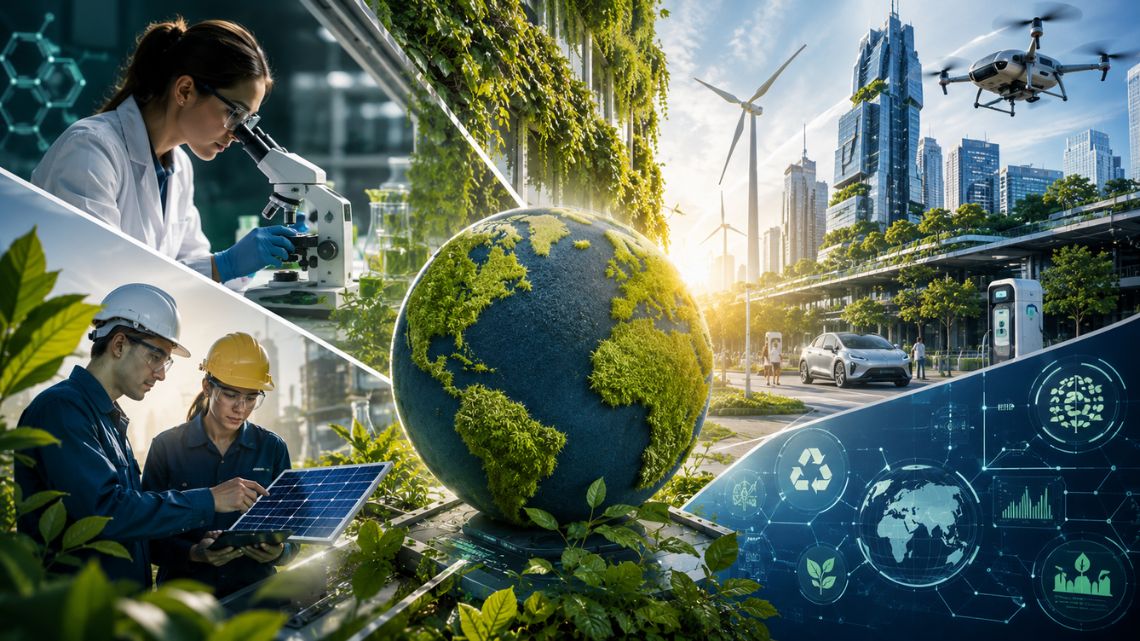
There is an engineering breakthrough that is about to announce itself quietly—either hidden in a lab note, in an accidental discovery, or in a revised formula that shatters the status quo. And before the world is ready to see the results of it through cleaner cities, lower-emission industries, or stronger batteries, someone, somewhere, leads with all but a simple question: “Is there a better way to construct this, and how can we go about it?”
That question is what drives modern engineering today. Climate change is no longer limited to theoretical discussions for policymakers; it has become an active, driving force that shapes the world’s research goals, investment strategies, and engineering innovations. And so in 2026, sustainability is no longer just a nice ambition for a growing organization to have; it is the baseline requirement for all engineering.
How Climate Policy is Steering Engineering Research
Historically speaking, research and development in engineering have driven solutions to some of society’s most critical problems. For instance, climate goals are leading today’s agenda. The International Renewable Energy Agency states that the updated Nationally Determined Contributions (NDCs) are prioritizing renewable energy, clean technologies, biofuels, and energy efficiency. Therefore, global policies directly shape where their research dollars are being spent.
These research teams pursue technological innovation not merely to break ground but to lower emissions, boost resilience, and support lasting sustainability.
What Lies Beyond Carbon Capture
Carbon capture is a major engineering focus today, and its research priorities are only expanding. As scientists work on removing carbon directly from the air, they are also working on low-carbon cement, biopolymers, recyclable composites, alternative battery chemistries, and hydrogen production.
The International Energy Agency’s Climate Strategy notes that reaching net-zero by 2030 requires scaling advanced batteries, hydrogen, and carbon capture. The strategic shift here is that the main objective has evolved from capturing carbon to stopping emissions entirely.
Building Greener Technologies From the Inside Out
Materials science is the quiet force behind the green transition, cutting emissions across countless projects by improving everyday materials like steel, concrete, and batteries. Researchers today are moving beyond extra green measures by designing sustainability directly into the material itself.
Success today is defined by engineering solutions that are both highly reliable and environmentally responsible. We have moved far past asking “Can we build it?” to “Can we build it responsibly?”
Innovation Needs Discipline, Anyday
The rush to meet global sustainability targets has urged technological progress, yet responsible engineering leadership requires strict validation. Thanks to advanced AI simulations, digital prototyping allows researchers to test thousands of design variations way before building and running physical tests.
However, moving quickly is not enough to ensure real progress. We still depend on careful lab testing, safety checks, and regulatory compliance. Sustainable innovation only succeeds when our environmental goals are matched by rigorous engineering.
Engineering the Next Climate Breakthrough
The Renewable Energy Policy Network for the 21st Century (REN21) highlights how the global energy transition depends a lot on transforming entire systems rather than simply swapping power sources. That transformation places engineering R&D firmly at its center.
Every progress made in sustainable materials, circular manufacturing, renewable energy, and industrial efficiency relies on researchers breaking traditional rules. The work happening in engineering labs goes well beyond building green technologies; it completely rewrites how we innovate.
Invisible Innovations Make for Extraordinary Impacts
In 2026, R&D in engineering marks the dawn of an era where innovation and environmental management are closely linked. The most critical discoveries of the future may operate behind the scenes, yet they will silently sustain the framework of our daily lives, powering the batteries, bridges, and infrastructure that keep our modern world moving.
Our future of sustainable engineering will never be measured just by what humanity builds; it will be measured by what innovations help the planet preserve as well.