
For more than three decades, lithium-ion batteries have been the backbone of modern energy storage. They power everything from smartphones and laptops to electric vehicles and utility-scale energy storage systems. Their high energy density, long cycle life, and declining production costs have made them the preferred choice for countless applications.
However, as global demand for renewable energy and electric transportation accelerates, the limitations of lithium-ion technology are becoming increasingly apparent. Concerns over raw material availability, rising costs, environmental impacts, safety risks, and recycling challenges are driving engineers to explore alternative energy storage technologies. The future of clean energy will not depend on a single battery chemistry but on a diverse portfolio of storage solutions designed for different applications. Engineering the next generation of energy storage is no longer about improving lithium-ion batteries alone. It is about developing technologies that are safer, more sustainable, and capable of supporting an increasingly electrified world.
The Limitations of Lithium-Ion Batteries
Lithium-ion batteries have transformed energy storage, but they are far from perfect. The growing demand for lithium, cobalt, and nickel has intensified concerns about resource availability, mining practices, and geopolitical dependence. Extracting these critical minerals often requires significant water consumption and can lead to environmental degradation if not managed responsibly.
Safety is another important consideration. Under extreme conditions, damaged or improperly managed lithium-ion batteries may experience thermal runaway, a chain reaction that generates excessive heat and can result in fires. Although modern battery management systems have significantly reduced these risks, ensuring safety remains a priority, particularly in electric vehicles and large-scale energy storage facilities. Furthermore, lithium-ion batteries gradually lose capacity over time. While suitable for many applications, they may not provide the long operational life required for storing renewable energy generated over extended periods or for supporting national power grids during prolonged fluctuations in electricity demand.
Sodium-Ion Batteries Offer an Abundant Alternative
Among the most promising alternatives is sodium-ion battery technology. Sodium shares many electrochemical characteristics with lithium but is significantly more abundant and widely distributed across the globe. This reduces concerns about resource scarcity and supply chain concentration.
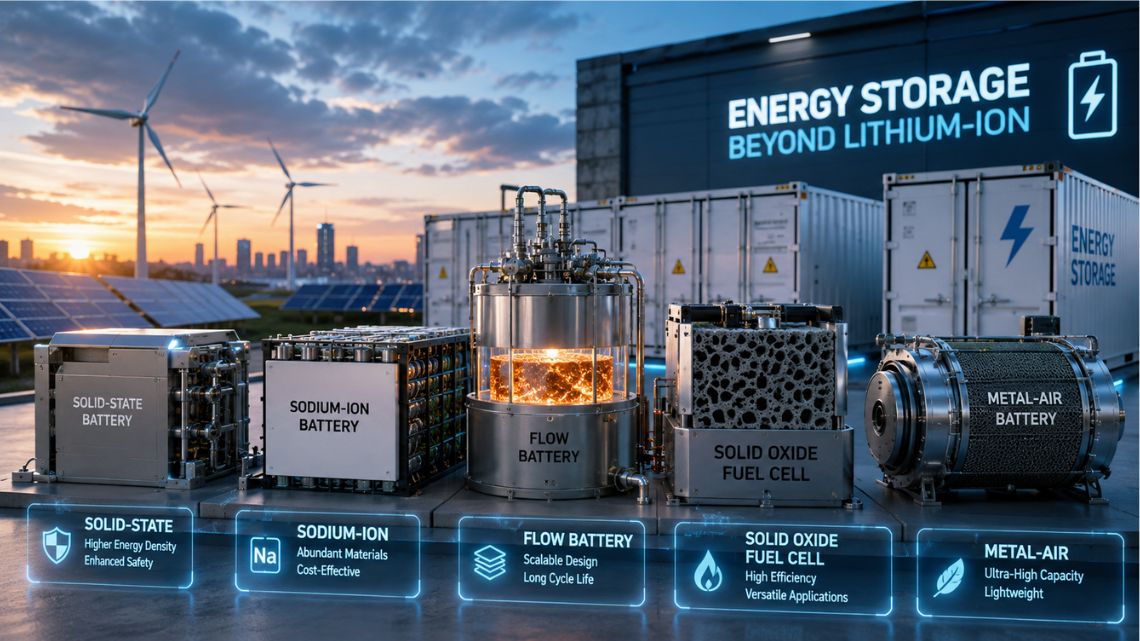
Although sodium-ion batteries generally offer lower energy density than lithium-ion batteries, they perform well in stationary energy storage applications where battery size and weight are less critical. They also demonstrate strong performance across a wider range of operating temperatures and eliminate the need for several expensive critical minerals. As manufacturing processes mature, sodium-ion batteries are expected to become a cost-effective solution for renewable energy storage, grid stabilization, and entry-level electric mobility.
Solid-State Batteries Promise Greater Safety and Performance
Solid-state batteries are widely regarded as one of the most significant advancements in battery engineering. Unlike conventional lithium-ion batteries, which use liquid electrolytes, solid-state batteries replace the liquid with a solid material that conducts ions between the electrodes. This design offers several important advantages. Solid electrolytes significantly reduce the risk of leakage and thermal runaway while enabling higher energy density. As a result, electric vehicles equipped with solid-state batteries could potentially travel longer distances while requiring less charging time.
Engineers are also investigating new electrode materials that can further improve battery performance and longevity. Despite these benefits, challenges related to manufacturing complexity, material durability, and production cost continue to slow large-scale commercialization. Nevertheless, substantial investments from automotive manufacturers and research institutions indicate strong confidence in the technology’s future.
Flow Batteries Could Transform Grid-Scale Storage
Not every energy storage application requires lightweight batteries. Electrical grids demand systems capable of storing massive amounts of energy over extended periods, making flow batteries an attractive alternative.
Unlike conventional batteries, flow batteries store energy in liquid electrolytes contained within external storage tanks. The larger the tanks, the greater the amount of energy that can be stored, allowing capacity to be expanded independently of power output.
Flow batteries offer long operational lifespans, minimal degradation over repeated charge cycles, and excellent safety characteristics because many electrolyte formulations are non-flammable. These features make them particularly well suited for integrating renewable energy sources such as wind and solar into national electricity networks, where energy generation often fluctuates throughout the day.
Hydrogen Is Emerging as a Long-Duration Energy Carrier
While hydrogen is not a battery, it is becoming an increasingly important component of future energy storage systems. Excess electricity generated by renewable energy can be used to produce hydrogen through electrolysis. The hydrogen can then be stored for extended periods before being converted back into electricity using fuel cells or combustion systems.
This approach addresses one of the greatest challenges facing renewable energy—seasonal and long-duration storage. Unlike batteries, which are typically designed for hours or days of storage, hydrogen can retain energy for weeks or even months.
Engineering improvements in electrolyzers, storage tanks, transportation infrastructure, and fuel cell technology are steadily improving the efficiency and economic viability of hydrogen-based energy systems. Although significant infrastructure investments remain necessary, hydrogen is expected to play an important role in decarbonizing industries such as heavy transportation, aviation, shipping, and steel manufacturing.
Sustainable Materials and Circular Battery Design
Advancing energy storage requires more than developing new chemistries. Engineers are increasingly focusing on designing batteries with sustainability throughout their entire lifecycle. Battery manufacturers are exploring recyclable materials, reducing dependence on scarce minerals, and developing manufacturing techniques that minimize carbon emissions. Design strategies that simplify battery disassembly and material recovery are making recycling more efficient while supporting a circular economy.
Researchers are also investigating organic electrolytes, bio-based materials, silicon anodes, and abundant metals such as zinc and iron to create batteries with lower environmental impacts. These innovations demonstrate that future energy storage solutions must be evaluated not only by their performance but also by their long-term sustainability.
Artificial Intelligence Is Accelerating Battery Innovation
Artificial intelligence has become an essential tool in modern battery engineering. Machine learning algorithms can rapidly evaluate thousands of potential material combinations, significantly reducing the time required to discover new battery chemistries. AI also improves battery management by monitoring charging patterns, predicting degradation, and optimizing performance throughout a battery’s operational life. Predictive maintenance systems can identify potential failures before they occur, improving reliability while extending battery lifespan.
Combined with advanced simulation software and digital twin technology, artificial intelligence is enabling engineers to accelerate innovation while reducing development costs.
Building a Diverse Energy Storage Future
The future of energy storage will not be defined by replacing lithium-ion batteries with a single superior technology. Instead, it will be shaped by a combination of complementary solutions, each engineered for specific applications. Electric vehicles may increasingly adopt solid-state batteries, power grids may rely on flow batteries and sodium-ion systems, while hydrogen could provide long-duration energy storage for industrial and national-scale applications.
Meeting global climate goals will require energy storage systems that are affordable, safe, scalable, and environmentally responsible. Continued investment in materials science, electrochemistry, manufacturing, and systems engineering will determine how successfully these emerging technologies transition from research laboratories to widespread commercial deployment. As renewable energy becomes the foundation of modern power systems, innovation in energy storage will be equally important. The engineering challenge is no longer simply storing electricity, it is designing resilient, sustainable, and intelligent energy storage systems capable of powering the world for decades to come.