
How Edge Computing Systems Are Redefining Real-Time Infrastructure Today, and Why Latency is Now the Greatest Constraint in the Engineering Realm
“The first time an autonomous robot hesitated for half a second, the engineer watching it knew the problem wasn’t intelligence; it was distance.” Let’s see what this means.
Distance—not in metres, but in milliseconds. The information signal had travelled to the cloud in 18 milliseconds, waited to be processed, and then returned just late enough to cause a “pause.” In a laboratory somewhere in Detroit, Michigan, that delay felt harmless. But on the factory floor, inside a moving robot arm, the same felt dangerous.
Why dangerous? That “pause” is exactly why edge computing systems have moved from design preferences to engineering necessities in 2026—because real-world systems can no longer tolerate delays. Engineers no longer ask whether systems can think; they ask whether the systems can think fast enough.
Why Latency Suddenly Matters
Before getting into why low latency (fast response times) matters, let’s see what edge computing means first.
Picture a robotic arm on a factory floor that must stop instantly when a human steps too close to it. If it sends that decision to a distant cloud server and waits for instructions to return, even a split second becomes too late. This is where edge computing systems come in, changing this equation by enabling the robot analyze its own sensor data on the spot and act immediately. It does not wait for permission from somewhere far away.
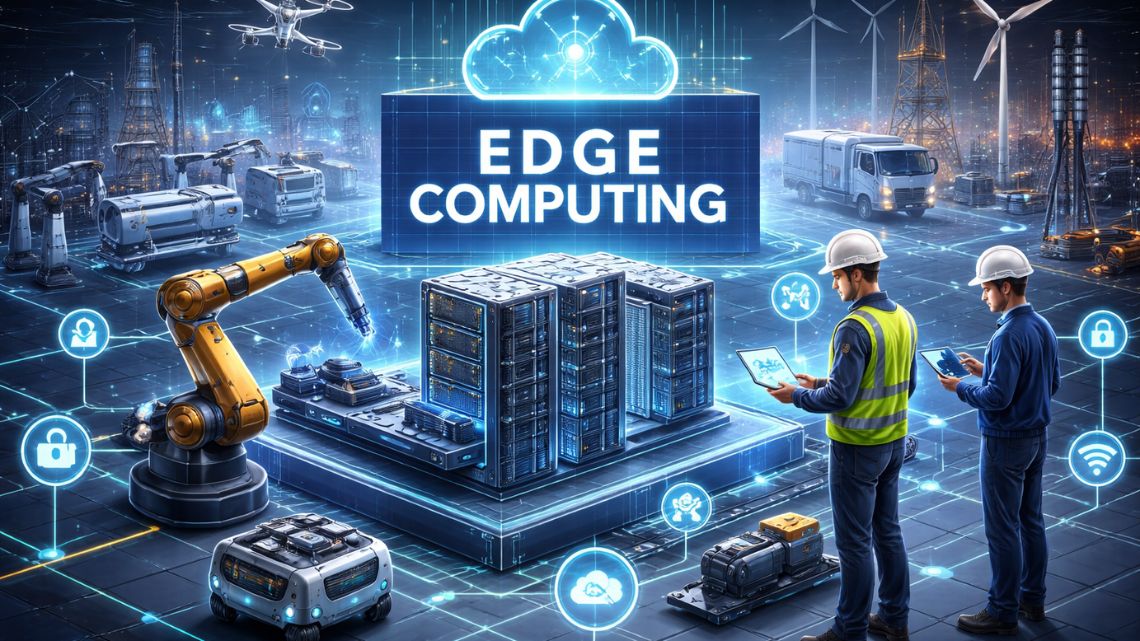
Edge computing positions computation next to sensors, control systems, and machines—inside factories, substations, vehicles, and wind farms—allowing for real-time decisions without the far round-trips to data centers.
For years now, cloud computing carried the weight of industrial data processing—offering scale, storage, and powerful analytics. But modern engineering systems now operate in environments where even the tiniest delay can have substantial physical consequences. Gartner notes that companies now handle nearly 75% of their corporate data at the edge, compared to only 10% in 2018. The data is driven largely by latency-sensitive industrial and infrastructure applications.
Edge Computing Already at Work in 2026
- Robots Don’t Wait Around Anymore – In industry 4.0 facilities, robots coordinate with machine vision (MV) and safety sensors in fractions of a second. Today, engineers deploy edge nodes (computing devices near data sources) directly on production lines to assess camera feeds, vibration data, and temperature readings locally.
According to McKinsey, manufacturers using edge-enabled AI systems today have 50% reduced service disruptions by detecting faults in real time rather than after cloud analysis. This change transforms predictive maintenance into preventive action. A robotics engineer at an automotive plant described it very simply: “The robot stopped waiting for permission and started thinking for itself.”
- Delay Equals Dangers – Autonomous vehicles and mobile robots rely on constant sensor fusion—LiDAR, cameras, radar, and GPS—which must sync immediately. This is because sending out that volume of data to distant cloud servers can cause delays, putting safety at risk.
According to IEEE, latency that’s above 10 milliseconds can weaken autonomous control loops in safety-critical systems. And so, edge computing enables near-zero latency in control systems, allowing machines to react in real time to obstacles, weather, and unexpected motions.
- Autonomy Runs on Speed – Power grids now resemble living organisms—adaptive, distributed, and constantly observed. Edge systems inside substations and wind farms analyze load fluctuations, detect faults, and isolate failures before outages crash.
According to the International Energy Agency, smart grid investments crossed $300 billion USD globally in 2024. Utilities then directed most of this funding into localized control systems and edge-based analytics in support of renewable integration and grid resilience.
Lastly, concerning remote wind farms, engineers now deploy tactical edge servers that withstand dust, heat, and vibration—processing data on-site as connectivity cannot be guaranteed.
Cloud vs. Edge: Two Brains, One System
Edge computing does not replace the cloud servers, but rather reshapes their role. Firstly, cloud systems handle predictive analysis, training models, and enterprise management. And secondly, edge systems handle immediate decisions, safety logic, and time-sensitive control.
According to the IDC, global expenses on edge computing are predicted to reach $378 billion USD by 2028. This reflects how engineering teams now build systems where local edge devices and cloud servers share the responsibility. For this, engineers must continue to balance:
- Speed vs. scalability,
- Reliability vs. connectivity, and
- Autonomy vs. management.
The trade-offs are what exactly define modern system engineering today.
The Limits of Real-World Edge Deployment
To emphasize, edge systems are no strangers to operating in harsh conditions—factories, deserts, offshore platforms, and highways—facing heat, electromagnetic noise, vibration, and cyber risks. According to NIST, maintaining data consistency between edge and cloud remains one of the top technical challenges in industry edge deployments. Engineers must manage software updates, security patches, and hardware failures without interrupting operations. And here is where latency solved one problem but exposed another: system complexity.
What Engineers Must Ask Now
Edge computing reframes how engineers think about intelligence in machines. As our autonomous infrastructure begins to think and act on its own, the biggest challenge presently is not how much data it can compute or store, but how quickly it can react. Because in autonomous systems, even a few milliseconds can decide safety, stability, or failure.
In the engineering realm of edge computing systems, the subtle yet decisive shift is this: engineering systems are not just connected anymore; they are becoming locally aware, instantly responsive, and physically accountable. In 2026, the future of engineering does not wait for the cloud; it thinks at the edge.