
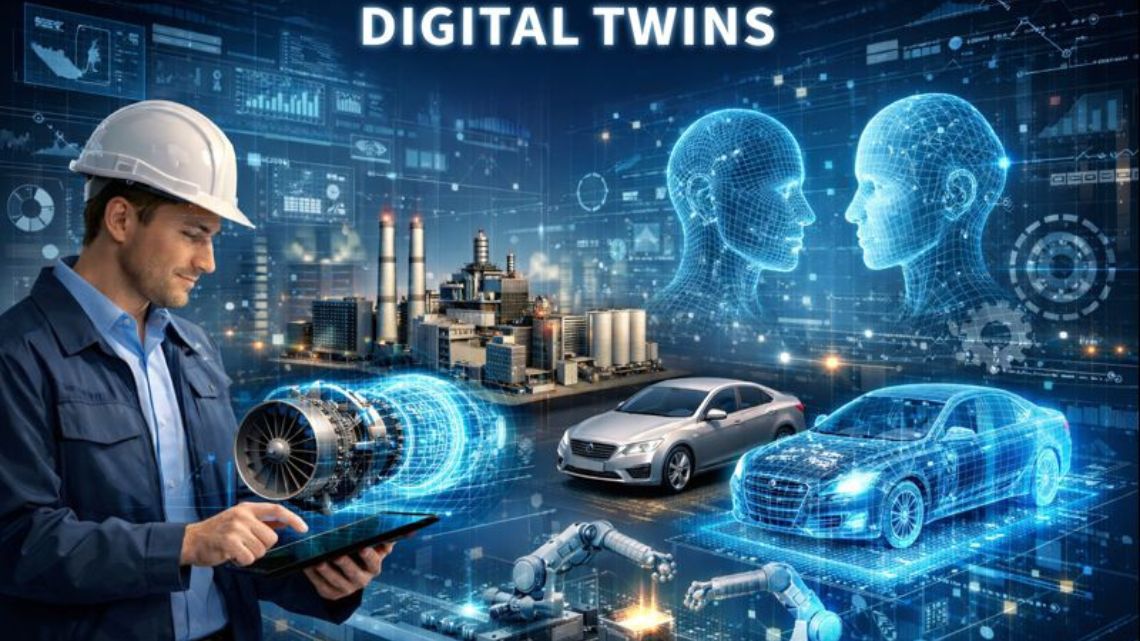
When yesterday’s workshop chatter about “vertical replicas” became tomorrow’s corporate culture, the engineering realm shifted its gears—not progressively, but fundamentally.
That shift didn’t just happen with a single product launch or a redeeming product feature. Rather, it began quietly inside simulation labs and on plant floors where engineers, fed up with guesswork and costly errors, asked just one crucial question: “What if we could see the failure before it happens?” This inquisitiveness—more than the technology hype—is what has propelled digital twin systems from ideation to implementation across modern engineering in 2026.
Why Digital Twin Systems Matter Right Now
Firstly, what are digital twin technologies and systems in the engineering realm?
According to IBM, unlike the traditional simulations that run isolated tests or snapshots in time, digital twin systems are live, synchronized virtual replicas of physical systems—powered by live data streams from sensors, IoT devices, and field telemetry. These digital twins don’t just virtually replicate a model; they mirror it continuously, allowing engineers to observe, test, and optimize systems without ever touching the physical asset.
In 2025 last year, the global digital twin market was valued at a rough USD 24.48 billion, and is predicted to surge to about USD 259.32 billion by 2032. This data by Fortune Business Insights shows nearly a tenfold increase driven by broad adoption across sectors like manufacturing, energy, aerospace, infrastructure, and healthcare. And this growth is factual. According to a Hexagon article, more than 29% of manufacturing companies worldwide have already implemented digital twin strategies. To top it off, a rough 65% of manufacturing leaders say they plan to prioritize digital twin technologies in 2026 to optimize their overall operations and sustainability.
From Factory Floor to City Grid: Adoption Stories
- Manufacturing’s Virtual Revolution – Say, people walk into a modern smart factory in 2026—even if it’s halfway across the world from them. They’re more likely to find a digital twin running quietly behind the scenes. According to the National Institute of Standards and Technology, these systems allow our engineers to simulate entire assembly lines, test process changes before committing to any physical modifications, and catch systemic failures before downtime costs soar.
To understand this, let’s take a look at this example. Engineers at a global automotive plant reduced commissioning time by weeks by using digital twin simulations to validate robotic stations and conveyor systems before physical deployment. Today, this is seen as the new standard for efficiency and quality in the engineering realm.
- Urban Infrastructure Gets a Digital Heartbeat – Countries like Singapore and India demonstrate how digital twins are redefining urban engineering today. Singapore provides a continuously updated 3D twin of the city-state’s metropolis, which planners utilize for flood risk assessments and for mobility and energy modeling.
Similarly, Varanasi in India received recognition for its 3D Urban Spatial Digital Twin Project, which uses light detection and ranging (LiDAR) and IoT data to simulate infrastructure conditions across 160 sq kms. The concerned authorities can now assess flood zones, traffic dynamics, and crowd patterns before potential events occur, blending historical preservation with strong long-term vision.
Furthermore, even power distribution is joining the digital revolution. In India, Rajasthan’s International Solar Alliance is deploying a digital twin of the electricity distribution network to enhance grid efficiency and renewable integration. This is proof that digital twin technologies and systems are moving way beyond analytics and into system transformation.
- Aerospace and Healthcare – The aerospace industry has emerged as an early adopter, using digital twins to test their aircraft systems under extreme conditions that would otherwise be too costly and dangerous to reproduce physically. According to AIMultiple, this approach accelerates certification timelines while improving safety margins and design confidence.
As to healthcare, the industry continues to explore digital twins for personalized medicine and hospital infrastructure planning. According to another AIMultiple article, virtual replicas of medical devices or medical care support give administrators and clinicians a heads-up on production limitations and equipment stress before they even hit crisis levels.
Yet even as all these digital twin technologies and systems prove their value across various sectors, their actual implementation continues to surface challenges that engineering teams can no longer afford to ignore.
Where the Technology Still Struggles
Despite all their potential, digital twin systems are not found or implemented globally—yet. According to a ScienceDirect 2025 research paper, smart city implementations often stop due to privacy and data governance concerns, as sensitive information from millions of sensors raises trust issues among citizens and regulators.
Interoperability across platforms remains to be another hurdle. According to IOT Analytics, a digital twin system built on one vendor’s tools may not easily integrate with others, driving engineers into costly customizations or data translation efforts.
And while digital twins excel at predictive insights, they still very much depend on high-quality data inputs, which many traditional physical systems were never designed to produce in the first place. As the National Institute of Standards and Technology states, achieving real-time fidelity, therefore, is as much an organizational challenge today as it is a technical one.
So What’s Next?
Digital twins are actually far more than just a design fad; in fact, they represent a dramatic change in the way engineering systems think in 2026. From inception through maintenance and lifecycle optimization, they stand to redefine how engineering systems are built, operated, and maintained throughout their entire lifespan—especially in an increasingly complex world.
As we progress into the new year, the question for engineering leaders is no longer whether to adopt digital twin technologies and systems. The question here is just how quickly and effectively they can integrate them into the fabric of real-world operations. Because in the end, the twin is not just a virtual shadow; it’s becoming the new strategic center of gravity for engineering excellence.