
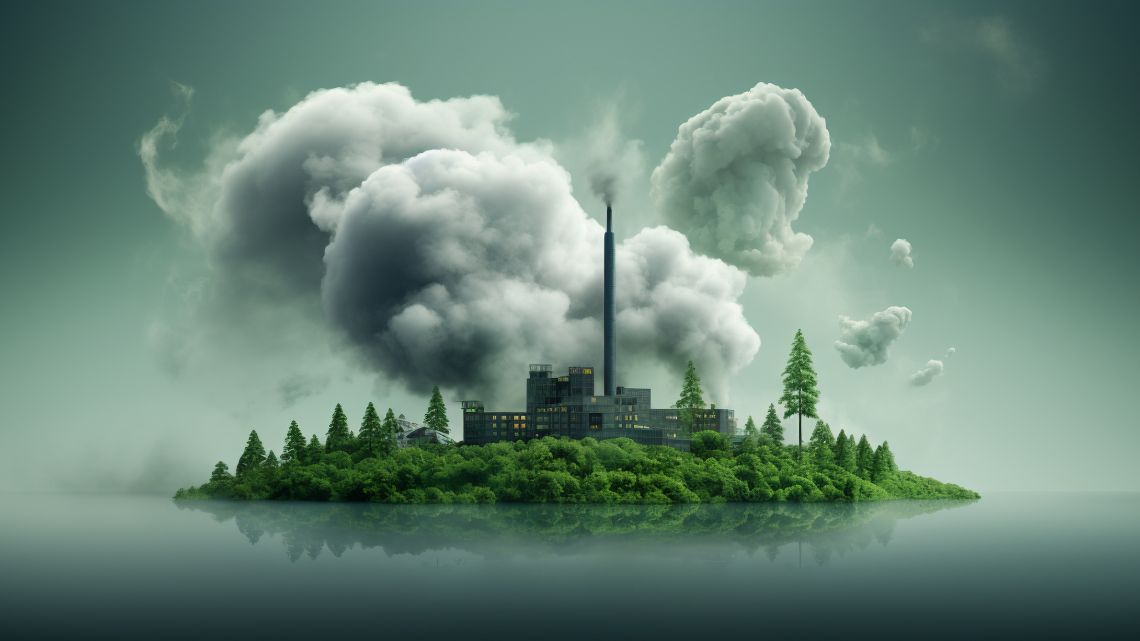
For decades, we have overlooked an opportunity. We committed the folly of treating carbon dioxide as an antagonist of progress, a villain to be incarcerated rather than a resource to be refined and utilized for economic and technological advancement.
When we say this, we are obviously not oblivious to the excess carbon emissions that continuously threaten our planet. Rather, we seek to outline how this environmental waste can be converted and refined into a useful resource.
Let us not constrain our imagination to the insidious effects of carbon emissions. Let’s think beyond the immediate and be guided by a pragmatic and profound idea—grounded in chemistry, economics, and a sober recognition of industrial reality. Even in its most optimistic transition scenarios, the global economy will continue to emit carbon dioxide for decades. Heavy industries like steel, cement, and aviation do not pivot overnight. The question, then, is not only how to reduce emissions but also how to work intelligently with what remains inevitable.
Carbon capture and utilization (CCU) offers one way forward. At its core lies a deceptively simple proposition: intercept carbon dioxide (CO₂) at the point of emission and transform it into something valuable. Carbon capture refers to removing CO₂ from emissions before it enters the atmosphere. Utilization means using that captured CO₂ to make new products. The execution, however, is anything but simple. It requires precise engineering, advances in catalyst technology (substances that speed up chemical reactions), and, above all, economically viable solutions.
Take the example of synthetic fuels. When captured CO₂ is combined with green hydrogen, produced from renewable sources, it is possible to create liquid fuels that behave much like conventional hydrocarbons. These fuels can integrate into existing infrastructure, such as pipelines, engines, and logistics networks, without requiring wholesale replacement. The chemistry is established; the challenge lies in scaling it affordably.
Elsewhere, carbon is finding new expression in materials. Startups and established firms are incorporating captured CO₂ into concrete, where it mineralizes and becomes permanently embedded. The result is not only a reduction in emissions but, in some cases, a strengthening of the material itself. Polymers are also being reengineered to include carbon-derived feedstocks, reducing reliance on virgin fossil inputs.
We have entered an age in which the crucial question is not just how to capture carbon, but how to convert CO₂ into value for industry and society.
Across the globe, the industrial vanguard is rethinking how it uses and values carbon dioxide. In Iceland, geologists are not simply storing CO₂; they are turning it into solid stone, locking emissions into basalt formations where they can remain for centuries. In North America, a new class of “carbon converters” is engineering microbes to consume industrial effluent and excrete everything from aviation fuel to the very polymers in a luxury vehicle’s interior. This is not a niche experiment. It is the advent of a manufacturing paradigm where the smokestack is reimagined as a feedstock.
For global elites—from investors to boardroom leaders—this represents a pivot no less lucrative and consequential than cloud computing.
The circular carbon economy is a framework for creating value from the carbon accumulated rather than following regulations. Captured CO₂ can be combined with green hydrogen to produce fuels or used to make materials such as methanol and polymers. When we cease to view CO₂ as an environmental footprint to be reduced, fixed, or mitigated, we begin to hedge against volatility by reducing our dependence on fresh fossil inputs, limiting exposure to price swings and supply disruptions, and gaining greater control through the reuse of existing carbon.
Yet, it would be misleading to call CCU a panacea. The thermodynamics are unforgiving. Converting a stable molecule like CO₂ into higher-energy compounds demands significant energy input. If that energy is not clean, the equation collapses. Moreover, the economy remains delicate. In many cases, producing carbon-based products from captured emissions is still more expensive than traditional methods.
This is where policy, capital, and corporate strategy all play a role. Measures such as carbon pricing, tax incentives, and procurement commitments can make carbon utilization more commercially viable. At the same time, investors are paying closer attention to transition risks and directing capital toward technologies that deliver both environmental and financial returns. For multinational companies, the focus is shifting from compliance to competitiveness. The ability to valorise emissions may soon distinguish industry leaders from laggards.
What is emerging is not a single solution but a range of approaches—capture, utilize, and store—each suited to different sectors and geographies. In regions with abundant renewable energy, carbon-to-fuel pathways may grow steadily, as seen in the Arabian Gulf, where countries are beginning to explore this shift by leveraging their access to solar energy, existing industrial base, and technology. In contrast, infrastructure-driven economies may place greater emphasis on using carbon in construction materials, where it can be integrated into existing systems. This diversity is not a limitation; it reflects the complexity of the challenge and the different ways it can be addressed.
Countries that rely on hydrocarbons are building new skills to produce fuels, materials, and products from captured emissions. Soon, the advantage will not belong just to those who cut emissions but also to those who use them purposefully.
Humans excel not in restraint but in transmutation. We turned sand into silicon. We turned crude into couture. Now, we must turn our most abundant waste product into the foundation of a durable economy.
Those who act on prohibitions only do not shape the future. Instead, it is built by those who have the audacity to look at a plume of smoke and envision something new—the raw material for a skyscraper, a road, or a second chance.
What we used to call waste is now a resource. What was once a problem can now become an advantage if used wisely.
This shift quietly redefines progress: eliminating waste is not enough—transforming emissions into resources is the new measure of advancement.