
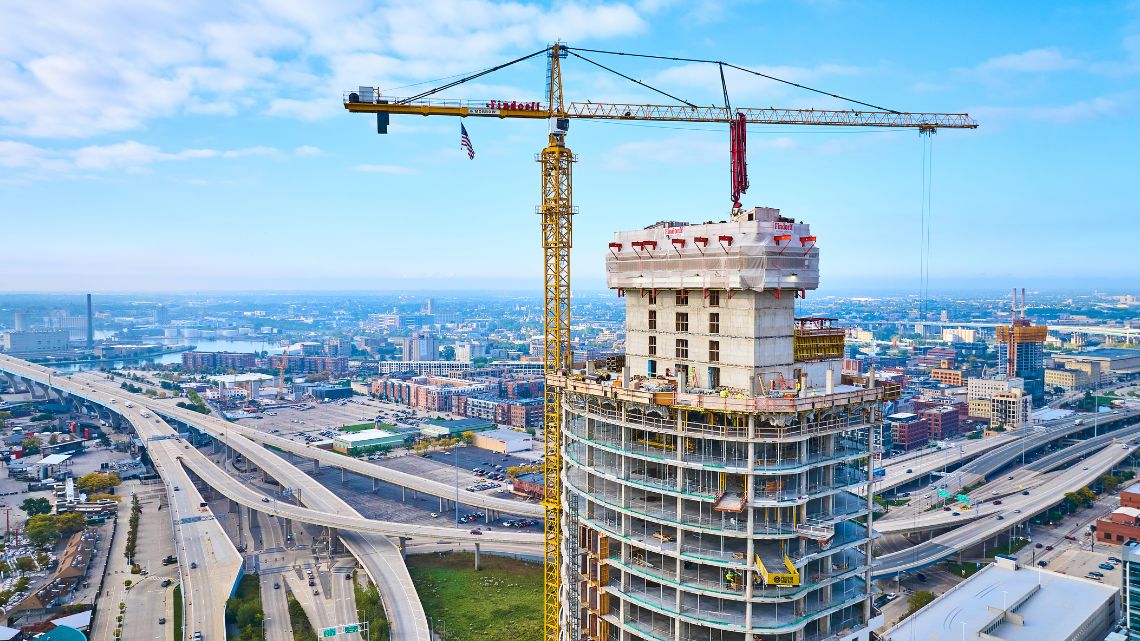
Construction and civil engineering were once practiced on relatively blank canvases. Sites could be cleared, traffic diverted, utilities relocated, and work sequenced with minimal interference from daily life. That context no longer exists in most major cities. Today’s infrastructure projects are executed in environments that must remain operational throughout the construction process. Roads stay open, rail systems run on compressed schedules, utilities cannot be interrupted, and surrounding buildings are sensitive to even minor ground movement.
This shift has fundamentally changed what it means to design and deliver civil infrastructure. Modern construction engineering is no longer defined only by structural adequacy or material performance. It is defined by the ability to build without stopping the city around it.
Urban Construction as a Live System Problem
In dense urban settings, construction sites function as part of a larger, continuously operating system. Traffic networks, drainage, power supply, communication lines, and adjacent structures all impose constraints that influence engineering decisions. The challenge is not simply to construct a bridge, tunnel, or utility corridor, but to do so while maintaining acceptable performance of the surrounding urban fabric.
This reality turns construction sequencing into a core engineering discipline. The order in which loads are introduced, supports are removed, excavations proceed, and temporary works are installed often matters as much as the final design. Poor sequencing can induce differential settlement, overstress temporary elements, or destabilize adjacent structures even when the permanent works are correctly designed.
Temporary Works Are No Longer Temporary Decisions
Historically, temporary works were treated as secondary engineering tasks, delegated late in the design process. In contemporary urban construction, temporary structures frequently govern risk. Shoring systems, temporary retaining walls, traffic decks, and construction-stage load paths must often carry significant forces for extended periods of time. These elements interact with soil and structures that were not designed for construction-induced loading. The distinction between temporary and permanent behavior becomes blurred.
Engineers are increasingly required to analyze construction stages with the same rigor applied to final structures. Temporary work failures now represent a disproportionate share of serious construction incidents, not because designs are inadequate, but because construction-stage behavior is more complex and less forgiving.
Ground Movement as a Limiting Factor
Urban construction often takes place above or adjacent to existing foundations, tunnels, and utilities with limited tolerance for movement. Even small ground displacements can compromise serviceability or trigger costly remediation.
As a result, ground movement control has become a primary design constraint. Excavation methods, support stiffness, and sequencing are selected not to maximize speed, but to minimize deformation. In many projects, allowable ground movement is measured in millimeters, leaving little margin for construction variability. This has driven increased reliance on staged excavation, top-down construction, and real-time monitoring. Civil engineers now design not only for ultimate capacity, but for predictable behavior during every construction phase.
Traffic and Utility Constraints Shape Structural Decisions
Infrastructure construction increasingly occurs beneath or alongside active traffic corridors and utility networks. Shutting down a major road or relocating services may be politically or economically impossible.
These constraints feed back into structural design. Span lengths, support locations, and foundation systems are often chosen based on what can be built without disrupting existing services. Structural efficiency is balanced against constructability under live conditions. In this environment, construction engineering and structural engineering are inseparable. Designs that are optimal on paper may be rejected because they cannot be executed without unacceptable disruption.
The Rise of Monitoring-Driven Construction
One of the most significant developments in modern civil engineering is the integration of instrumentation into construction execution. Settlement markers, inclinometers, strain gauges, and vibration sensors are now standard on complex urban projects.
This data allows engineers to compare predicted behavior with observed performance in real time. When deviations occur, construction methods can be adjusted before problems escalate. Monitoring transforms construction from a fixed plan into a controlled process with feedback. Importantly, this approach acknowledges uncertainty rather than attempting to eliminate it. Urban ground conditions and existing structures are never fully known. Monitoring provides a mechanism to manage that uncertainty responsibly.
Risk Allocation and Engineering Responsibility
Urban construction has also changed how risk is allocated across projects. Owners, contractors, and designers are increasingly aligned around shared performance outcomes rather than isolated scopes of responsibility.
From an engineering perspective, this means greater involvement during construction, not just design. Engineers are expected to engage with sequencing decisions, temporary works, and field conditions. The traditional boundary between design and construction has become porous. This evolution elevates engineering judgment. Calculations remain essential, but interpretation, adaptation, and decision-making under incomplete information are now core competencies.
Sustainability and Construction Impact
Sustainability considerations further complicate urban construction. Noise, dust, vibration, and carbon footprint are no longer secondary concerns. Construction methods are evaluated based on environmental impact as well as technical feasibility.
This influences equipment selection, material logistics, and sequencing. Longer construction durations may be accepted to reduce disruption. Modular construction may be favored to limit on-site activity. Civil engineering solutions increasingly balance structural, environmental, and social performance simultaneously.
Why This Matters Now
Cities worldwide are investing heavily in infrastructure renewal and expansion. Ageing assets must be replaced or upgraded without halting economic activity. At the same time, public tolerance for disruption is declining. This places construction and civil engineers at the center of urban resilience. Their ability to deliver infrastructure while preserving daily function determines not only project success but public trust.
Engineering for Construction Reality
Modern civil engineering cannot be separated from construction reality. Designs that ignore sequencing, temporary conditions, and operational constraints are no longer viable in dense urban environments.
The most successful projects today are those where construction behavior is treated as a design problem from the outset. This requires engineers to think beyond final form and focus on how structures come into being, not just how they stand when complete. As cities continue to grow and densify, the ability to build while the city keeps moving will define the next generation of construction and civil engineering excellence.