
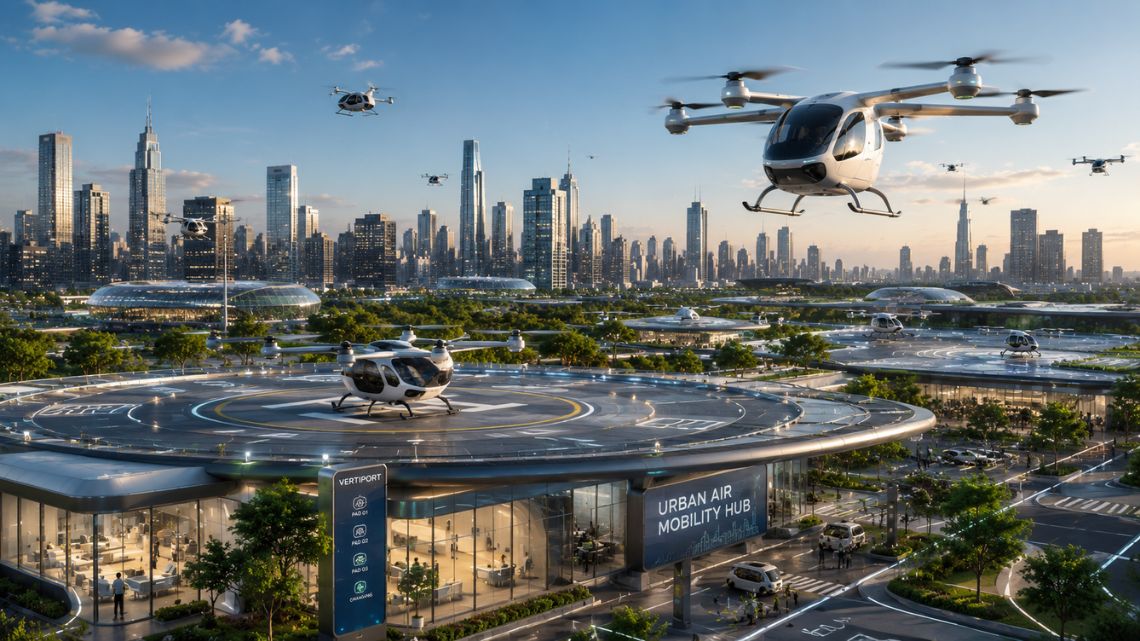
For more than a century, humanity has repeatedly fallen in love with the same impossible promise…
Every generation imagined that one day traffic would simply disappear—not because roads became wider, but because vehicles would quietly lift themselves into the sky. Imagine parallel parking in the air, too. The dream appeared in science fiction novels, then in children’s cartoons, futuristic exhibitions, and finally on the big screen in Hollywood blockbusters. Yet every decade ended the same way: the skies remained full of airplanes, the roads remained full of cars, dreams remained just dreams, and flying taxis continued living comfortably inside tomorrow.
Maybe this dream was simply never ahead of its time, and aerospace engineering simply needed time to catch up with such imagination. The era of proving electric vehicle takeoff and landing (eVTOLs) aircraft can fly is over. In 2026, engineers are racing to solve the true commercialization puzzle: designing aircraft that regulators will certify, cities can support, batteries can sustain, and passengers will feel safe riding in.
Around the world, engineers are quietly transforming urban air mobility from an ambitious vision into one of aviation’s most technically demanding engineering problems. Now that we’re passing major certification hurdles and seeing real-world politics, it’s crystal clear that the real bottleneck isn’t the engineering or the physics; it’s the system itself.
Building the Machine Was the Easiest Part All Along…
An eVTOL is a modern evolution os the helicopter, using electric power for vertical takeoffs and landings. By swapping a single heavy motor for multiple small and quiet propellers, incorporating advanced composite materials, and using automated stabilization flight-control computers, the aircraft achieves highly efficient flight. To get a visual picture of what an eVTOL looks like, take a look at the one-manned flying machine in James Cameron’s famous cinematic series, Avatar.
But designing the aircraft itself is only half the battle. Unlike helicopters, air taxis need powerful motors to lift a heavy vehicle straight up, yet remain highly efficient when cruising forward. Here, engineers face a constant balancing issue: making the aircraft aerodynamic and lightweight while maximizing battery life, cooling, system redundancy, and safety. After all, it’s the ultimate test of bringing many complex systems together in aerospace engineering.
The Weight of Every Watt
Every discussion about the future of flying taxis eventually boils down to one question: “Are our batteries up to the task?” Contrary to a standard EV, an eVTOL can’t just coast to the side of the road when its energy dips. Because the flying taxi requires massive amounts of power to just take off and land vertically, and the heavy batteries needed to achieve this directly eat into payload and range.
In the background, our engineering teams are relentlessly focused on improving battery capacity, cooling, software reliability, and safety. Every kilogram engineers shave off the battery allows direct translation into room for an additional passenger or an extended flight range. The NASA Advanced Air Mobility research program team highlights energy storage as one of the biggest hurdles for electric flight. In the long run, the future of this industry rests just as heavily on battery innovation as it does on aerodynamic design.
Winning the Toughest Approval in Aviation
The true challenge in aviation isn’t assembling the aircraft, but proving it’s safe to fly. Over the years, aerospace engineers push every component—from batteries and propulsion units to flight computers, structural components, and emergency backup systems—to their absolute breaking point. And only after proving that every system performs safely under extreme conditions do regulators finally approve the aircraft for passenger travel.
As the Federal Aviation Administration and global regulators establish safety frameworks for next-generation aircraft, Joby Aviation and Archer Aviation are steadily checking off vital certification milestones. A Business Report International article suggests that winning the air taxi race now depends less on speed and more on proving millions of hours of safe, reliable flight.
The Digital Highways Above Our Heads
While obtaining a flight certification is a major step, navigating congested city skies presents an entirely new challenge. Since thousands of eVTOLs cannot navigate cities by themselves, engineers are designing smart air-traffic networks. This requires seamless, real-time data sharing of location, weather, obstacle, route, and traffic, all while steering clear of existing flight paths.
Moreover, the widespread adoption of urban air mobility depends less on the vehicles themselves and more on the supporting ecosystem—including vertiports, charging infrastructure, communications networks, and digital traffic management. While the flying taxi may steal the spotlight, this comprehensive ecosystem will be the one to determine whether the technology scales efficiently.
The Interconnected Ecosystem Behind Urban Air Mobility
For all one knows, the biggest misconception about flying taxis is that they represent a transportation revolution. In truth, they are actually an infrastructure revolution. Current pilot programs in the U.S. and early commercial launch plans in Dubai prove that governments, regulators, infrastructure developers, and aerospace companies are now building interconnected ecosystems instead of standalone aircraft. Furthermore, a recent LiveScience article on electric vehicles noted how urban air mobility is steadily and rightfully becoming a coordinated transportation network rather than an isolated technological experiment.
For years, flying taxis belonged to artists who imagined what tomorrow would look like. In 2026, this imagination now belongs to aerospace engineers who are patiently solving one certification test, one battery improvement, one flight-control algorithm, and one safety requirement at a time. The greatest breakthrough may not be teaching an aircraft to fly above a city; it may just be teaching an entire city how to safely fly with it.