
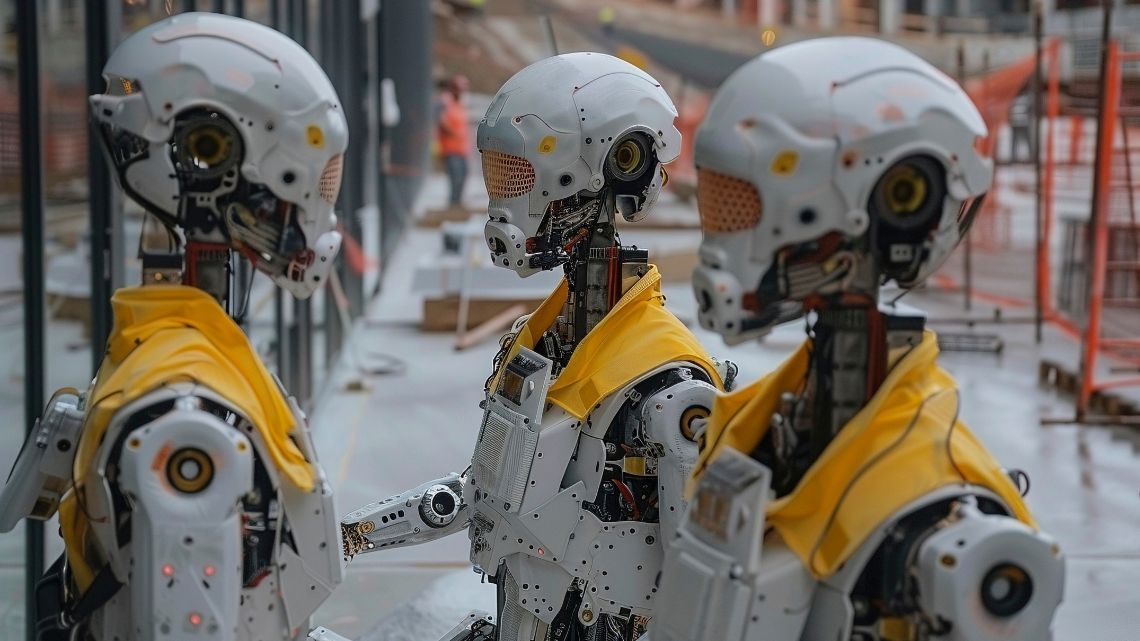
The Algorithmic Architect (Who Thinks They Know Better)
For about a century, building a bridge was a respectable affair. You had your Engineer, your slide rule (eventually a calculator, bless its heart), and a set of sacred, non-negotiable codes (AASHTO, Eurocodes, the works). The process was reliable, rigorous, and proudly conservative. Safety factors weren’t just a recommendation; they were a loving, protective blanket wrapped around the general public.
But now, our trusty engineer has a new, aggressively smart intern: Artificial Intelligence.
This isn’t an intern who just fetches coffee; this is one who designs the entire blueprint while the engineer is still deciding which coffee machine to use. Machine Learning (ML) can churn through a million designs in the time it takes you to explain what a bending moment is, delivering structures that are incredibly light, efficient, and often look like something H.R. Giger designed for a sci-fi museum.
The core promise is dazzling: cheaper, faster, better bridges.
The core problem? When the machine suggests a gravity-defying, spaghetti-like marvel and then spontaneously becomes a pile of rubble years later, who gets the blame? The rise of AI in critical infrastructure means engineers now carry an “ethical load”—a terrifying burden of transparency, equity, and accountability—that is far heavier than any girder.
The Technical Triumph: When the AI Gets a Gold Star
Let’s be fair: AI is amazing at the stuff humans are slow at. It’s like having a hyper-caffeinated math genius on your team who never sleeps and only drinks data. The benefits are impossible to ignore:
Generative Design: Skeletal Masterpieces
AI’s favorite party trick is Generative Design and topology optimization. Instead of the human engineer sketching a truss and checking if it holds up, the AI is just handed the starting block and told, “Go nuts. But make it strong and cheap.” The result is often an intricate, almost biological geometry—structures that are perfectly optimized, using the absolute minimum amount of concrete or steel. It’s the design world’s equivalent of making a five-star meal out of two things you found in the fridge. Efficient, but faintly unsettling.
Data-Driven Resilience: The True-Crime Podcaster of Engineering
Traditional design relies on standard models. AI, however, binges on decades of global infrastructure data (like the National Bridge Inventory), analyzing millions of failures, traffic jams, and geological quirks. It uses this historical trauma to predict precisely what type of bridge will not collapse in its specific location. This gives us designs highly customized for resilience, helping us avoid those “1,000-year” flood surprises that now seem to happen every Tuesday.
Speed and Cost Efficiency: The Unpaid Overtime Machine
In the world of billion-dollar infrastructure, time is money. AI compresses the painful, iterative prototyping phase—the part where you stare at a screen for a week calculating stress points—from months into hours. High-quality, hyper-complex designs that were once budgetary fantasies are now accessible, because the AI is working for free (sort of).
The Core Ethical Challenges: The Party’s Over
The moment we let self-learning systems design structures that carry our lives (literally), we introduce some very serious, very un-funny problems.
The Black Box Dilemma (A.K.A. “Show Your Work”)
The most terrifying issue is the Black Box Dilemma. Modern AI, especially Deep Learning, often works like a brilliant, moody teenager: it gives you the perfect answer, but refuses to show its messy math.
How do you, the Professional Engineer (PE), ethically stamp your highly-coveted seal on a design when the AI cannot explain why it decided a load-bearing column should be shaped like a pretzel? This lack of Explainable AI (XAI) is a license-risking problem. It fuels automation bias, where we become so intimidated by the AI’s genius that we lose the guts (and skill) to question it, even if it suggests an arch made of jello.
The Data Contagion (A.K.A. Structural Discrimination)
AI is just a mirror held up to the data we feed it. And unfortunately, that data is rarely a picture of fairness. If our historical data shows that only wealthy neighborhoods got the nice, heavily-maintained, robustly-documented bridges, the AI is not going to suddenly develop a social conscience. It will simply shout, “Yes, keep building the good stuff for the rich zones!”
This data contagion means algorithmic bias translates directly into inequity in public safety. If the model lacks good data from rural, low-income areas, the designs it suggests for those places might be unsafe or, at the very least, woefully suboptimal.
Accountability Pinball: Who Pays the Bill?
When the fancy new algorithm-designed bridge fails, the chain of accountability looks less like a chain and more like a busted pinball machine. Who is on the hook?
- The Engineer: Did they sign off on a design they secretly didn’t understand? Negligence?
- The Software Vendor: Was there a glitch in the expensive code? Product liability?
- The Data Scientist: Did they use a biased dataset or mess up the parameters? Data malpractice?
Until we have legal and regulatory frameworks that can definitively answer this question, the public is left holding the bag of risk, and the engineer is left holding a very nervous, very expensive pen.
Mitigating the Load: Setting Ground Rules for the Robot
Since we can’t put the genie back in the bottle, we have to teach it some manners. A responsible framework requires embedding human morality back into the machine’s perfect efficiency.
Human-in-the-Loop Oversight: The Designated Adult
The PE is the last line of defense—the Designated Adult. We need to mandate Human-in-the-Loop systems. The AI generates the optimal suggestion, but the human engineer must treat it as a strong recommendation, not gospel. The design must still pass traditional, human-validated checks against established, conservative safety factors. Your professional license depends on your judgment, not the robot’s shrug.
Data Auditing: Inspecting the AI’s Diet
Firms need to become fanatical about Data Auditing. We must continuously check the training data for hidden biases. Is it geographically sound? Does it equally account for materials used in low-budget projects? This means actively re-weighting under-represented data or generating synthetic data to ensure the model doesn’t neglect vulnerable populations or environments. We are actively teaching the AI to be fair, even if the past wasn’t.
Explainable AI (XAI): Installing the Window
No more black boxes for life-safety critical applications. Explainable AI needs to be a mandatory requirement for vendors. Tools must be integrated that force the AI to break down its decision-making into understandable parameters. This turns the black box into a “glass box,” allowing the engineer to not just check the final answer, but validate the reasoning behind it.
Ethical Education: Training the AI Whisperers
Future civil engineers can’t just be structural gurus; they need to be AI whisperers. We must integrate AI ethics and data science literacy into university curricula. They must be trained to recognize the smell of bad data, the danger of automation bias, and the crucial limitations of their high-tech tools.
Human Ethics Are the Ultimate Load-Bearing Structure
The collaboration between human intellect and algorithmic speed is set to redefine every piece of infrastructure built in the next century. AI is the optimal solution-finder, capable of delivering astonishing efficiency.
But never forget: the professional engineer’s core duty is the health, safety, and welfare of the public. Period. AI is a tool, not a colleague with a moral compass. The ethical load demands that we design a system where the AI provides the optimal blueprint, and the human engineer—the one with the license, the experience, and the non-negotiable ethical code—provides the judgment. It’s the only way to ensure that when we drive across that beautiful, minimalist, algorithm-designed bridge, we’re not simultaneously placing a bet on our own survival.