
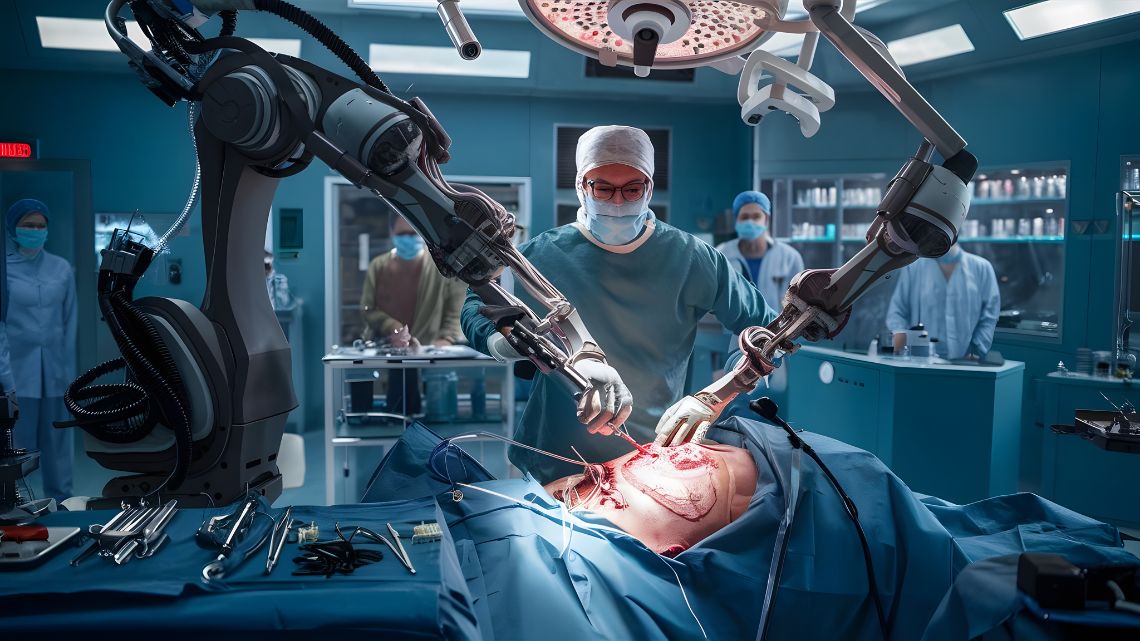
Surgical robotics represents one of the most demanding frontiers of control engineering. Unlike industrial automation, where systems operate in structured environments with predictable dynamics, surgical robots function inside the human body, an environment defined by variability, fragility, and irreversibility. Every movement occurs millimeters from vital tissue. Every delay, oscillation, or unintended force carries consequences that cannot be undone.
At the heart of this discipline lies control engineering, tasked with transforming surgeon intent into motion that is precise, stable, responsive, and safe under all conditions. In surgical robotics, control systems do not merely optimize performance; they safeguard life.
Why Surgical Robotics Is a Control Engineering Problem
At a mechanical level, surgical robots are assemblies of actuators, joints, sensors, and tools. At a systems level, they are real-time control problems operating under strict physical and physiological constraints. The surgeon does not directly manipulate tissue; instead, intent is mediated through layers of computation, signal processing, and feedback control.
Control engineers must ensure that motion remains accurate despite nonlinear dynamics, friction, backlash, time delays, and interaction with soft, deformable biological tissue. Unlike factory robots, surgical systems cannot rely on rigid fixtures or repeatable geometries. The environment changes continuously, and the system must adapt without becoming unstable.
Master–Slave Control Architecture
Most surgical robots operate using a master–slave configuration. The surgeon interacts with a master interface, while robotic arms act as slaves executing scaled and filtered motions inside the patient. Control engineering governs how faithfully and safely this translation occurs.
Motion scaling is critical. Large hand movements are converted into microscopic tool displacements, allowing precision beyond natural human capability. Tremor filtering removes involuntary hand oscillations without introducing perceptible lag. Achieving both simultaneously requires finely tuned control loops that balance responsiveness against stability.
Latency is a central concern. Even small delays can disrupt hand–eye coordination and degrade surgical accuracy. Control engineers design predictive and compensatory algorithms to ensure that the robotic response feels immediate, preserving the surgeon’s intuitive sense of control.
Force Control and the Absence of Touch
One of the defining challenges in surgical robotics is force interaction. Human surgeons rely heavily on tactile feedback to judge tissue resistance, tension, and integrity. Robotic systems, however, often operate with limited or no direct force feedback.
Control engineers address this through impedance and admittance control strategies, regulating how the robot responds to contact forces. The goal is to prevent excessive force application while maintaining sufficient stiffness for precise manipulation. In delicate procedures, the control system may enforce virtual boundaries that limit force regardless of surgeon input.
Some systems attempt to recreate haptic feedback by measuring tools–tissue interaction forces and reflecting them back to the surgeon interface. This requires extremely stable force control loops; any oscillation or amplification can lead to dangerous tool chatter. In this context, control stability is not a theoretical concern, it is a clinical necessity.
Dealing With Nonlinear and Soft-Tissue Dynamics
Biological tissue behaves very differently from engineered materials. It is nonlinear, viscoelastic, anisotropic, and patient-specific. Tissue response varies with hydration, pathology, and surgical history. These properties challenge traditional control models based on rigid-body dynamics.
Control engineers increasingly rely on adaptive and model-based control approaches that update system behavior in real time. Rather than assuming fixed parameters, the controller estimates tissue properties on the fly and adjusts force and motion accordingly.
This adaptability must be carefully bound. Over-aggressive adaptation risks instability, while conservative tuning limits performance. The art of surgical robotics control lies in navigating this balance under extreme safety constraints.
Redundancy, Fault Tolerance, and Safety Control
Surgical robots must assume that components can fail. Sensors may drift, actuators may degrade, and communication links may experience errors. Control systems are therefore designed with redundancy and fault detection as core features.
Safety controllers operate alongside primary motion controllers, monitoring system behavior and intervening when predefined limits are exceeded. These systems can freeze motion, retract instruments, or transition the robot into a safe state within milliseconds.
Unlike industrial environments, surgical systems cannot rely on emergency stops alone. Abrupt halts may themselves cause harm. Control engineers must design graceful degradation strategies that preserve safety without introducing new risks.
Autonomy Under Strict Supervision
While fully autonomous surgery remains limited, partial autonomy is increasingly common. Robots may assist with suturing, camera positioning, or repetitive subtasks. Each increment of autonomy increases the complexity of the control problem.
Supervisory control architectures are used to ensure that autonomous actions remain within surgeon-defined boundaries. The system must recognize when conditions deviate from expected patterns and relinquish control instantly. This layered control structure reflects a broader principle in surgical robotics: autonomy is permitted only where control engineering can guarantee predictable and reversible behavior.
Real-Time Constraints and Verification
Surgical control systems operate under hard real-time constraints. Control loops must execute within guaranteed time windows, often at kilohertz frequencies. Missed deadlines are not performance issues; they are safety hazards.
Verification of these systems extends beyond functional testing. Control engineers must demonstrate stability across the full operating envelope, including worst-case delays, disturbances, and fault scenarios. Regulatory scrutiny demands rigorous documentation and validation of control behavior under all foreseeable conditions.
Industry Influence and System Integration
Commercial surgical platforms, such as those developed by Intuitive Surgical, have driven significant advances in control engineering by integrating mechanical design, sensing, and control into tightly coupled systems. These platforms demonstrate how control decisions influence everything from instrument design to surgeon ergonomics.
As systems become more capable, control engineering increasingly defines competitive advantage—not through speed or power, but through smoothness, predictability, and trust.
Control as the Invisible Surgeon
In surgical robotics, control engineering operates largely out of sight, yet it determines whether robotic assistance enhances human capability or introduces unacceptable risk. The success of these systems depends not on raw computational power, but on disciplined control design that respects the limits of both machines and the human body.
As surgical robots become more prevalent and more intelligent, the responsibility borne by control engineers will only increase. Their work ensures that every movement is intentional, every force is measured, and every action serves the patient’s safety above all else.
In this domain, control engineering is not an abstract discipline. It is the quiet guarantor of precision where error has no margin.