
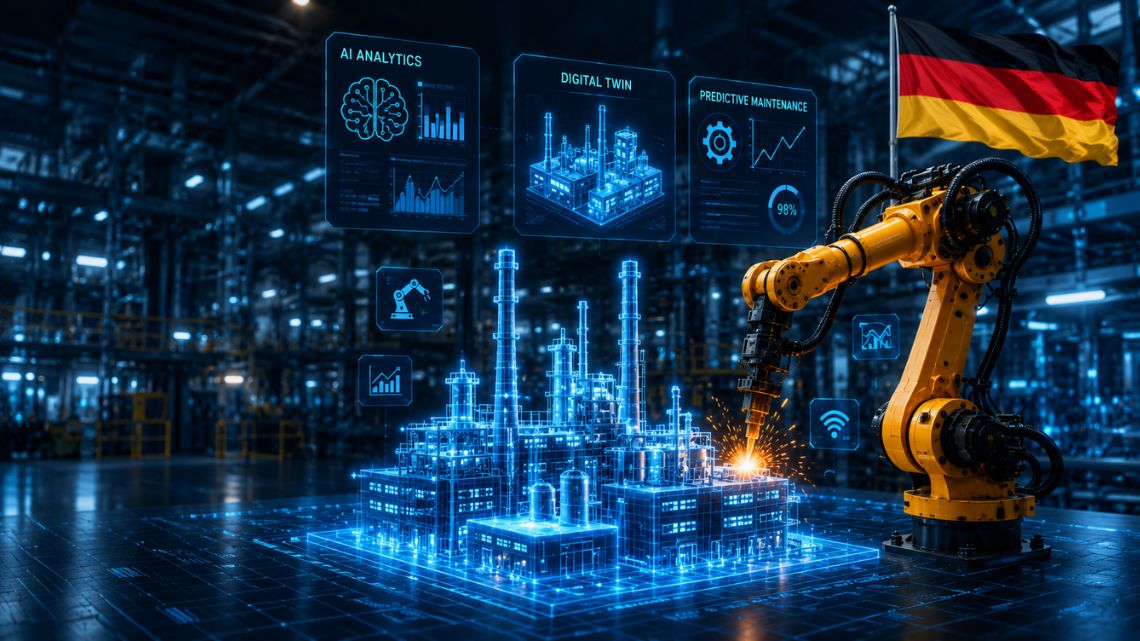
Long before the first physical gear turns or before the first bolt is fastened, a German machine lives a complete, second life behind the scenes. It’s an existence that plays out in the digital world—a simulated sandbox where the design is tested, challenged, and refined. In the space between that virtual model and the final physical metal lies the true heart of Germany’s industrial rebirth: a story where software and intelligence are just as important as steel.
For many a generation, Germany earned its reputation in mechanical engineering through its flawless craftsmanship. Whether it’s producing automotive systems, precision tools, industrial machinery, or factory automation, its manufacturers built products that became the standards rather than simply participating in the market.
In 2026, German engineering finds itself standing at an important crossroads, where rising energy costs, global competition, and supply chain uncertainty have forced even the world’s most respected manufacturers to rethink the very science of precision. Rather than yielding or stepping back, Germany is digitizing its manufacturing sector through Industry 4.0.
The Evolution of German Manufacturing
Industry 4.0 was once described as a network of interconnected machinery. But today, it represents a far broader cyber-physical ecosystem. Now, AI helps production lines predict equipment failures, digital twins test manufacturing processes before their physical assembly, and autonomous robots drive continuous self-optimizing systems.
The 2026 Roadmap on Artificial Intelligence and Machine Learning for Smart Manufacturing research paper reveals how AI is driving toward a new era of industrial operations, central to advanced sensing, predictive maintenance, sustainable manufacturing, digital twins, and supply chain logistics. In all this, one can confidently say that Germany’s competitive advantage has evolved beyond precision engineering; it now lies in combining traditional mechanical excellence with smart manufacturing systems.
The Mittelstand Reinvention
Today’s greatest business revolution isn’t just transforming multinational enterprises; it’s actively redefining the Mittelstand—the closely-knit ecosystem of specialized, family-run German SMEs that have long served as the engine of the nation’s industrial success.
These SMEs combine traditional craftsmanship with smart technology, like automated quality checks, connected machinery, and digital production platforms. Instead of replacing human talent, this hybrid manufacturing approach creates a powerful synergy where experienced engineers collaborate with smart algorithms.
The Machinery and Equipment Manufacturers Association (VDMA) acts as the voice for roughly 3,600 mechanical and plant engineering companies, highlighting both the sheer scale and diversity of Germany’s industrial landscape. For a growing number of these firms, digitization is no longer an innovative perk; it’s now an absolute strategic necessity.
The Virtual Factory Advantage
The digital twin is the true poster child of Germany’s industrial rebirth. For generations, engineers relied on grease, sweat, and physical models to test their limits. But today, they build virtual clones first to track performance, predict equipment failure, and monitor production. By fixing mistakes in the virtual world before they happen in the physical one, factories are quietly eliminating waste, creating sustainable products, and launching them in record time.
Furthermore, research in smart manufacturing shows how digital twins can use live data to improve production autonomously. This redefines the mechanical engineering profession itself, as engineers are now required to build the digital brain that runs the machine during its entire lifetime, rather than just designing the physical parts of it.
Competing in a Tougher World
Germany’s engineering renaissance is not unfolding without pressure. As per Reuters, German machinery exports fell 5% in 2024, reflecting weaker global demand and broader structural challenges facing manufacturers.
Meanwhile, another Reuters report notes that Germany’s robotics and automation industry faces growing pressure from rapidly expanding Chinese manufacturers. This shift forces Germany to accelerate its innovation while protecting its long-standing reputation for quality. That competitive landscape explains why sustainability, automation, and AI have evolved from basic upgrades into strategic survival tactics. German manufacturers now recognize that future market leadership will rely not only on building better machines, but also on building smarter factories.
The Future of German Manufacturing
Germany’s mechanical engineering story has never been about producing the most machines; it has always been about producing the machines other manufacturers depend upon. The principle stays the same, while only the definition of precision has evolved.
In 2026, precision does not end when the machine leaves the assembly line; it continues on through real-time data, connected production, predictive intelligence, and digital feedback that allow every generation of machines to become more capable than the last. Germany is not abandoning its engineering heritage; it’s teaching it how to think.