
Autonomous vehicles have the potential to transform the future of transportation by reducing traffic accidents, improving mobility, and making roads more efficient. Equipped with advanced sensors, artificial intelligence, and real-time decision-making capabilities, these vehicles are designed to operate with minimal or no human intervention. Despite these technological advancements, public acceptance of autonomous driving depends on one fundamental requirement, safety. A self-driving vehicle must continue operating reliably even when faced with hardware failures, software errors, or unexpected environmental conditions.
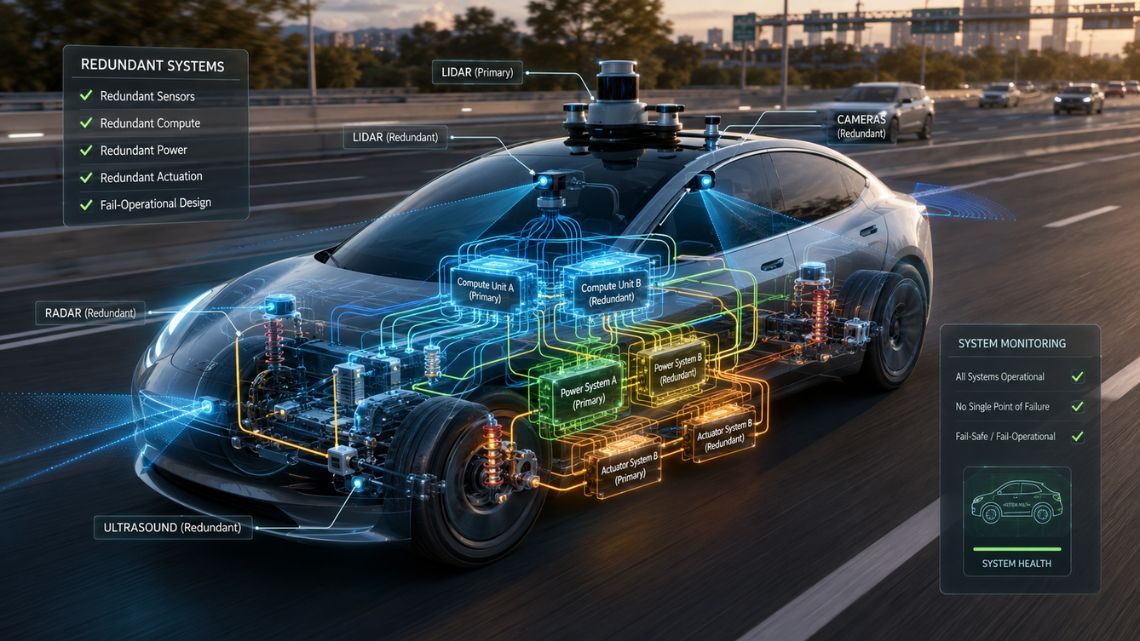
To achieve this level of reliability, engineers employ a design philosophy known as redundancy. Instead of relying on a single component or system to perform a critical function, redundant systems provide multiple layers of backup. If one component fails, another immediately takes over, ensuring that the vehicle remains stable and capable of making safe decisions. This principle has long been used in industries such as aerospace, healthcare, and nuclear energy, where system failures can have serious consequences. Today, it serves as one of the most important foundations of autonomous vehicle engineering.
Building Reliable Perception Through Multiple Sensors
An autonomous vehicle’s ability to navigate safely begins with its perception of the surrounding environment. Unlike human drivers, who rely primarily on vision, self-driving vehicles collect information through a combination of cameras, radar, LiDAR, ultrasonic sensors, and satellite-based positioning systems. Each of these technologies contributes unique strengths while compensating for the limitations of others.
Cameras provide detailed visual information necessary for identifying traffic signals, road markings, and pedestrians. Radar accurately measures the speed and distance of surrounding objects and continues to perform effectively in adverse weather conditions. LiDAR creates detailed three-dimensional maps that allow the vehicle to understand the shape and position of nearby objects with remarkable precision. Ultrasonic sensors assist with close-range obstacle detection, particularly during parking and low-speed manoeuvres.
Rather than depending on a single sensor, engineers combine information from all of them. If heavy rain reduces camera visibility or snow interferes with LiDAR performance, radar and other sensors continue providing essential information. This overlapping capability ensures that no single sensor failure compromises the vehicle’s awareness of its surroundings.
Sensor Fusion Creates a More Accurate Picture
Collecting information from multiple sensors is only part of the solution. Autonomous vehicles must also interpret that information accurately and quickly. This is achieved through sensor fusion, a process that integrates data from different sensing technologies into a unified understanding of the environment.
Advanced algorithms continuously compare information from each sensor, identify inconsistencies, and eliminate inaccurate readings before decisions are made. For example, if a camera incorrectly identifies an object due to poor lighting, radar and LiDAR can verify its presence and location. This constant cross-validation significantly improves the accuracy of object detection, lane recognition, and hazard identification while reducing the likelihood of incorrect decisions. Sensor fusion also enables vehicles to maintain reliable performance across varying weather conditions, road environments, and traffic situations, making it one of the most significant engineering advancements in autonomous driving.
Redundant Computing Ensures Continuous Decision-Making
Autonomous vehicles process enormous volumes of data every second, requiring exceptional computing power. Every driving decision—from steering adjustments to emergency braking, must be made within fractions of a second. To prevent a single processor failure from disrupting vehicle operation, engineers incorporate redundant computing systems.
Instead of relying on one central computer, multiple processors perform the same calculations simultaneously. Their outputs are continuously compared, allowing the system to detect inconsistencies almost instantly. If one processor experiences a fault, another seamlessly assumes control without interrupting vehicle operation.
This architecture greatly improves system reliability and minimizes the risk of failures affecting critical driving functions. Similar approaches have been successfully employed in aircraft flight control systems for decades, demonstrating the effectiveness of redundancy in safety-critical applications.
Reliable Control Systems Beyond Software
Safety in autonomous vehicles extends well beyond sensing and computing. The systems responsible for steering, braking, acceleration, and electrical power must also remain operational under unexpected circumstances. For this reason, engineers incorporate redundancy into the vehicle’s physical control systems.
Electronic braking systems may include independent backup circuits capable of generating braking force even if the primary system fails. Steering mechanisms often feature duplicate actuators that maintain directional control during hardware malfunctions. Multiple power supplies and communication networks further ensure that essential safety functions remain available if one electrical pathway is compromised. These redundant control systems enable the vehicle to maintain stability long enough to perform a safe manoeuvre, such as slowing down or moving to a secure location.
Continuous Monitoring and Intelligent Fail-Safe Responses
Redundant systems are only effective when combined with continuous monitoring. Autonomous vehicles constantly evaluate the health of their sensors, processors, communication networks, and control systems through advanced diagnostic software.
When abnormal behaviour is detected, the vehicle isolates the affected component and continues operating using healthy backup systems. If the failure becomes too significant to guarantee safe driving, the vehicle executes a predefined fail-safe procedure. Rather than stopping abruptly, it gradually reduces speed, activates hazard signals, and moves to a safe location before coming to a controlled stop. This ability to recognise problems and respond intelligently is a defining characteristic of modern autonomous vehicle engineering.
Testing Redundancy Before Vehicles Reach the Road
Redundant systems undergo extensive testing long before autonomous vehicles are introduced into public traffic. Engineers subject vehicles to millions of kilometres of virtual simulations, closed-track evaluations, and real-world road testing.
These tests intentionally expose vehicles to extreme weather conditions, sensor failures, unexpected pedestrian behaviour, and complex traffic situations that may occur only rarely during normal driving. Simulation environments also allow engineers to recreate dangerous scenarios repeatedly, ensuring that backup systems respond consistently under a wide range of conditions. This rigorous validation process helps identify weaknesses early and strengthens the reliability of autonomous driving systems before commercial deployment.
The Future of Autonomous Vehicle Safety
As autonomous vehicle technology continues to evolve, redundant systems will become even more sophisticated. Future vehicles are expected to integrate more advanced artificial intelligence, stronger cybersecurity protections, faster computing architectures, and increasingly resilient communication networks. These developments will further reduce the impact of individual component failures while improving overall system performance.
Engineering safer autonomous vehicles is not simply about making better sensors or more powerful computers. It is about designing systems that continue operating reliably when unexpected challenges arise. Redundancy provides the resilience necessary to achieve this goal, ensuring that autonomous vehicles can respond safely even when individual components do not perform as intended.
The widespread adoption of autonomous mobility will ultimately depend on public confidence. By embedding multiple layers of protection into every critical function, engineers are creating vehicles capable of earning that trust and delivering a safer, more dependable future for transportation.