
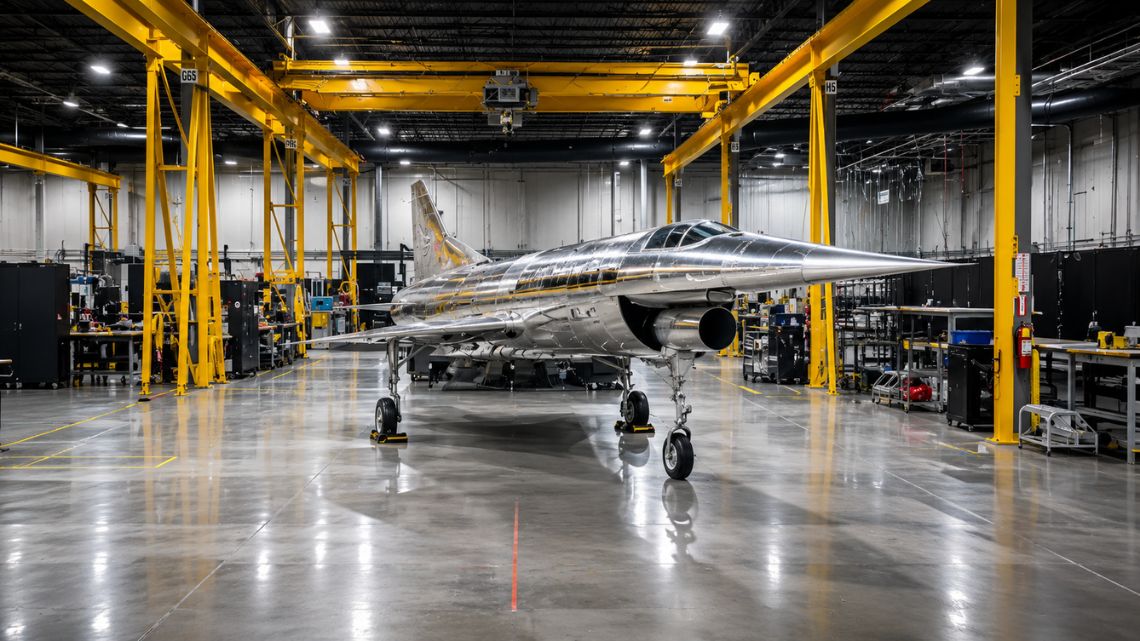
There exists a certain speed beyond which the sky parts and quietly withdraws its cooperation.
Long before engines roared, mankind learned to fly by reading and listening to the subtle whispers of the wind. The fundamental forces of flight served as humanity’s introduction to the skies. As generations of engineers dared to stretch these natural limits, aircraft eventually broke through the sound barrier, transforming old myths into modern reality.
Welcome to Mach 5, where aerospace engineering is no longer a contest against gravity alone, but against physics itself. Here, air compresses into walls of heat, shockwaves collide, temperatures soar high enough to threaten the aircraft itself, and every surface becomes part of an unforgiving physics experiment. Long before a vehicle reaches the edge of space, the sky has already become its greatest adversary yet.
In 2026, the aerospace race has evolved from a simple chase of speed into a battle for survival against extreme forces of nature. Across the globe, engineers are redesigning materials, aerodynamics, and thermal protection to endure the brutal realities of modern flight.
Where Speeds Rewrites Aerodynamics
Breaking the sound barrier revolutionized aviation, and crossing Mach 5 redefined physics itself. The U.S. National Aeronautics and Space Administration defines hypersonic flight as exceeding five times the speed of sound, a threshold at which airflow behaves according to entirely different physical laws than those of standard supersonic travel.
Rather than a harmless void, the atmosphere becomes a volatile rival for hypersonic engineers. They must master blistering shockwaves, erratic pressure spikes, and molecular dissociation. At these speeds, an aircraft stops navigating the sky and begins a violent battle for structural survival.
The Battle Against Heat
One of the greatest challenges in hypersonic flight is not generating thrust, but surviving the resulting heat produced. At speeds exceeding Mach 5, friction can raise surface temperatures to over 1,000℃, posing a threat to the aircraft’s structural integrity. As per NASA again, thermal protection technologies and atmospheric re-entry are utmost critical for high-speed flight today.
Our aerospace engineers overcome such extreme environments using cutting-edge titanium, carbon-carbon materials, ceramic matrix composites, and ultra-high-temperature ceramics. They maintain structural integrity by enduring rapid cooling, harsh mechanical stress, and repeated thermal explosions where conventional materials fail.
Designing Engines for Extreme Flight
While traditional jet engines perform exceptionally well at conventional speeds, hypersonic flight requires an entirely different propulsion approach. Global research organizations across the U.S., Japan, Europe, and Australia are presently leading the way in air-breathing propulsion systems tailored for extreme Mach numbers.
The European Space Agency notes that sustained hypersonic flight requires propulsion systems that withstand intense thermal stress while maintaining stable airflow through the engine. For aerospace engineers, this means executing propulsion with strict precision. As air rushes through the engine in milliseconds and temperatures spike, combustion must remain perfectly stabilized despite conditions that defy conventional engineering assumptions.
Testing Physics Before Reality Does
Before a hypersonic vehicle takes off from the ground, they fly thousands of digital missions. Engineers now use computational fluid dynamics, AI, and digital twins in dedicated spaces alongside wind-tunnel testing to simulate extreme flight environments, making continuous improvements to physical prototypes much easier.
NASA and several other international aerospace agencies rely heavily on high-performance computing to evaluate structural integrity, airflow, and thermal dynamics. Today, aircraft development does not begin with building physical models that get to experience the runway; before anything at all, they begin with multiple, advanced virtual simulations.
The Technologies That Reach Beyond Mach 5
The pursuit of hypersonic flight pushes boundaries far beyond speed. These breakthroughs are laying the groundwork for reusable spacejets, orbital re-entry crafts, and point-to-point intercontinental travel. Additionally, the heat-resistant materials and precision simulations originally developed for extreme flight are rolling upgrades in commercial aviation, spacecraft, and modern satellite technology.
Now, agencies like ESA, NASA, the Japan Aerospace Exploration Agency, and other global private aerospace sectors are investing heavily in technologies that enable humanity to travel and work safely at extreme speeds.
The Sky Was Never the Finish Line
High-speed flight today proves that engineering trumps the once impossible. The greatest barrier is no longer gravity, but the unpredictable mix of pressure, heat, and aerodynamics unleashed when pushing aircraft beyond atmospheric limits.
Aerospace engineers in 2026 are doing something far grander than chasing Mach 5; they are reimagining humanity’s relationship with the skies. Innovations in materials and propulsion are turning the high-pressure environment of hypersonic flight into standard practice. This is because at Mach 5, building the aircraft is only half the battle; the rest is mastering the atmosphere itself.