
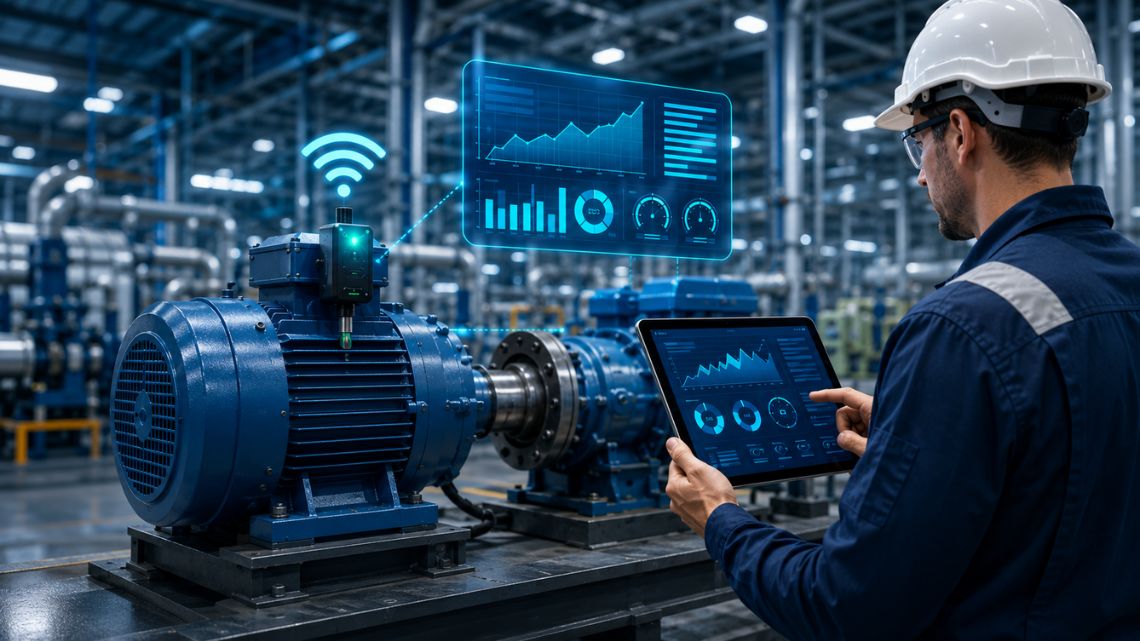
For decades, industrial maintenance ran on one of two philosophies: fix it when it breaks, or fix it on a fixed schedule, whether it needs it or not. Both approaches sound reasonable until you put a price tag on them. A single hour of unplanned downtime on a production line can cost a manufacturer anywhere up to $260,000, and the average plant racks up roughly 800 hours of downtime a year. Multiply that out, and “we’ll fix it when it breaks” starts to look like one of the most expensive habits in industry. That’s the gap Predictive Maintenance is closing—and it’s doing so faster than almost anyone predicted even a couple of years ago.
Powered by Artificial Intelligence (AI), Industrial Internet of Things (IIoT) sensors, cloud computing, and advanced analytics, Predictive Maintenance (PdM) is helping organizations move from reacting to equipment failures to anticipating them before they happen. The result is a fundamental shift in how factories, power plants, oil refineries, logistics hubs, and manufacturing facilities operate.
The $1.4 Trillion Cost of Downtime
As factories become more automated and production schedules more tightly optimized, the cost of unexpected equipment failures continues to rise. According to Siemens’ 2024 True Cost of Downtime report, the world’s 500 largest companies lose an estimated $1.4 trillion annually due to unplanned downtime—equivalent to roughly 11% of their revenues. Automotive manufacturers are particularly vulnerable, with downtime costs averaging around $2.3 million per hour, the highest among the industries surveyed.
What makes these losses particularly concerning is that major disruptions rarely begin as major problems. More often, they start with small warning signs that go unnoticed—a bearing vibrating slightly beyond normal levels, a pump seal beginning to wear, or a motor consuming more power than expected. On their own, these issues may appear insignificant. Left unchecked, however, they can escalate into equipment failures that halt production and disrupt entire operations. The consequences extend far beyond the maintenance department. Unplanned downtime can leave workers idle, delay shipments, disrupt supply chains, increase energy waste, and trigger costly recovery efforts. In highly interconnected manufacturing environments, a single point of failure can bring an entire production line to a standstill.
Why Traditional Maintenance Is Reaching Its Limits
For much of the last century, preventive maintenance was considered the most effective way to improve reliability. Rather than waiting for equipment to fail, companies performed inspections and component replacements at fixed intervals. Compared to reactive maintenance, it was a significant improvement. But the problem is that machines do not follow calendars.
Two identical motors installed on the same day can experience entirely different operating conditions. One may run continuously under stable loads, while the other faces frequent starts and stops, contamination, vibration, and temperature fluctuations. Treating both assets identically often results in either unnecessary maintenance or unexpected failures. This is where predictive maintenance changes the equation. Rather than relying on assumptions about asset condition, engineers can increasingly measure it directly. Vibration signatures, thermal patterns, lubricant condition, electrical characteristics, and process variables provide clues about how equipment is actually performing. The results can be significant. McKinsey estimates that predictive maintenance can reduce machine downtime by 30–50%, and increase equipment life by 20–40%.
Transforming Production Operations
The most significant impact of predictive maintenance may not be on maintenance itself—it is on production. Manufacturers invest heavily in production planning, scheduling, automation, and process optimization. Yet all of those efforts depend on one assumption: the equipment will be available when needed. Unexpected failures undermine that assumption. By reducing unplanned downtime, predictive maintenance creates greater operational stability. Production schedules become more reliable, delivery commitments become easier to meet, and facilities can operate with greater confidence. According to Siemens, full adoption of condition monitoring and predictive maintenance practices across Fortune Global 500 industrial organizations could generate approximately $388 billion in value through a 5% increase in productivity. Much of that value comes not from reducing repair costs but from increasing asset availability and improving operational continuity. For manufacturers, reliability effectively becomes additional production capacity. In many cases, the cheapest way to increase output is not purchasing new equipment; it is ensuring existing equipment remains operational.
Changing How Maintenance Teams Work
Predictive maintenance is also reshaping the role of maintenance personnel. Traditionally, maintenance teams spend a considerable portion of their time responding to emergencies. Equipment fails unexpectedly, technicians are called in, production stops, and resources are diverted toward urgent repairs. This approach is both costly and disruptive. Siemens reports that mature predictive maintenance programs can improve maintenance workforce productivity by up to 55%. By identifying issues before they become emergencies, organizations can schedule interventions during planned maintenance windows rather than reacting to failures after they occur. The difference may appear operational, but its impact is strategic. Planned maintenance typically requires fewer resources, causes less disruption, improves worker safety, and allows maintenance teams to focus on higher-value activities. Instead of constantly fighting fires, technicians can concentrate on improving asset performance.
The Technologies Making It Possible
Three forces are making predictive maintenance more accessible than ever: smarter sensors, edge and cloud computing, and advances in AI. Industrial-grade vibration, thermal, and current sensors have become affordable enough to deploy across entire fleets of equipment rather than only the most critical assets. Vibration monitoring, in particular, has become a cornerstone of predictive maintenance. Changes in vibration patterns can often reveal wear, imbalance, misalignment, and bearing faults long before a failure occurs, making rotating equipment an ideal starting point for many programs.
At the same time, edge computing and cloud analytics have made it possible to process and analyze equipment data at scale. Data can be evaluated closer to the machine while cloud platforms aggregate information across multiple facilities, providing a broader view of asset performance.
AI is providing the final piece. As models learn from larger volumes of operational data, they become more effective at identifying patterns associated with equipment degradation and failure. This is expanding predictive maintenance beyond rotating equipment into more complex assets, including robotic systems, electrical infrastructure, and automated production lines.
Challenges and Limitations
Despite its benefits, predictive maintenance is not a plug-and-play solution. Many industrial facilities still rely on legacy equipment that was never designed for continuous monitoring, making data collection and integration challenging. The quality of predictions also depends heavily on the quality of the data being collected. Inaccurate sensor readings, insufficient historical failure data, and poorly configured analytics models can lead to false alarms or missed failures. Additionally, implementing predictive maintenance often requires significant investment in infrastructure, training, and organizational change before meaningful returns can be realized.
The Takeaway
As industrial operations become more automated and interconnected, equipment reliability is becoming increasingly critical to productivity. Predictive maintenance gives organizations a way to address problems before they escalate into costly disruptions. While implementation still presents technical and organizational challenges, the direction is clear: maintenance is becoming more data-driven, more proactive, and more closely tied to operational performance than ever before.