
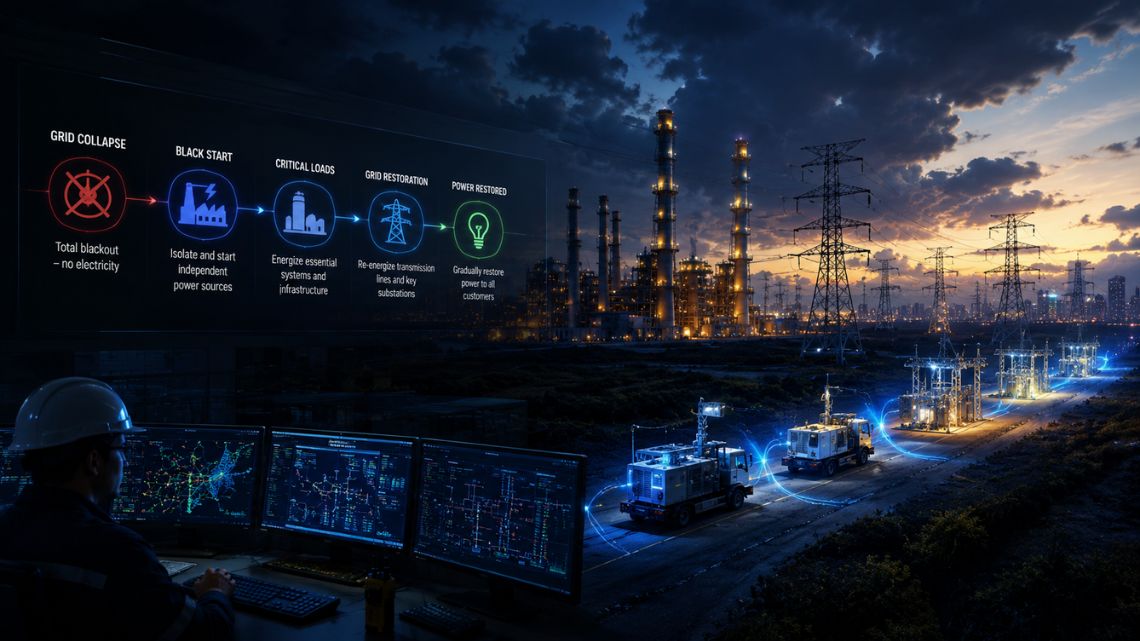
When power systems operate as intended, their complexity is largely invisible. Electricity flows continuously through transmission networks, substations regulate voltage, and generation units respond dynamically to changing demand. Reliability is measured by consistency, the expectation that power will remain available whenever it is needed. But what happens when an entire grid loses power?
Large-scale blackouts are often discussed in terms of their immediate social and economic consequences. Far less attention is given to the engineering challenge that follows: restoring a power system that has no power available to restart itself. This process, known as black start, represents one of the most complex and strategically important disciplines in power engineering.
Why Power Systems Cannot Simply Be Switched Back On
Unlike smaller electrical systems, large interconnected grids cannot be restarted simultaneously. Most power generation facilities require electricity to operate essential equipment such as pumps, cooling systems, control units, and auxiliary drives.
Under normal conditions, this electricity is drawn directly from the grid itself. During a total grid collapse, however, that source disappears. This creates a fundamental problem. The infrastructure responsible for generating electricity depends on electricity to function.
Black start engineering addresses this challenge by establishing carefully planned pathways for restoring power incrementally, allowing generation assets and transmission systems to return to operation in a controlled sequence.
The Role of Black Start Units
At the center of any restoration strategy are black start-capable generating units. These facilities possess the ability to initiate operation without relying on external grid power.
Hydroelectric facilities have traditionally played an important role because they can often be restarted rapidly using local energy sources. Certain combustion turbines and diesel generators also provide black start capability due to their operational flexibility.
Once operational, these units energize selected transmission corridors and provide the auxiliary power needed to restart larger generating stations. The process resembles rebuilding an ecosystem from a few surviving components rather than activating an entire network at once.
Restoration as a Sequential Engineering Process
Black start procedures follow carefully defined sequences. Power restoration is conducted gradually to maintain system stability and prevent additional failures. Transmission lines are energized in stages. Critical substations are brought online selectively. Generation capacity is increased progressively as system demand grows.
A key challenge lies in maintaining the balance between supply and demand throughout the process. Excess generation can destabilize frequency just as readily as insufficient generation.
Unlike routine grid operations, where thousands of interconnected components provide stability through scale, black start conditions involve a relatively fragile system operating with limited reserves. Every restoration decision carries system-wide implications.
Renewable Energy and Emerging Challenges
The changing composition of power systems is introducing new considerations into black start planning. Traditional restoration strategies evolved around large synchronous generators such as coal, gas, and hydroelectric facilities. Many renewable energy technologies operate differently.
Solar and wind installations often rely on external voltage references and inverter systems that were not originally designed for independent grid restoration. As renewable penetration increases globally, engineers are exploring methods to integrate these technologies into black start capabilities.
Grid-forming inverters, advanced battery storage systems, and hybrid restoration architectures are emerging as potential solutions. The transition toward cleaner energy systems is therefore reshaping one of the oldest operational challenges in power engineering.
The Importance of Communication and Coordination
Black start is not solely a technical process. It requires extensive coordination among control centers, generation operators, transmission providers, and field personnel.
Communication systems themselves must remain operational under blackout conditions. Backup power systems, redundant communication pathways, and emergency procedures become essential components of restoration planning.
Human decision-making also plays a critical role. Operators must continuously assess system conditions, modify restoration sequences, and respond to unexpected developments. Engineering resilience depends as much on procedural preparedness as it does on physical infrastructure.
Simulation and Training in Modern Restoration Planning
Because large-scale blackouts occur infrequently, restoration expertise cannot rely solely on operational experience. Simulation environments have become increasingly important tools for preparing engineers and operators. Restoration scenarios allow teams to evaluate procedures, identify vulnerabilities, and refine decision-making processes without placing actual infrastructure at risk.
Digital modeling also enables planners to assess how evolving grid conditions influence restoration capability. As power systems become more interconnected and technologically diverse, simulation-based preparedness is becoming an essential aspect of black start engineering.
Operational Relevance
Recent years have highlighted the vulnerability of energy infrastructure to extreme weather events, cyber threats, equipment failures, and operational disruptions. While large-scale blackouts remain relatively uncommon, their consequences have become more significant as societies grow increasingly dependent on uninterrupted electricity.
Hospitals, telecommunications systems, transportation networks, water treatment facilities, and digital infrastructure all depend on reliable power availability. Black start capability therefore represents more than a technical contingency. It forms part of the broader resilience strategy supporting modern economies.
System-Level Perspective
Black start engineering offers an important reminder that infrastructure reliability is defined not only by how systems operate under normal conditions, but by how effectively they recover from disruption. The discipline requires engineers to think beyond efficiency and generation capacity toward restoration pathways, operational flexibility, and system resilience.
As energy systems continue to evolve, the ability to restart complex networks following widespread failure will remain a critical engineering capability. Power systems are often judged by their ability to avoid outages altogether. Yet their true resilience may ultimately be measured by something else entirely: how effectively they return when the lights go out.