
There was a period when a farmer would walk the length of his field, kneel into the soil, crumble it between his fingers, glance toward the horizon, and make a decision that could determine an entire season.
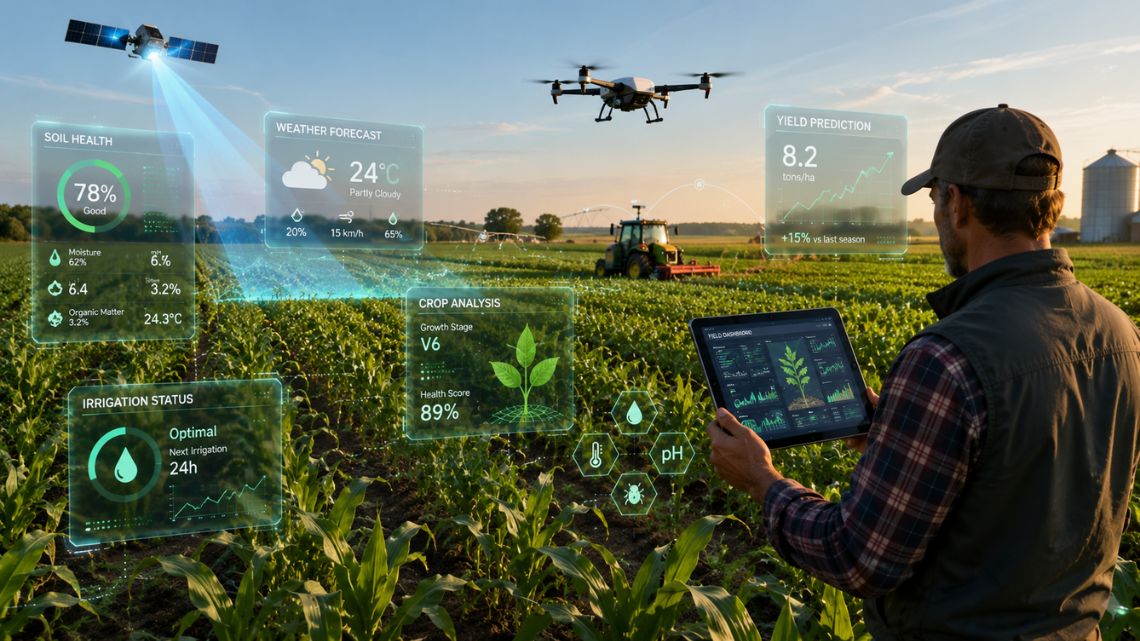
Today, those same fields tell the world of their own stories, but through a chorus of orbiting satellites, deep-soil sensors, hovering drones, and real-time algorithms. 2026 transforms agricultural engineering from simply growing crops to translating complex data into immediate action. And at the center of that information stands precision agriculture.
Farming One Meter at a Time
Traditional farming often treats entire fields as uniform environments. But today, agronomists know of a different reality. Crop health, Soil moisture, pest activity, and nutrient levels can differ greatly across even a single hectare of farmland. As the United Nations Food and Agriculture Organization states, because agriculture consumes nearly 70% of the world’s freshwater, maximizing water efficiency is an immediate, top-tier priority.
Agricultural engineers tackle this by building systems that monitor farm conditions with extreme precision. Rather than a blanket approach to water and fertilizer, modern farms apply resources exactly where necessary. And the result is pure precision, not just efficiency.
Monitoring Agriculture from Earth’s Orbit
Modern farms are no longer defined by just fences and irrigation pipes. Satellites help to keep a continuous track of soil quality and crop growth across vast tracts of land. And by using vegetation indices, farmers identify crop stress long before the human eye ever could.
In addition to that, the European Space Agency’s Earth observation programs also continue to provide agricultural monitoring data, helping farmers identify emerging problems earlier and make faster, more informed decisions. A field that took days to manually inspect now takes minutes. The hurdle for today’s agricultural engineers is not about collecting data, but interpreting it to maximize crop output and minimize resource loss.
Making Every Drop of Water Count
It is a no-brainer that water is one of agriculture’s most valuable resources. It is also a known fact that aeons of climate change cause global uncertainty in rainfall and water supplies. To solve this, engineers use connected irrigation lines, soil-moisture sensors, and automated control networks on their farms. These systems measure real-time data to irrigate crops. And instead of following fixed schedules, farms now adapt accordingly to actual plant needs.
To be specific about soil-moisture sensors, these systems allow farmers to cut water use while maximizing harvests. For engineering teams, protecting natural reserves is a win for the environment and a masterclass in design—a true win-win scenario.
The Smartest Tool in the Modern Farm
Artificial intelligence has become one of the newest tools in the agricultural engineer’s toolbox. Advanced platforms work with data from weather forecasts, satellites, historical crop performance, machinery, and sensors simultaneously. These systems help predict disease outbreaks, optimize fertilizer application, and identify production risks before they go haywire.
Farming used to rely completely on one’s gut feeling, but now 24/7 predictive AI is here to lend a hand. The goal is not to replace our farmers, but to give them the best tools possible to make smart choices.
Agriculture’s Next Great Challenge
Precision agriculture prepares us for future obstacles and not for efficiency alone. As per UN reports, feeding a population of 9.7 billion by 2050 puts extreme pressure on global agriculture. In view of this, engineers are innovating to boost crop production while using significantly fewer resources.
Agricultural engineers are designing systems that combine satellite intelligence, sensors, automation, and data analytics into a single operational ecosystem. The field itself has not changed, and crops still grow from soil, water, sunlight, and time. What’s new is our newfound clarity regarding these variables.
In 2026, precision agriculture is less about adopting new machines and more about embracing a new agricultural ethos. It is a philosophy where every input is meticulously quantified, and every harvest benefits from seeing the unseen.