
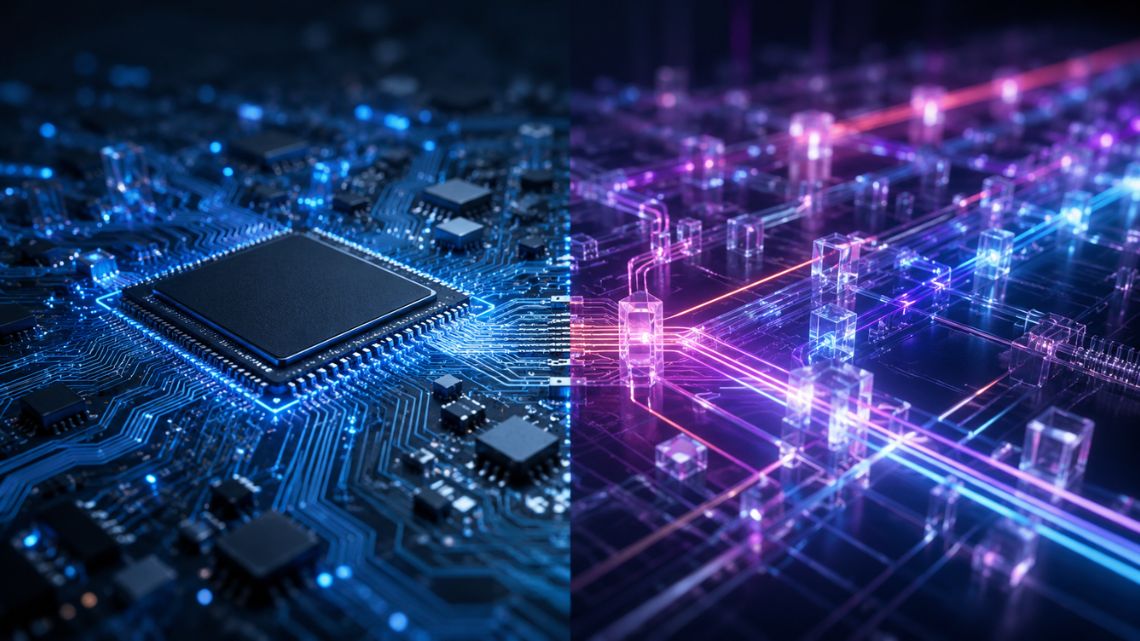
If you listen to the software evangelists tell it, artificial intelligence is an infinite, gravity-defying escalator. We just need to keep piling parameters into our models, write slightly smarter algorithms, and watch the digital brains scale to godhood. It’s a clean, friction-free narrative that treats silicon microprocessors as magical, infinitely scalable black boxes. It’s the kind of PowerPoint optimism that thrives in venture capital boardrooms where the laws of physics are treated as minor inconveniences to be solved by the next software patch.
But if you talk to the systems engineers who actually have to wire those AI servers together, they will tell you we are staring at a massive, solid-metal ceiling. And that ceiling is made of copper.
For the last seventy years, computing has been a game of routing electrons through metal. We’ve done this incredibly well, packing billions of microscopic copper wires onto silicon chips. But we have officially hit the end of the physics runway. We cannot push electrons any faster or pack those wires any closer together without the whole system turning into a very expensive, melting space heater.
If we want the computing revolution to survive, we have to stop trying to push more electrons through copper. We need to start routing light.
The Red Light on the Motherboard
To understand why our chips are choking, you have to look at the unglamorous world of “interconnects”—the microscopic copper traces that carry data between the processor, the memory, and the rest of the motherboard.
When you run a modern AI workload, the processors themselves are incredibly fast. But they spend a massive, humiliating amount of time idle, waiting for data to crawl across the copper traces from the memory chips. In the industry, this is known as the Memory Wall or the Interconnect Bottleneck. Running a high-density AI cluster on copper traces is the systems equivalent of buying a million-dollar hypercar and driving it through a crowded school zone. You have all this raw, theoretical horsepower, but you are completely limited by the physical congestion of your infrastructure.
Why can’t we just turn up the clock speed of the copper? Because of the brutal reality of electromagnetic resistance.
As you push more data through a copper wire at higher frequencies, the electrons crowd toward the outer edge of the wire—a phenomenon called the Skin Effect. This drastically increases resistance, which generates heat. If we try to push the data speeds any higher, the copper wires generate so much thermal waste that they would literally melt the silicon surrounding them. We are paying a massive, non-negotiable “heat tax” just to move data a few millimeters across a circuit board. We’ve optimized the math of the software, but we are losing the war against the thermal conductivity of metal.
The Optical Hack: Silicon Photonics
This is where optical systems engineering enters the room with a solution that sounds like science fiction: Silicon Photonics.
Instead of using electrons to carry data through metal, silicon photonics uses photons (light) to carry data through microscopic glass tunnels called waveguides etched directly into the silicon.
Photons are the ultimate data messengers. Because they have no mass and no electric charge, they don’t experience electromagnetic resistance. You can pack hundreds of different wavelengths of light into a single microscopic channel without them interfering with each other—a trick called wavelength division multiplexing. This means you can move a staggering volume of data at the speed of light, with virtually zero heat generation and zero signal degradation.
To the uninitiated, putting lasers and fiber optics onto a microchip sounds like an over-engineered nightmare. But look at the systems-level math. A single silicon photonic link can carry up to one hundred times the data of a copper connection of the exact same size. Furthermore, because light doesn’t generate resistance heat, you slash the data center’s cooling bill by up to 30%. You are no longer wasting megawatts of power just to fight the thermal limits of metal wires. You are letting the physics do the heavy lifting.
The Engineering Nightmare: Gluing Light to Silicon
If the physics of light is so perfect, why aren’t all our computers already optical? Because manufacturing this stuff is an absolute metallurgical and mechanical horror show.
Silicon is fantastic for routing light, but it is chemically incapable of generating light. In the language of materials science, silicon is an “indirect bandgap” semiconductor. If you run electricity through it, the excited electrons release their energy as heat, not photons. It’s a great thermal conductor, but a terrible light bulb.
To get light onto a chip, you need a laser made from different materials, typically gallium arsenide or indium phosphide. But you can’t easily grow those materials on a standard silicon wafer; their atomic grids don’t align, creating structural flaws that ruin the chip. It’s like trying to puzzle together pieces from two completely different jigsaw sets.
For years, the only solution was to build the laser separately and try to physically align it with the silicon waveguide using robot arms. But when you are dealing with wavelengths of light measured in nanometers, even a microscopic vibration or a tiny temperature shift can throw the laser out of alignment, breaking the data stream. It’s like trying to shoot a laser pointer through a keyhole from a mile away while standing on a trampoline.
Startups like Ayar Labs and Lightmatter are cracking this by designing Co-Packaged Optics (CPO). Instead of trying to grow lasers on silicon, they are using advanced packaging techniques to “glue” the laser chips directly onto the main processor substrate with sub-micron precision, using specialized polymer waveguides that can bend light around tight corners without losing the signal. It is a masterpiece of mechanical alignment, turning a physics bottleneck into a packaging victory.
The Business Case: The Latency Moat
For the tech entrepreneur and the hardware investor, the transition to optical computing is the ultimate scalability play.
In the AI gold rush, power and latency are the absolute constraints. The companies that win the next era of computing won’t be the ones with the flashiest software; they will be the ones who can run their neural networks with the lowest latency and the smallest power bill.
By replacing copper interconnects with silicon photonics, you don’t just speed up a single chip; you redesign the entire architecture of the data center.
In a traditional setup, your processor and your memory have to be physically crammed close together on the motherboard to prevent signal delay. This creates massive “hot spots” that are incredibly hard to cool. With optics, you can place your memory banks thirty feet away in a separate rack, connected by fiber optic cables, and the processor won’t notice a single millisecond of latency.
This is the Disaggregated Data Center. It turns the server room from a rigid collection of individual boxes into one giant, fluid pool of computing resources. You can upgrade your memory or swap out your processors independently, without throwing away the whole server. It’s a modular, hyper-efficient architecture that completely rewrites the economics of cloud computing.
Conclusion: Atoms Must Make Way for Photons
The tech world has spent the last decade acting as if every hardware bottleneck can be solved with a clever compiler, a better virtualization layer, or another round of venture funding. But the physical reality of copper is a cold reminder that the laws of electromagnetism do not care about your software’s valuations.
We cannot run a 21st-century, optical-speed AI civilization on a 19th-century telegraph infrastructure. The “Silicon Ceiling” is the ultimate reality check for the digital boom. The hardware startups that will dominate the next era of tech are the ones abandoning the electron entirely, grabbing the lasers, and learning how to route the future at the speed of light.
Put away the copper wire. Turn the lasers on. The era of the photon has begun.