
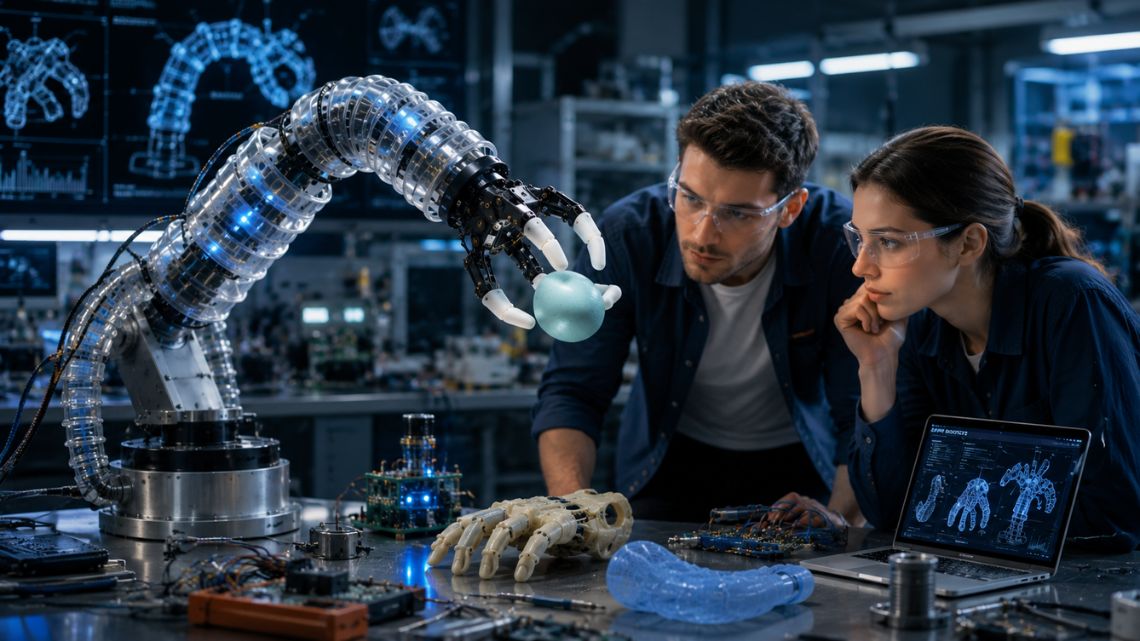
For many centuries, mechanical engineering has drawn inspiration from nature. Engineers religiously studied wings to build aircraft, fish to design submarines, and bones to understand structures. In 2026, that relationship is deepening. Instead of merely observing the natural world, engineers are now adopting its biological instincts.
Soft robotics is turning traditional mechanical engineering on its head by proving that strength does not require rigidity. Instead of relying on steel joints and gears, these new machines bend like tentacles, navigate tight spaces, and handle delicate objects with human-like gentleness.
Learning How to Build Machines from Life Itself
Most often, inspiration comes from some of the most unexpected places. For example, an octopus does not need a skeleton to handle objects with precision; an elephant’s trunk can lift a heavy tree branch as well as pick up a single small fruit; and a starfish can adapt its movements to unpredictable terrain without complex mechanical structures. Today’s engineers are translating those biological lessons into machines.
A 2026 technology report by PatSnap notes that soft robotics now includes rehabilitation systems, wearable exosuits, surgical tools, and adaptive industrial devices, with growing innovation primarily driven by bio-inspired designs and AI-driven control systems. Mechanical engineering is no longer asking how machines can become stronger; it is just asking how they can become more adaptable.
The Art of Engineering a Softer Touch
Gripping objects is where soft robotics truly comes through. Traditional robotic grippers excel at handling rigid components but often struggle working with fragile products like fruits, medical supplies, laboratory materials, and electronics. To solve this, a 2026 Cornell University study introduced a soft-rigid hybrid gripper that uses inflatable silicone pockets to boost friction instead of relying on brute force. This allows robots to safely handle fragile goods like tofu, eggs, fruits, and paper cups without leaving a scratch. That capability alone is attracting a lot of industrial attention.
Data from Global Market Insights estimates that the industrial soft robotics industry achieved a market size of nearly USD 2.15 billion in the first half of 2026. This sector is only expected to rise dramatically through 2035, supported by the implementation of flexible robotic systems for fragile assembly and material handling. That means fewer damaged products for manufacturers, and redesigning machines around flexibility rather than force for mechanical engineers.
Soft Robotics Designed Around People
Healthcare offers the most telling glimpse into what lies ahead. The UK Soft Robotics for Healthcare Network states that flexible robotic systems are enabling wearable exosuits, soft surgical devices, and assistive technologies that interact safely with the human body. Unlike conventional robots, these systems bend, stretch, and conform to biological structures rather than forcing the body to adapt to the machine.
At the same time, the robotic prosthetics sector continues to expand. As per Coherent Market Insights, the global robotic prosthetics market is said to reach USD 2.20 million in 2026, reflecting growing demand for advanced assistive technologies. The goal now is no longer to build machines that subdue human limitations, but to just work alongside them.
Into Places Humans Cannot Reach
Whenever traditional automation faces physical limits, soft robotics provides the solution. A 2026 Engineering study highlights a spike in soft robot adoption in medicine, exploration, and search-and-rescue—areas that prioritize safety and adaptability over raw power.
Researchers have already developed soft robotic grippers that assess vital signs in disaster zones while gently adapting to injured victims’ positions. These clever machines safely navigate their way through debris without pushing or pulling.
Soft Robotics is the New Today
Soft robotics will not replace every industrial machine as factories will still need solid structures, heavy equipment, and high-strength systems. But the rise of bio-inspired designs reveals something larger about the future of mechanical engineering.
For generations, engineers built machines that demanded precision from the world around them. Now, they are building machines that adapt when the world refuses to cooperate. And conceivably, that is nature’s greatest lesson of all time: the future does not always belong to the strongest system; sometimes, it belongs to the one who knows how to bend.