
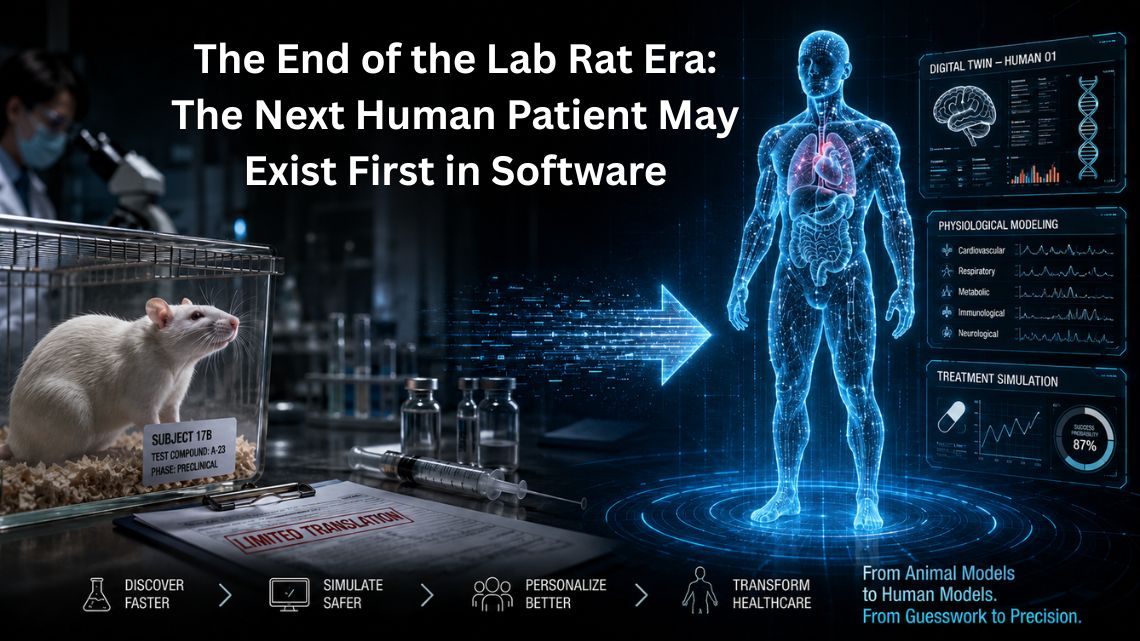
There was a time when people learned medicine by cutting into cadavers. It is quite graphic, and simply hearing about it makes one wince—let alone seeing it done in an actual operating room. Then came the era of scans, sensors, and simulation. Biomedical engineering has reached unprecedented heights in 2026: teaching machines to predict how a human organ might fail before the body itself does.
Global pharmaceutical and research teams are now quietly pioneering human digital twins. These systems breathe, respond, absorb chemicals, and simulate disease patterns—taking biological testing out of the hospital and into the digital realm.
“But why?” one might ask. The world is not in some race to discover only new drugs; it is just about rebuilding the entire process of human testing itself. The U.S. Food and Drug Administration notes that regulators are adopting animal-free testing methods, such as organ-on-chip systems and computational models, to predict human biological responses more accurately than traditional approaches. That shift has drawn global investment into digital twins, AI-powered simulation systems, and virtual clinical environments. Let’s dive deeper.
Biomedical Engineering’s Smallest Revolution Yet
It is completely out of the question to still continue experimenting with drug development using animal and human trials. Today, researchers in some biomedical engineering labs are growing living human cells inside clear chips lined with microscopic channels that imitate blood vessels and tissue behaviour. This is what engineers call organ-on-chip systems. At first glance, these chips look sneakily complex, but in reality, these devices may soon fundamentally alter pharmaceutical development altogether. Yes, it’s really that significant despite its miniature size.
As per the National Institutes of Health, organ-on-chip systems can replicate key functions of human organs such as the liver, intestine, lung, and heart, while allowing researchers to study disease progression and drug toxicity with far greater precision than many previously used animal-based models. And precision here matters enormously. The Biotechnology Innovation Organization also reports that nearly 90% of drugs entering clinical trials still fail before reaching patients, often because preclinical testing fails to capture human responses.
And so, our biomedical engineers believe that digital organs reduce those failures dramatically. Companies like CN Bio, Emulate, and TissUse work alongside several pharmaceutical giants today to simulate organ interactions digitally before human trials even begin. In some cases, engineers can observe how a drug metabolises inside a liver-chip system within days instead of waiting for months for traditional testing cycles.
The Next Patient May Not Be Real
The most significant shift, however, goes far beyond ‘artificial organs.’ Engineers are building AI-driven digital twins of patients, creating virtual replicas using wearable device data, genetic information, medical imaging, and physiological simulations. This significantly helps clinicians and researchers predict surgical, medical, and disease progressions.
NVIDIA, Siemens Healthineers, and several other global research hospitals have expanded partnerships focused on medical digital twins and simulation-based healthcare systems in the last two years alone. Test treatments on virtual patients before treating the real ones sounds like a goal that is almost too good to be true—almost science fiction-like. But the pharmaceutical industry sees another advantage as well: SPEED.
Today, virtual clinical trials allow researchers to simulate portions of patient response data digitally, reducing recruitment pressures and shortening early-stage development timelines. Even Deloitte’s 2024 Global Life Sciences Outlook states that rising AI integration and simulation technologies could significantly reduce overall drug development costs over the next decade.
The Regulatory Behind Digital Medicine
In spite of everything, the rise of digital organs also introduces difficult questions: “Who owns a patient’s digital twin? How much trust should regulators place in AI-generated biological predictions? And if simulations eventually replace portions of animal and human testing, who then becomes responsible when algorithms make the wrong decision?”
At the moment, biomedical engineering is balancing a volatile mix of computation, ethics, medicine, and regulation. Moreover, rising pressures on healthcare are accelerating industry momentum. Aging populations, high R&D costs, and a demand for precision medicine leave pharma leaders in urgent need of faster, safer, and more reliable testing systems.
While past engineers merely enhanced human ability, today’s biomedical innovators are achieving something far more significant: engineering systems that breathe life into the artificial.