
If you ask a layperson to picture an Industrial Engineer, they will almost certainly conjure up a terrifying archetype from the mid-20th century: a severe-looking figure in a short-sleeved button-down, clutching a clipboard and a mechanical stopwatch, standing over a factory worker to time exactly how long it takes them to reach for a bolt.
This is the legacy of Frederick Winslow Taylor—the father of ‘Scientific Management’ and the man who turned the human worker into a machine-like unit of efficiency. For decades, the stopwatch was the scepter of the IE kingdom. If you wanted to improve a process, you sat in a folding chair, clicked your thumb until it was raw, drew a ‘spaghetti diagram’ that looked like a toddler’s crayon drawing, and tried to shave three seconds off a cycle.
But let’s be honest: everybody hated it. Workers felt like lab rats, engineers felt like prison guards, and the data was notoriously unreliable because people naturally work differently when a guy with a clipboard is staring at them (a psychological phenomenon known as the Hawthorne Effect).
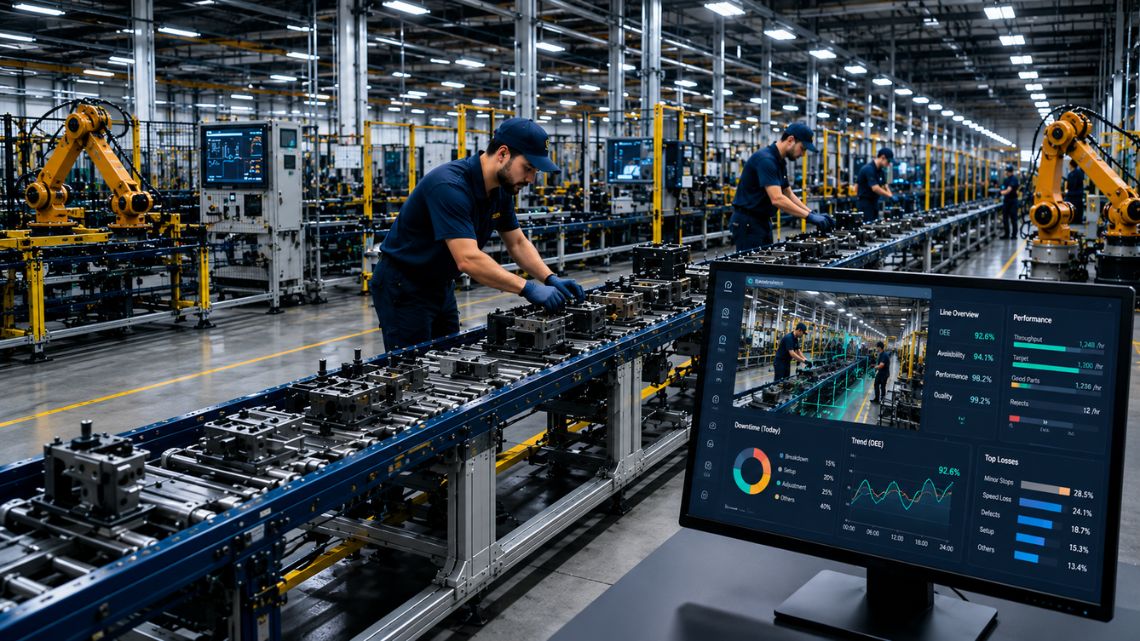
Today, the stopwatch is dead. A new generation of IE entrepreneurs is replacing clipboard-warfare with Computer Vision and Spatial AI, turning the tedious art of ‘Continuous Improvement’ (Kaizen) into a self-running, real-time software loop.
The Watchful Eye of the Spatial AI
In a modern, tech-forward factory, you don’t need to hire a consultant to sit on the floor and time your workers. You already have a massive network of security cameras hanging from the rafters. By feeding those existing video streams into spatial AI models, the factory floor becomes a living, breathing data set.
This isn’t about ‘Big Brother’ spying on employees to see who is slacking off; it’s about mapping the flow of work.
- Automated Therbligs: In classical IE, ‘Therbligs’ are the basic, microscopic motions of a task—grasping, holding, positioning, releasing. An AI can analyze a video stream and automatically break a worker’s hand movements down into these micro-motions.
- Instant Spaghetti Diagrams: Instead of an engineer drawing physical lines on a blueprint to see how far a worker has to walk to find a tool, the software generates a real-time heatmap of foot traffic. If a technician is walking three miles a day just to fetch a specific hex wrench from a central tool crib, the system flags the layout flaw automatically.
Killing the ‘Cold Pizza’ Kaizen Event
Historically, if a manufacturing company wanted to fix a messy process, they held a ‘Kaizen Event.’ This was a bizarre corporate ritual where you shut down a production line for a week, locked a cross-functional team in a conference room with cold pizza and endless sticky notes, and tried to redesign the workflow. By Wednesday, everyone was arguing; by Friday, you implemented a change that worked on paper but fell apart three weeks later because of human nature.
AI-driven IE is replacing the quarterly Kaizen Event with Continuous Continuous Improvement.
Because the computer vision system is constantly monitoring the line, it doesn’t wait for a special week to suggest changes. It identifies ‘Muda’ (the Japanese term for waste) on a daily basis. If a slight change in the height of a parts bin in Cell 3 reduces wrist strain and cuts cycle time by 4%, the system alerts the supervisor on their tablet. It’s micro-Kaizen on autopilot, running 24/7 without the drama of sticky notes or team-building exercises.
The Ergonomic Twin: Preventing the System from Breaking
In the old days of Industrial Engineering, ergonomics was treated as an afterthought—something you worried about only when a worker filed a workers’ comp claim for a bad back. But a human body is the most delicate ‘hardware’ on your shop floor. If your workforce is fatigued, your quality drops, your cycle times skyrocket, and your turnover rates ruin your margins.
By combining computer vision with skeletal-tracking AI, modern IEs can build an Ergonomic Twin of the workforce.
The system tracks the angles of a worker’s joints as they lift, bend, and assemble. If a technician is consistently bending their back at a dangerous 45-degree angle to reach a component, the software flags it instantly.
For the entrepreneur, this is a massive financial shield. It allows you to redesign a workstation—adjusting a conveyor height or adding a mechanical lift—before a repetitive strain injury sidelines your best worker. It turns ergonomics from a moral obligation into a highly predictable, risk-mitigation tool that directly lowers your insurance premiums.
The Trust Factor: Privacy-First AI on the Shop Floor
However, if you walk onto a factory floor and announce that you are installing AI-powered cameras to monitor every shrug, reach, and step, you should prepare for an immediate mutiny. No one wants to feel like they are starring in a corporate dystopia. This psychological resistance is a massive hurdle that has quietly killed many high-tech optimization initiatives before they ever got past the pilot phase.
This is why the smartest IE innovators are focusing on Privacy-First AI. The breakthrough isn’t just in how the AI tracks movement, but in how it discards data.
Modern spatial systems do all of their processing ‘at the Edge’—meaning on the camera unit itself—and instantly delete the raw video footage. Instead of recording faces or names, the software converts the human body into an anonymized, 3D coordinate map of skeletal vector points. By the time the data reaches a supervisor’s dashboard, it is completely decoupled from individual identity.
This shifts the company culture from ‘we are watching you’ to ‘we are optimizing the system.’ When workers realize the technology is being used anonymously to protect them from back strain rather than micromanage their bathroom breaks, a culture of mutual trust can actually flourish.
The Business Case: Erasing the ‘Consultant Tax’
Why is this shift a massive win for the hard-tech startup or the growing manufacturing firm? Because it completely erases the ‘Consultant Tax.’
Traditionally, small-to-medium manufacturing companies couldn’t afford to keep a team of high-level Industrial Engineers on the payroll. They had to pay exorbitant fees to external consulting firms to come in, do a time-and-motion study, and hand over a dusty 200-page report that nobody ever read.
By moving process optimization into the software layer:
- The Plant Optimizes Itself: The software is your permanent, in-house IE consultant. It doesn’t leave when the contract ends, and it doesn’t charge by the hour.
- Dynamic Line Balancing: If one worker is faster than another, a traditional line gets backed up. An AI-orchestrated line can dynamically adjust the flow of parts, redistributing tasks to different stations in real-time to keep the throughput perfectly balanced.
- Instant Training Feedback: When a new hire starts, the system can compare their movements to the ‘ideal’ model and gently guide them—via augmented reality overlays—to improve their form, slashing the onboarding curve by up to 60%.
Liberating the Engineer
The death of the stopwatch isn’t the death of the Industrial Engineer; it is their liberation.
We are finally moving past the era where engineers are treated as human metronomes, counting seconds and policing movements. By handing the boring, repetitive work of timing and tracking over to AI, the modern IE gets to focus on what they were actually trained to do: systems design.
The future of the Engineering Realm isn’t about squeezing your workforce like a wet sponge to wring out three more seconds of labor. It’s about designing elegant, frictionless systems where the right move is always the easiest move.
Put the stopwatch in a museum. Turn the cameras on. It’s time to let your software do the measuring, so your people can do the engineering.