
If you attend any major industrial tech conference today, the keynote is almost guaranteed to feature a slide of a ‘Generative Design’ component. It’s usually an organic-looking, skeletal bracket or engine mount that looks less like a piece of human engineering and more like a bone grown by an alien. The speaker will proudly tell you that an AI generated this design in twelve seconds, shaving 40% off the weight while maintaining structural integrity. The crowd always applauds.
But if you look closely at the engineers in the back of the room, you will notice a distinct lack of clapping. Instead, they are staring at that skeletal bracket with a quiet, creeping sense of dread.
They aren’t worried about losing their jobs to the machine. They are worried about something much worse: Liability.
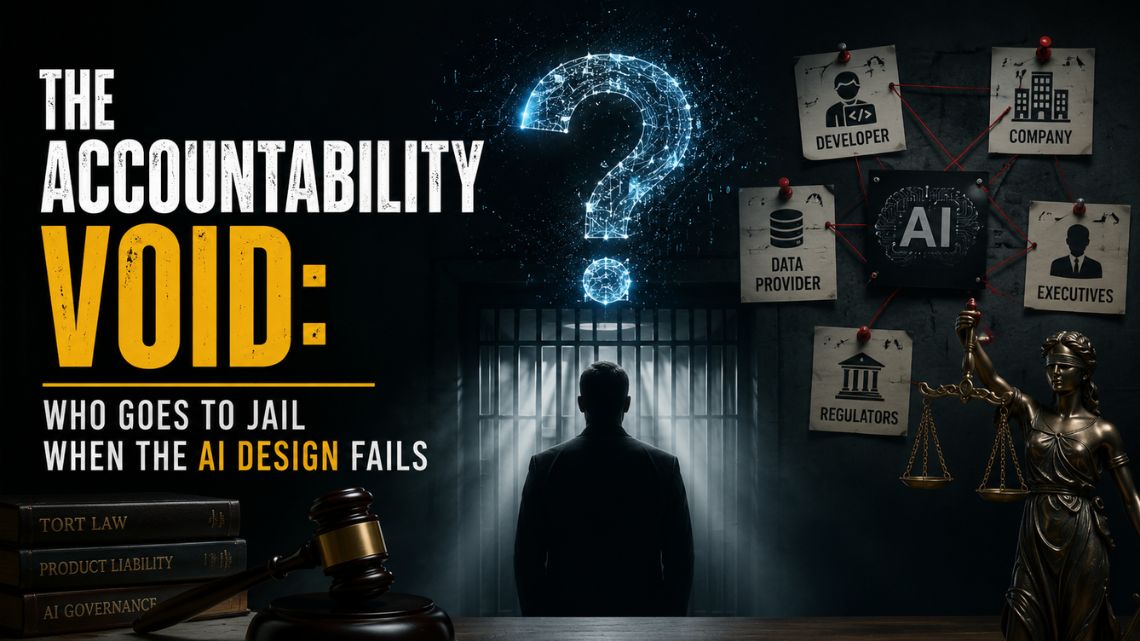
As we rapidly hand over the keys of physical design—bridges, medical devices, chemical reactors, and aircraft—to deep-learning algorithms, we are heading straight toward a massive, systemic collision. We are creating an accountability void. When an AI-designed physical system fails in the real world and lives are lost, who goes to federal prison? The software developer? The venture capitalist? Or the human engineer who stamped a drawing they didn’t actually understand?
The ‘Black Box’ on the Shop Floor
In traditional engineering, we build things using ‘First Principles.’ We know exactly why a beam is a certain thickness because we calculated the bending moment, applied the safety factors, and verified the material properties. The logic is linear, transparent, and auditable. If a bridge falls, we can trace the math back to the exact calculation that went wrong.
Generative AI doesn’t work on first principles. It works on probability.
When you feed a set of load constraints into a generative design engine, it runs millions of iterations in a ‘black box.’ It spits out a shape that works in simulation, but it cannot explain why it chose that specific geometry. It can’t tell you why a certain curve exists or why a specific structural rib is placed where it is.
This means we are starting to manufacture physical objects whose internal stress distributions are fundamentally mysterious to the humans who build them. We are trading intellectual comprehension for structural efficiency, and in the physical world, that is a terrifying bargain.
The Slow Death of Engineering Intuition
The greater danger, however, isn’t just the black box; it’s the erosion of the human operating system.
Every seasoned engineer has ‘intuition.’ It’s that unscientific, gut-level feeling that looks at a drawing and says, “I know the math says this works, but that bracket looks too thin to handle the vibration.” This intuition is built on years of physical feedback—touching the steel, watching things fail on the test bench, and feeling the rumble of a machine that is working too hard.
When young engineers spend their entire day acting as ‘prompt managers’ for generative AI, they never develop this intuition. They become ‘Output Approvers.’ If the software says the design is safe, they click ‘Approve.’
Over time, we are producing a generation of engineers who are intellectually blind to the physical reality of their designs. If the AI ‘hallucinates’ a structural flaw—which they do with alarming frequency—the human in the loop won’t have the instinctual alarm bells required to spot the error before it’s cut into steel.
The PE Stamp: A Legal Shield Turned Target
In the United States and many other countries, the ultimate line of defence in the physical world is the Professional Engineer (PE) license. To build a public structure, a licensed PE must physically stamp their personal legal stamp on the blueprints. By doing so, they are taking personal, civil, and criminal liability for the safety of that design.
But how does a PE stamp a design generated by an algorithm they didn’t write, using logic they can’t see?
Currently, the legal system has no concept of ‘AI Liability’ for physical structures. If a building collapses due to an algorithmic design flaw, the courts won’t care about the software vendor’s Terms of Service. They will look for the human who stamped the paper.
This is creating a defensive, terrified culture among senior engineers. They are being pressured by business leaders to adopt AI tools to speed up product development, but they are being asked to bet their freedom on the reliability of a black-box algorithm. It is a system designed to exploit the engineer’s legal liability while stripping them of their creative control.
The ‘Software-ification’ of Safety
This culture clash is driven by a fundamental misunderstanding of ‘Failure’ between the software and physical worlds.
In Silicon Valley, a ‘Bug’ is a natural part of the lifecycle. You ship the code, you find the crash, you push a patch, and life goes on. But in the physical world, there are no ‘hotfixes’ for a collapsed roof or a ruptured chemical pipeline. The cost of failure is asymmetric.
When software-minded executives take over hard-tech companies, they try to apply the ‘Agile’ approach to physical safety. They assume that if the AI simulation says a part is safe, we can skip the expensive, time-consuming physical testing cycles. They treat the physical test bench as an old-fashioned bottleneck rather than what it actually is: the ultimate arbiter of truth.
5. Reclaiming the Stamp: A Manifesto for Leadership
To survive the AI transition without a catastrophic wave of infrastructure failures, engineering leaders need to change how they define ‘Value’ on their teams.
- Skeptical Supervision as a Core Skill: We need to stop rewarding engineers for how fast they can generate designs, and start rewarding them for how thoroughly they can critique them. The premium skill of the future isn’t creation; it’s forensic analysis.
- The ‘Physical First’ Rule: If an AI designed it, a human must test it physically. We must resist the temptation to rely entirely on virtual simulations. If you can’t afford to build a prototype and break it on a shaker table, you can’t afford to use the AI design.
- Shared Liability Models: It is time for software vendors who build generative engineering tools to put some skin in the game. If your software claims to guarantee structural safety, your corporate insurance should share the liability when that claim fails. Until that happens, engineers should treat AI design suggestions as ‘unverified drafts,’ not final solutions.
The Human remains the Anchor
Artificial Intelligence is the most powerful tool ever handed to the engineering community. It will allow us to build lighter rockets, cleaner engines, and more efficient grids. But we cannot let the excitement of the ‘generate’ button blind us to the physical reality of the world we inhabit.
The physical world doesn’t care about your software’s funding round, your generative prompt, or your slide deck. It only cares about the unyielding laws of gravity, thermodynamics, and material fatigue.
The next generation of engineering thought-leaders won’t be the ones who fully automate the design process. They will be the ones who understand that the human engineer isn’t a bottleneck to be bypassed—they are the final, irreplaceable anchor of accountability in a world that is spinning out of control.