
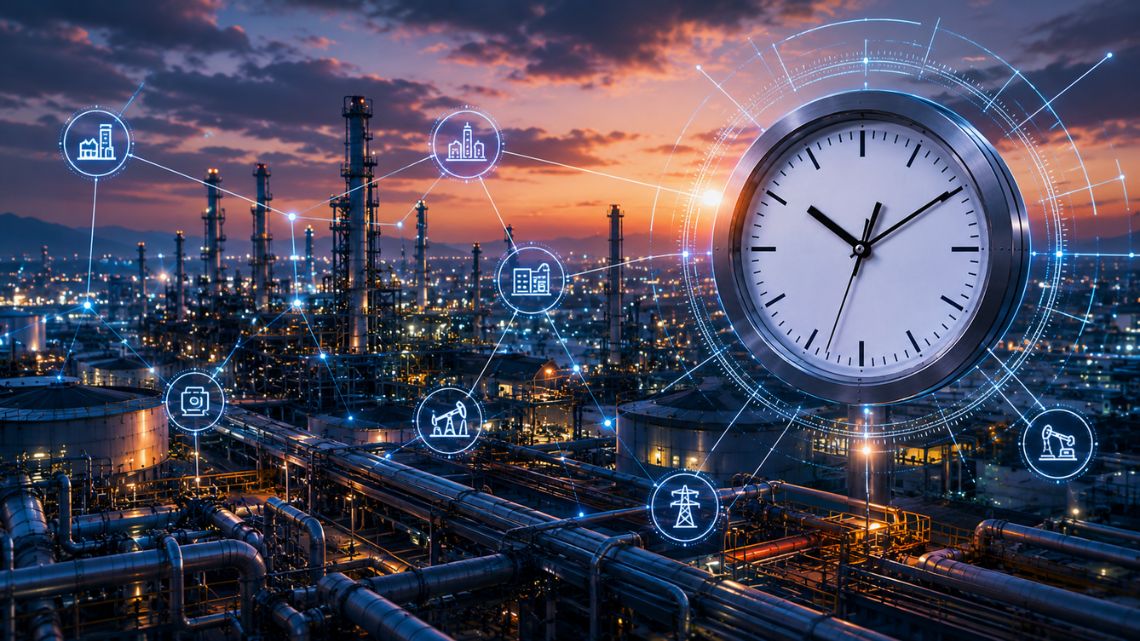
Modern engineering systems depend on synchronization. Industrial automation networks, power grids, telecommunications infrastructure, and autonomous systems all rely on coordinated timing between distributed components. Sensors collect data, controllers process information, and actuators respond in sequences measured in milliseconds or microseconds.
Yet beneath these systems lies a less visible engineering challenge: clock drift. Every digital device operates using an internal clock to measure time and coordinate operations. These clocks are never perfectly accurate. Over time, small timing deviations accumulate between devices, creating misalignment across the system. In isolated systems, the effect may be negligible. In distributed real-time environments, it becomes a significant operational constraint.
Clock drift is not simply an electronics issue. It is increasingly a system-level engineering problem affecting reliability, synchronization, and control.
Why Timing Consistency Matters
Distributed systems operate through coordinated actions. Data generated in one location must align with events occurring elsewhere. In industrial automation, for example, multiple machines may execute sequential tasks based on shared timing assumptions. In power systems, synchronized measurements are essential for maintaining grid stability. In autonomous systems, delayed or misaligned timing can alter decision-making behavior.
The accuracy of these operations depends not only on communication speed, but on whether all parts of the system agree on time itself. When clocks drift apart, systems begin operating on different temporal references. Data may arrive in the correct order but with incorrect timing relationships. Control actions can become misaligned even when network communication remains functional.
The Nature of Clock Drift
Clock drift originates from imperfections in timing hardware. Oscillators inside electronic systems are affected by temperature, voltage variation, aging, and manufacturing tolerances. Even highly precise clocks experience slight deviations over time.
A drift of a few microseconds may appear insignificant. In real-time systems operating continuously, however, these deviations accumulate. Over long periods, devices that were initially synchronized can diverge substantially. This divergence affects how systems interpret events. Measurements that should represent simultaneous conditions may no longer align, altering the system’s understanding of reality.
Synchronization in Industrial Automation
Industrial automation systems are increasingly distributed across networks rather than centralized around isolated controllers. Machines, robotic systems, and sensors coordinate actions through communication protocols that depend on synchronized timing. In high-speed production environments, timing discrepancies can affect sequencing and precision. Robotic systems may respond slightly earlier or later than intended. Sensor data may be processed out of alignment with physical events. These effects can reduce product quality or create instability in tightly coordinated operations.
To address this, modern industrial networks implement synchronization protocols designed to minimize timing differences between devices. However, synchronization itself introduces complexity. Systems must continuously correct drift without disrupting ongoing operations.
Power Systems and Time Alignment
Power infrastructure is particularly sensitive to timing accuracy. Modern grids rely on synchronized measurements from geographically distributed locations to monitor frequency, phase angle, and system stability. Phasor measurement units, for example, depend on precise time synchronization to compare electrical conditions across the grid. Even small timing errors can distort measurements and affect operational decisions.
As renewable energy integration increases, grid behavior becomes more dynamic. This places greater pressure on synchronization systems to maintain accurate timing under variable conditions. Clock drift, if unmanaged, can therefore influence not only measurement accuracy but overall grid reliability.
Data Integrity and Event Correlation
Distributed systems generate large volumes of time-stamped data. Engineers rely on this data to reconstruct events, diagnose failures, and optimize performance. When clocks drift, event sequencing becomes unreliable. Logs from different systems may appear inconsistent, making it difficult to determine causality during failures or disturbances.
In cybersecurity and infrastructure monitoring, this issue is especially significant. Accurate event correlation depends on synchronized timestamps across systems. Without consistent timing, identifying the origin and progression of failures becomes more difficult. Clock synchronization is therefore closely linked to operational visibility and system accountability.
Autonomous Systems and Decision Timing
Autonomous engineering systems, including robotics, transportation systems, and intelligent infrastructure, rely heavily on synchronized timing for coordination. Sensor fusion algorithms combine inputs from multiple sources such as cameras, lidar, and radar. These inputs must be aligned temporally to create an accurate representation of the environment. Clock drift introduces discrepancies between sensor streams, affecting perception and decision-making.
In systems operating at high speed, even small timing mismatches can alter outcomes. A delay that appears insignificant computationally may correspond to meaningful physical movement in the real world. Engineering autonomous systems therefore requires managing not only spatial accuracy, but temporal accuracy as well.
The Challenge of Scaling Synchronization
Maintaining synchronization becomes more difficult as systems scale. Larger networks involve more devices, greater communication latency, and more environmental variation affecting clock behavior.
Centralized synchronization approaches can create bottlenecks or single points of failure. Distributed synchronization methods improve resilience but increase coordination complexity. Engineers must balance synchronization accuracy with scalability and reliability. This often requires hierarchical timing architectures, redundancy, and adaptive correction methods. The problem is not merely technical. It influences system architecture itself.
Latency, Drift, and System Behavior
Clock drift interacts closely with latency. Delayed communication affects synchronization accuracy, while timing misalignment influences how systems respond to latency.
Together, these effects shape dynamic system behavior. A system may appear operational under normal conditions yet become unstable during disturbances because timing assumptions no longer hold.
This highlights an important shift in engineering systems: performance is increasingly determined by coordination quality rather than component capability alone.
Operational Relevance
The importance of synchronization is growing as industries adopt connected, automated, and distributed architectures. Real-time infrastructure, industrial IoT systems, and autonomous operations all depend on precise timing relationships.
At the same time, systems are becoming more decentralized. Processing occurs across cloud platforms, edge devices, and embedded controllers operating under different conditions. This environment makes clock drift a more visible engineering concern than it was in earlier generations of isolated systems.
System-Level Perspective
Clock drift illustrates how seemingly minor technical effects can influence large-scale system behavior. The issue is not that clocks are inaccurate in isolation, but that distributed systems depend on shared temporal understanding to function correctly.
Engineering synchronization is therefore about more than maintaining accurate time. It is about preserving coordination across systems that operate continuously, interact dynamically, and respond in real time. As engineering systems become more interconnected, timing itself becomes infrastructure. Reliability will increasingly depend on how well systems maintain alignment, not just in function, but in time.