
Bolted joints are among the most common elements in mechanical engineering. They are used to assemble structures, transmit loads, and allow disassembly for maintenance. Their design is often considered mature, governed by well-established principles of preload, friction, and static strength. Yet in many high-cycle mechanical systems, bolted joints fail in ways that are not predicted by conventional analysis.
One of the least visible but most critical mechanisms behind these failures is fretting fatigue, a phenomenon driven by microscopic motion at contact interfaces under cyclic loading. Unlike overt mechanical failure, fretting fatigue develops gradually, often without clear warning, and can significantly reduce the lifespan of otherwise well-designed systems.
Understanding Fretting at the Interface
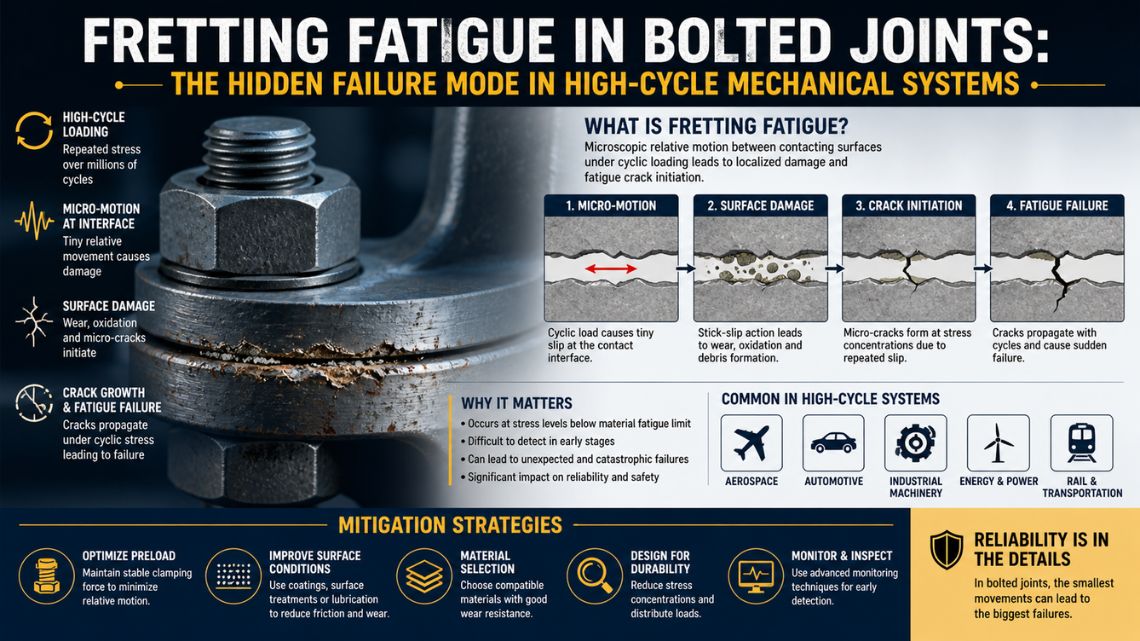
Fretting occurs when two surfaces in contact experience small, repeated relative motion. In bolted joints, this motion is typically on the scale of micrometers, far below what can be observed during normal operation. Despite its small magnitude, this movement creates localized stress concentrations and surface damage.
At the contact interface, frictional forces resist motion. As cyclic loads are applied, these forces cause repeated stick-slip behavior. This leads to surface wear, oxidation, and the formation of micro-cracks. Over time, these cracks propagate under cyclic stress, eventually leading to fatigue failure. The key point is that fretting does not require large displacement. It occurs precisely because the movement is constrained and repetitive.
Why Preload Alone Is Not Sufficient
Bolted joints are typically designed with sufficient preload to prevent relative motion between components. In theory, maintaining high clamping force should eliminate slip and, therefore, fretting.
In practice, preload is not constant. It can decrease over time due to factors such as material relaxation, thermal expansion, and embedding of surface irregularities. Even a small reduction in preload can allow micro-movements to occur under cyclic loading. Additionally, complex loading conditions, such as vibration, bending, or multi-axial stress, can introduce localized slip even when overall preload appears adequate. This means that fretting fatigue can develop even in joints that meet standard design criteria.
High-Cycle Environments and Accumulated Damage
Fretting fatigue is particularly relevant in systems subjected to high-cycle loading. Rotating machinery, automotive assemblies, aerospace structures, and industrial equipment all operate under conditions where components experience repeated stress cycles over extended periods.
In these environments, the cumulative effect of micro-damage becomes significant. Each load cycle contributes a small increment of wear or crack growth. Over time, this accumulation leads to failure, often at stress levels well below the material’s nominal fatigue limit. Because the process is gradual, it is rarely detected during early operation. Failures may appear sudden, but they are the result of long-term degradation at the interface.
Surface Conditions and Material Behavior
The susceptibility of a bolted joint to fretting fatigue depends heavily on surface conditions. Roughness, hardness, and material compatibility influence how contact surfaces behave under load.
Harder materials may resist wear but can be more prone to crack initiation. Softer materials may absorb some deformation but are more susceptible to surface damage. Surface treatments, coatings, and lubrication can alter these interactions, either reducing or exacerbating fretting effects. Engineers must therefore consider not only bulk material properties, but also how surfaces interact at the microscopic level.
Environmental Influences
Environmental conditions play a significant role in fretting fatigue. Moisture, temperature variations, and corrosive environments can accelerate damage processes.
Oxidation at contact interfaces can produce debris that increases abrasion. Temperature changes can affect material properties and alter preload conditions. In corrosive environments, chemical reactions can weaken material surfaces, making them more vulnerable to crack initiation. These factors often interact with mechanical loading, creating combined effects that are more severe than any single condition alone.
Detection and Predictive Challenges
One of the most challenging aspects of fretting fatigue is detection. Because the damage occurs at contact interfaces, it is not easily visible during routine inspection. By the time cracks propagate to detectable levels, significant degradation may have already occurred. Traditional fatigue analysis methods often do not account for fretting effects explicitly. As a result, predicted lifetimes may be overly optimistic.
Advanced monitoring techniques, such as vibration analysis and acoustic emission, are being explored to identify early signs of fretting. However, these methods require careful interpretation and are not yet universally applied.
Design Strategies for Mitigation
Mitigating fretting fatigue requires a combination of design, material selection, and operational considerations. Increasing preload stability is one approach, achieved through improved fastening methods and materials that resist relaxation.
Surface engineering is another key strategy. Coatings, surface treatments, and lubrication can reduce friction and wear at the interface. In some cases, design modifications that redistribute load or reduce stress concentration can limit conditions that lead to fretting. Importantly, engineers must consider how joints behave over time, not just under initial assembly conditions.
Operational Relevance
Fretting fatigue is receiving increased attention as mechanical systems become lighter, faster, and more efficient. Weight reduction and higher operating speeds often lead to reduced safety margins and increased sensitivity to micro-level effects.
In industries such as aerospace, automotive, and energy, the reliability of bolted joints is critical to overall system performance. Failures attributed to fretting fatigue can result in unplanned downtime, maintenance costs, and safety risks. Understanding this phenomenon is therefore essential for ensuring long-term reliability.
System-Level Perspective
Bolted joints are often treated as simple connectors, but their behavior is influenced by the broader system in which they operate. Load paths, vibration characteristics, thermal conditions, and material interactions all affect joint performance. Fretting fatigue highlights the importance of considering these interactions. It demonstrates that failure mechanisms can emerge from subtle effects at interfaces rather than from obvious structural weaknesses.
As mechanical systems continue to evolve, engineering design must account for these less visible but highly influential factors. Reliability is not determined solely by strength, but by how well systems manage the conditions that lead to gradual degradation. Fretting fatigue, though often overlooked, is a reminder that the smallest movements can have the most significant consequences over time.