
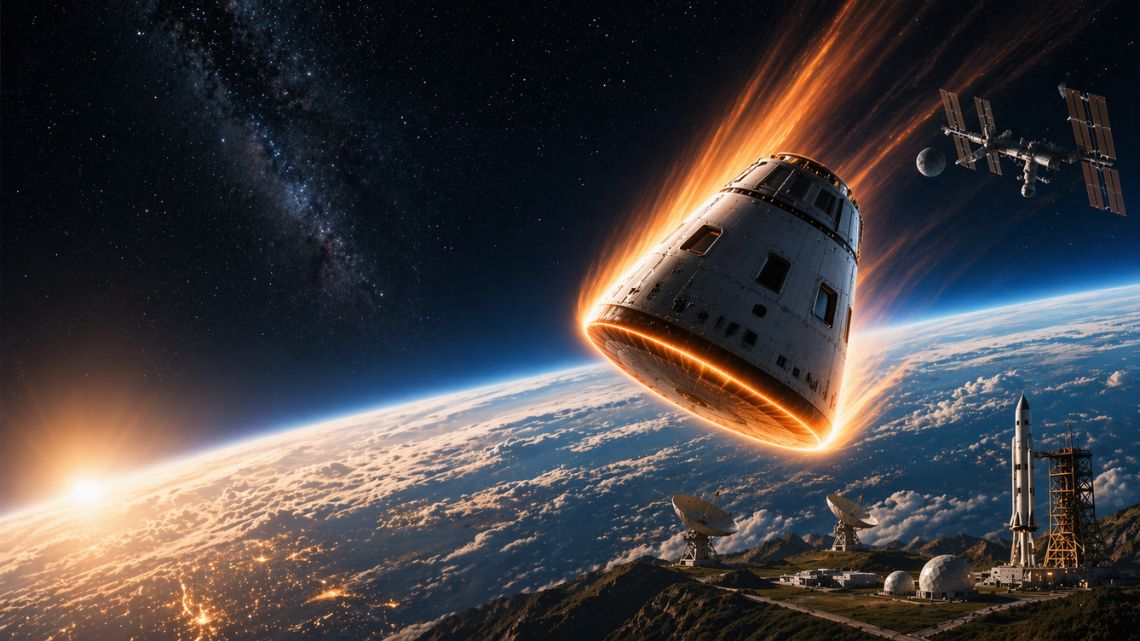
There was a time when looking up at the sky, and dreaming about one day reaching space on a massive spaceship meant letting go—of fuel, of machinery, of possibility itself. Rockets would rise in brilliance but fall in silence, never to return as they left. Today, that story has changed; unlike in the past, today’s rockets come back home to us.
In 2026, going to space is not the matter, but how often, fast, and sustainably we can return home. And somewhere in that process—from one-way ambition to repeatable space journeys—lies one of the most profound engineering transformations of our time.
When Space Became Recheable Again and Again …
For many decades, spaceflight has followed a very costly pattern: building a rocket, launching it, discarding it, and repeating the process. Each mission into space required entirely new hardware, making space exploration both rare and expensive.
However, that soon changed when companies like SpaceX in the U.S. began landing orbital-class rockets. The National Aeronautics and Space Administration (NASA) reveals that reusable launch systems have significantly reduced the cost to reach space today, dropping by over 50% in the last decade alone. This aeronautical development did more than just save money—it redefined access. Today, we do not throw our rockets away; we bring them home to fly again.
Engineering the Return of Our Rockets
Bringing a rocket back home to Earth may look like a cakewalk, but it is actually very difficult in reality. It demands precision across propulsion, materials science, aerodynamics, and control systems. Moreover, our engineers must make sure to reignite engines mid-descent, guide massive structures through atmospheric disturbances, and land the rockets upright—on platforms no larger than a football field. Additionally, the reusable boosters in these rockets endure extreme thermal cycles, structural fatigue, and repeated launches.
As a solution, the aeronautical team is actively building advanced alloys, thermal protection systems, and autonomous guidance software to make sure each return remains controlled and reliable. With each rocket landing also being a technical feat for engineers, the shift toward operational aerospace engineering matters even more so today because being consistent is also equal to being innovative.
An Economy That Lives Above Us
As of recently, lower launch costs have unlocked a surge in activity beyond our atmosphere. Once restricted to only governments and large corporations, satellite developments are now accessible to startups as well.
As per the European Space Agency (ESA), reports state a 100% increase in active satellites since 2021, a trend driven largely by commercial constellations supporting navigation, communication, and Earth observation. This expansion has created an entirely new economy, one where the new space race is about building the foundation, not just the vehicle.
The Human Instinct to Reach Beyond What’s Visible
Despite the progress made and despite the technological maturity, aerospace engineering is still deeply human. Meaning, it reflects a deep desire that predates modern science: the urge to explore beyond what is visible. Reusable rockets embody that mindset. They do not just reach space; they make space reachable again and again. At present, engineers are working toward scaling rapid launch cycles, interplanetary missions, and even sustained human presence beyond Earth.
Companies like Blue Origin and several other emerging global players continue to do their part in investing in reusable rocket systems, orbital habitats, and lunar missions, signaling that the next frontier is full “Operation Go.”
The Sky Was Only The Beginning
By making space accessible now, reusable rockets have broken the mold of traditional space exploration. They have completely changed the narrative of space travel from “hard-to-reach” to “here to stay.”
In 2026, aerospace engineering continues to define human ambition not because it reaches the stars, but because it adamantly refuses to stop at just reaching them once. It builds systems that return, improve, and launch again. Because much like aerospace engineering itself, ambition was never designed for a single flight, and the sky was never the limit.