
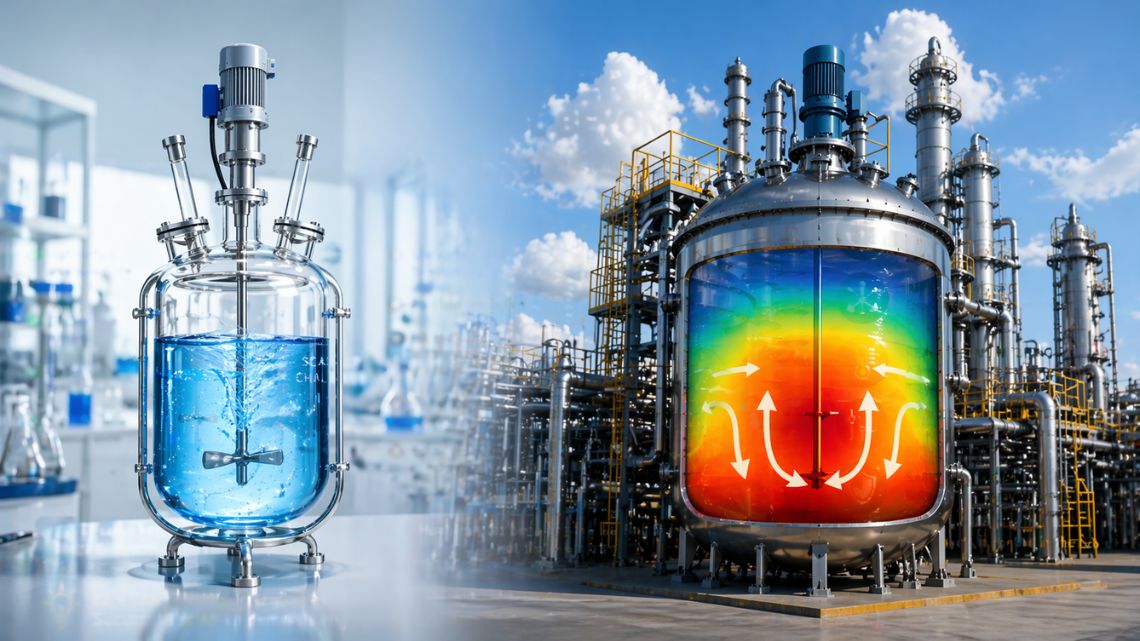
Chemical processes often behave predictably at laboratory scale. Reaction kinetics can be characterized, yields optimized, and temperature profiles maintained within controlled environments. These conditions, however, do not translate directly to industrial systems. As processes scale, one constraint consistently emerges as a limiting factor, heat transfer.
For exothermic reactions in particular, the ability to remove heat at the same rate it is generated becomes increasingly difficult with scale. What is manageable in a laboratory reactor can become unstable in a production unit. This transition is not simply a matter of size. It reflects a shift in the balance between reaction rates and heat dissipation. Understanding and controlling this balance is a central challenge in chemical engineering.
Why Heat Transfer Becomes a Limiting Factor
Exothermic reactions release heat as they proceed. At small scales, this heat can be removed efficiently due to a high surface-area-to-volume ratio. Laboratory reactors dissipate heat quickly through their walls, maintaining stable temperatures.
As reactor size increases, volume grows faster than surface area. This reduces the relative capacity for heat removal. At the same time, the total heat generated by the reaction increases with volume.
The result is a system where heat generation can outpace heat removal. Temperature rises, reaction rates accelerate, and the system moves toward conditions that may exceed safe operating limits. This imbalance is one of the primary reasons why scale-up cannot rely solely on laboratory data.
Thermal Gradients and Reaction Behavior
In large reactors, temperature is rarely uniform. Thermal gradients develop between the reactor core and its boundaries. These gradients influence reaction rates, product distribution, and overall system stability.
Higher temperatures in localized regions can lead to side reactions or undesired byproducts. In extreme cases, they can initiate thermal runaway conditions, where increasing temperature accelerates reaction rates in a self-reinforcing cycle.
Controlling these gradients is as important as controlling average reactor temperature. Uniformity becomes more difficult to achieve as system size increases, particularly in highly exothermic systems.
Mixing and Heat Transfer Interaction
Heat transfer in reactors is closely linked to mixing. Effective mixing distributes heat throughout the reaction medium, reducing localized hotspots and improving temperature uniformity.
At laboratory scale, mixing is often efficient due to small volumes and simple geometries. Industrial reactors, however, involve more complex flow patterns. Inadequate mixing can create zones of high temperature where heat removal is insufficient.
Impeller design, agitation speed, and reactor geometry all influence how heat is distributed. Engineers must consider how mixing dynamics change with scale and how these changes affect thermal behavior. The interaction between mixing and heat transfer is therefore a critical aspect of reactor design.
Cooling System Design Constraints
Industrial reactors rely on external cooling systems to manage heat removal. These systems may include jackets, internal coils, or heat exchangers integrated into the reactor design.
The effectiveness of these systems depends on factors such as heat transfer coefficients, fluid flow rates, and temperature differentials. As reactor size increases, achieving sufficient heat transfer through these mechanisms becomes more challenging.
Cooling systems must be designed not only for average operating conditions but for peak heat generation scenarios. This requires careful analysis of worst-case conditions and safety margins. In many cases, limitations in cooling capacity define the maximum feasible scale of a process.
Reaction Kinetics and Temperature Sensitivity
Exothermic reactions are often highly sensitive to temperature. Small increases in temperature can significantly accelerate reaction rates. This sensitivity creates a feedback loop between heat generation and reaction speed.
At scale, this feedback becomes more difficult to control. Temperature fluctuations can lead to rapid changes in reaction behavior, making the system less predictable. Engineers must account for this sensitivity when designing control systems. Temperature control strategies must respond quickly and reliably to prevent instability.
Process Control and Monitoring
Modern chemical plants rely on advanced control systems to manage reactor conditions. Temperature sensors, flow controllers, and automated feedback loops are used to maintain stable operation.
However, control systems are only as effective as the data they receive. Sensor placement becomes critical in large reactors, where temperature may vary across different regions. A single measurement point may not represent overall system conditions.
Engineers must design monitoring systems that capture relevant data and provide a comprehensive view of reactor behavior. This may involve multiple sensors, redundancy, and data validation strategies.
Scale-Up Strategies and Engineering Approaches
To address heat transfer limitations, engineers employ a range of strategies during scale-up. These include modifying reactor geometry, enhancing mixing, improving heat exchange surfaces, and adjusting operating conditions.
In some cases, processes are redesigned to operate in continuous reactors rather than batch systems. Continuous systems can offer better control over heat removal due to smaller effective volumes and steady-state operation.
Another approach involves dividing large reactors into smaller units, reducing the impact of scale on heat transfer. This modular strategy improves control but may increase system complexity. Each approach reflects the need to align reaction behavior with heat transfer capability.
Operational Relevance
Heat transfer limitations are a critical consideration in industries ranging from petrochemicals to pharmaceuticals. As demand for production increases, processes must be scaled without compromising safety or product quality.
Failures related to inadequate heat removal can have significant consequences, including equipment damage, production loss, and safety risks. These risks make thermal management a central focus of chemical plant design and operation.
System-Level Perspective
Scaling exothermic reactions is not a straightforward extension of laboratory conditions. It requires a comprehensive understanding of how heat generation, heat transfer, mixing, and reaction kinetics interact within a larger system.
Chemical engineering must address these interactions at the system level, recognizing that performance is determined by the balance between competing processes. Effective reactor design is therefore not defined by reaction efficiency alone, but by the ability to maintain controlled, stable operation under realistic conditions. As industrial processes continue to scale and evolve, managing heat transfer will remain a defining challenge in chemical engineering.