
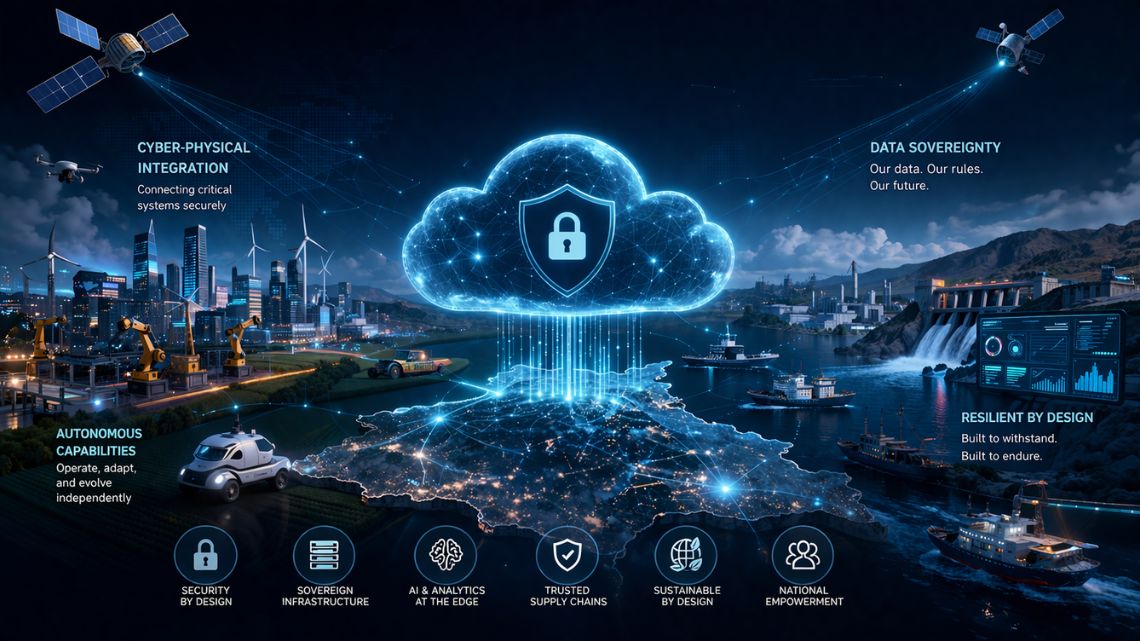
In the early days of the digital revolution, the ‘Cloud’ was marketed as a borderless utopia—a place where data could roam free, unburdened by geography or local laws. It was a beautiful vision of a globalized, frictionless economy. But for the modern systems engineer working in critical infrastructure, defense, or high-stakes manufacturing, ‘borderless’ has slowly become a synonym for ‘vulnerable.’
As global tensions rise and supply chains become weaponized, we are seeing the birth of the Sovereign Cloud. This isn’t just another marketing buzzword or a fancy name for a private server. It represents a fundamental, ground-up shift in how we architect the systems that run our world. It is the engineering of digital environments that are physically, legally, and logically bound to a specific jurisdiction. For the technology entrepreneur, building in the Sovereign Cloud isn’t just about security—it’s about creating a high-walled moat that protects the ‘Cyber-Physical’ systems that keep the lights on and the factories humming.
1. Beyond Encryption: The Physics of Data Residency
For years, the tech industry leaned on a comfortable lie: that encryption was the silver bullet. The theory was that if the data is scrambled well enough, it doesn’t matter if it sits on a server in Virginia, Dublin, or Shanghai. But the reality of the 2020s has shattered that illusion. Between the U.S. CLOUD Act and Europe’s aggressive GDPR enforcement, where your bits physically live is now a life-or-death engineering requirement.
Modern systems engineers are now being forced to think like urban planners and border guards. They are designing Geofenced Infrastructure that treats geography as a primary constraint.
- Air-Gapped Hybrid Clouds: We’re seeing a surge in systems that offer the scalability of the cloud but remain physically disconnected from the public internet. This forces a complete rethink of how we handle basic tasks like software updates and telemetry. You can’t just ‘push to production’ when your production environment is in a lead-lined bunker with no outside connection.
- Hardware-Rooted Trust: The battle has moved from the software layer down to the silicon. Sovereign systems are increasingly utilizing custom Hardware Security Modules (HSMs) that ensure the ‘keys to the kingdom’ never leave the physical facility. Even if a rogue admin with global permissions tries to access the data, the hardware itself says ‘no.’
2. Cyber-Physical Integrity: Protecting the ‘Living’ Machine
In the world of Systems Engineering, we aren’t just worried about someone stealing credit card numbers or leaking emails. We are worried about ‘integrity’—the absolute assurance that the command you sent to a power turbine, a water pump, or a robotic arm is the exact command that arrived, untampered and on time.
In a traditional, globalized cloud, your data might hop through three different countries and dozens of third-party routers before it reaches the machine. Each one of those hops is a ‘Surface Area’ for attack. It’s a game of digital telephone where the stakes are a physical explosion.
- Deterministic Networking: Sovereign clouds are moving away from the ‘best effort’ delivery of the public internet. Instead, they use dedicated, private fiber or satellite links to ensure ‘Fixed Latency.’ If your system needs to react in 2 milliseconds to prevent a pressure valve from failing, you can’t be at the mercy of a Netflix outage in a different hemisphere.
- Zero-Trust Architecture (ZTA): The best entrepreneurs in this space are building systems that assume the network is already compromised. Every single interaction between a sensor and a controller is treated with extreme suspicion. Local sovereignty becomes the ultimate source of truth, creating a system that is resilient even when the ‘global’ web is under fire.
3. The Business Case: Stability as a Premium
Why should an entrepreneur care about the Sovereign Cloud? Because the world is moving from an era of ‘Move Fast and Break Things’ to an era where stability is the ultimate luxury.
- Regulatory Compliance as a Product: For startups in MedTech, FinTech, or Aerospace, building on a sovereign stack is a massive sales feature. When you approach a government client or a conservative utility company, you aren’t just selling them a tool; you’re selling them the peace of mind that their data will never leave their soil. That ‘sovereignty’ becomes a line item that justifies a 30% price premium.
- Avoiding the ‘Cloud Tax’: Relying on a global cloud giant is like being a tenant in a building where the landlord can double the rent or change the locks at any time. Sovereign engineering focuses on Interoperability. By using open-standard containerization like Kubernetes on private, sovereign hardware, companies can avoid being held hostage by the pricing whims or political alignments of a single provider.
- The Insurance Moat: As cyber-insurance premiums skyrocket, underwriters are looking for physical proof of security. Companies that can demonstrate their systems live within a sovereign, audited environment are finding they can negotiate significantly lower premiums. In the long run, sovereignty pays for itself in reduced liability.
4. The Orchestration Headache
The real engineering challenge here isn’t just building one isolated pod; it’s Orchestration. How do you manage a fleet of sovereign systems that are intentionally designed to be hard to reach?
This is where the new generation of Systems Engineers is making their mark. They are developing Federated Management Layers. This allows a company to have a ‘Global View’ of their operations—a dashboard that shows how the whole company is doing—while the ‘Local Execution’ (the actual sensitive data and physical commands) remains locked within sovereign pods. It is the engineering equivalent of a ‘need-to-know’ basis for machines. You get the insights without the exposure.
5. The Rise of ‘National Stacks’
We are witnessing the birth of ‘National Stacks’—integrated systems where the hardware, the operating system, and the cloud environment are all engineered within a single economic zone. This is a return to the craftsmanship of engineering. We are moving away from “Off-the-Shelf” global solutions and back toward Bespoke Systems Design.
In this new world, the specific constraints of the environment—be they legal, physical, or political—dictate the architecture of the system. It’s a challenge that requires more than just coding skills; it requires a deep understanding of the world the machine lives in.
The Digital Iron Curtain
The dream of a unified, global internet is fading, replaced by a ‘Splinternet’ of sovereign zones. While this may be a headache for social media apps and advertisers, it is a golden age for Systems Engineering.
The Sovereign Cloud is the place where the high-tech dreams of the Industrial Metaverse meet the cold, hard reality of national security. For the entrepreneur, the message is clear: the most valuable systems of the future won’t necessarily be the fastest or the cheapest. They will be the ones that stay exactly where you put them, doing exactly what they were told, regardless of what is happening in the world outside.
The era of borderless data is over. The era of the digital fortress has begun.