
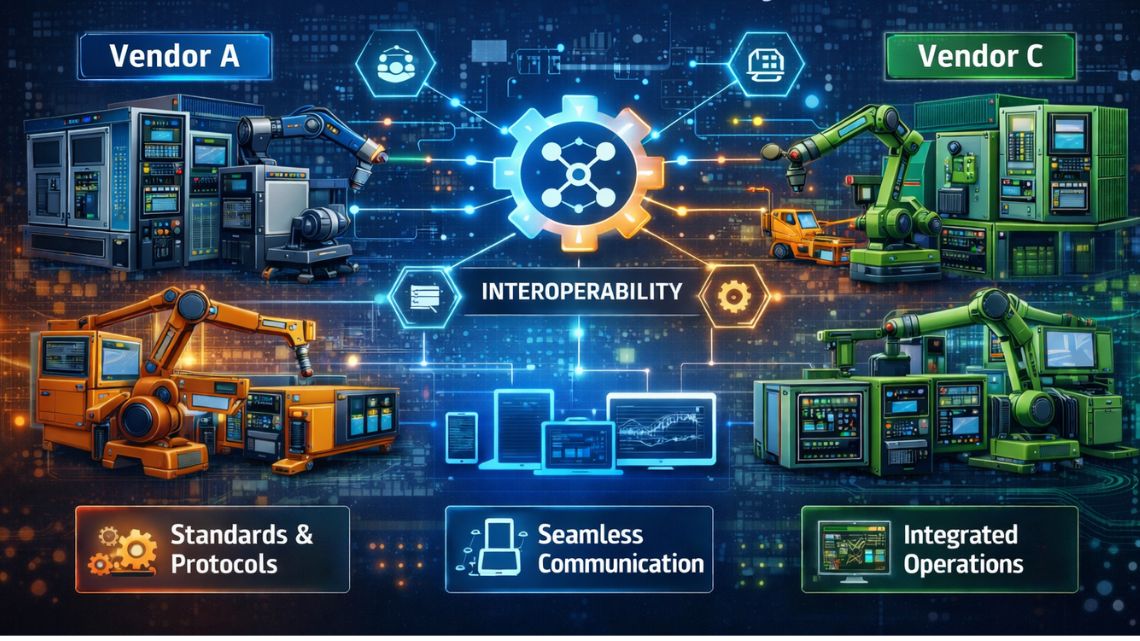
Industrial systems are no longer built as isolated, self-contained units. Modern facilities, whether manufacturing plants, energy systems, or infrastructure networks, are composed of equipment, software, and control architectures sourced from multiple vendors. This shift has enabled specialization, flexibility, and faster deployment. At the same time, it has introduced a persistent engineering challenge: interoperability.
Interoperability is often framed as a communication issue, whether systems can exchange data. In practice, it is a deeper engineering problem involving synchronization, compatibility, reliability, and long-term system behavior. Systems may connect, but they do not necessarily work together effectively.
From Standardization to Fragmentation
Historically, industrial systems were designed around unified platforms. A single vendor often supplied control systems, hardware, and software, ensuring compatibility across components. While this approach simplified integration, it limited flexibility and innovation.
Today’s systems are intentionally heterogeneous. Sensors, controllers, actuators, analytics platforms, and enterprise systems are sourced independently, often using different communication protocols, data formats, and update cycles. Open standards have expanded connectivity, but they have not eliminated fragmentation. As a result, interoperability is no longer guaranteed by design. It must be engineered.
Interoperability Beyond Communication
Basic interoperability ensures that systems can exchange data. Engineering interoperability requires that this data is meaningful, timely, and actionable within the context of system operation.
Differences in data structure, units, timing, and interpretation can create inconsistencies. A temperature reading transmitted from one system may not align with the control logic of another if sampling rates differ or if calibration standards are inconsistent. These discrepancies are rarely visible during initial integration but become critical during operation. The challenge is not simply to connect systems, but to ensure that they operate on a shared understanding of state and behavior.
Timing and Synchronization Challenges
In industrial environments, timing is as important as data itself. Control systems rely on coordinated actions across multiple components. Delays, mismatched update cycles, or asynchronous responses can introduce instability.
Multi-vendor systems often operate on different internal clocks and communication intervals. A control command issued by one system may reach another with a delay that is insignificant in isolation but disruptive in a tightly coupled process.
This becomes particularly critical in high-speed manufacturing, power systems, and automated environments where small timing discrepancies can propagate into larger system-level issues. Engineers must design synchronization strategies that account for these differences, often introducing buffering, time-stamping, or prioritization mechanisms.
Integration Complexity at the Interface Level
Most interoperability failures occur at interfaces, not within individual components. Each system may perform correctly according to its specifications, yet fail when interacting with others. Interfaces introduce ambiguity. Data may be interpreted differently across systems. Control boundaries may overlap or conflict. Error states may not propagate clearly, leading to partial system awareness.
Engineering these interfaces requires detailed understanding of both systems involved. It also requires anticipating how they will behave under non-ideal conditions, such as partial failures or degraded communication. The complexity increases as systems scale. Adding more components does not linearly increase integration effort; it multiplies potential interaction pathways.
Lifecycle and Update Mismatch
Industrial systems are expected to operate over long lifecycles. Vendors, however, update hardware and software at different rates. This creates compatibility challenges over time.
A software update in one system may introduce changes that are incompatible with existing components. Hardware replacements may require new communication standards or protocols. Maintaining interoperability becomes an ongoing engineering task rather than a one-time integration effort. Version control, backward compatibility, and controlled update strategies are therefore essential. Engineers must design systems that can evolve without disrupting operation.
Cybersecurity as an Interoperability Constraint
As systems become more connected, cybersecurity considerations increasingly influence interoperability. Integrating systems from multiple vendors introduces multiple potential entry points for security vulnerabilities.
Security protocols may restrict communication between systems, limiting interoperability. At the same time, insufficient security integration can expose critical infrastructure to risk. Engineering interoperability now involves balancing openness with protection. Secure communication layers, authentication mechanisms, and access control must be integrated without compromising system functionality.
The Role of Standards and Their Limits
Industry standards play an important role in improving interoperability. Protocols such as OPC UA, Modbus, and others provide frameworks for communication between systems. However, standards define how data is transmitted, not how it is used.
Different vendors may implement the same standard in different ways. Optional features, extensions, and interpretation differences can lead to partial compatibility. Engineers must often bridge these gaps through custom integration layers or middleware solutions. Standards reduce complexity but do not eliminate it. Effective interoperability still depends on system-level engineering decisions.
Toward System-Level Engineering Approaches
Addressing interoperability challenges requires a shift from component-focused design to system-level thinking. Engineers must consider how all parts of the system interact, not just how each part performs individually. This includes defining clear data models, synchronization strategies, interface behaviors, and failure responses. Integration is treated as a core design activity rather than a final step.
Testing strategies also evolve. Systems are validated not only for functional performance but for interaction under varying conditions. Simulation and staged deployment are used to identify issues before full-scale implementation.
Operational Relevance
The push toward digitalization, automation, and connected infrastructure is accelerating. Industrial systems are becoming more complex and more interdependent. At the same time, organizations are prioritizing flexibility, often selecting best-in-class components from different vendors.
This combination increases the importance of interoperability. Systems that cannot integrate effectively limit the benefits of advanced technologies. In some cases, interoperability challenges become the primary barrier to adoption.
The Outlook
Interoperability is no longer a secondary technical concern. It is a defining factor in the performance and reliability of modern industrial systems. The most effective engineering approaches recognize that integration is not achieved through connectivity alone. It requires alignment in data, timing, behavior, and lifecycle management.
As multi-vendor environments continue to expand, the ability to engineer systems that function cohesively will distinguish robust infrastructure from fragmented ones. Interoperability, when treated as an engineering discipline rather than a configuration task, becomes a foundation for scalable and reliable industrial systems.