
400 million tonnes—that’s the amount of plastic produced globally every year. Much of it ends up in landfills, is incinerated, or slowly breaks down into microplastics that now pollute our soil, water, and even the air we breathe. Despite decades of investment and public awareness campaigns, recycling alone has not been sufficient to solve the problem.
Traditional mechanical recycling — melting plastics down and reprocessing them — often degrades the material over repeated cycles, and struggles to keep pace with the volume of waste being generated. That’s why a more fundamental solution is needed, and chemical engineers have increasingly turned their attention to a different approach: upcycling plastics into something more useful than lower-grade plastic.
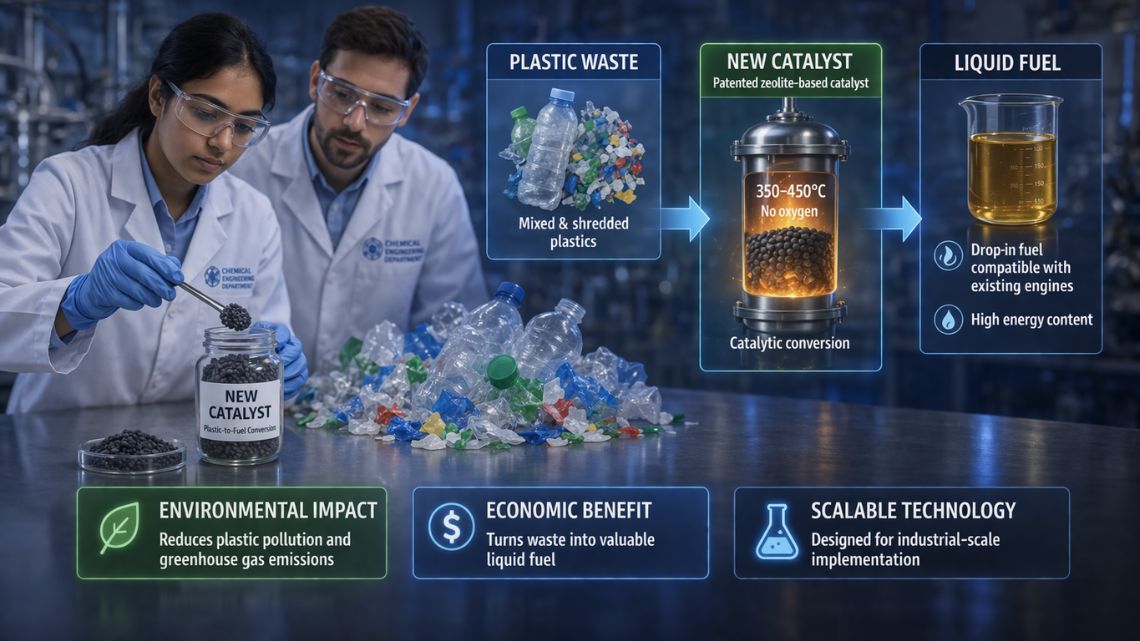
A new study from researchers at the University of Delaware suggests that converting discarded plastics into valuable liquid fuels could become significantly faster and more efficient. The team demonstrated a new type of catalyst that converts plastic waste into liquid fuel significantly faster and with fewer unwanted by-products than previously reported systems under similar conditions.
One promising approach to plastic upcycling is hydrogenolysis, a catalytic process in which hydrogen gas breaks down long polymer chains into shorter hydrocarbon molecules that can be used as liquid fuels for transportation and industrial purposes. The approach has attracted considerable interest because it offers a way to treat plastic waste as a chemical feedstock rather than a disposal problem. However, it has consistently run into a practical engineering limitation: the large, bulky polymer molecules in plastics struggle to reach the active sites on conventional catalysts where the reaction actually takes place. Poor contact between the polymer and the catalyst means slower reaction rates, lower efficiency, and a higher proportion of unwanted by-products, including methane, a potent greenhouse gas.
The University of Delaware team approached this challenge through a materials science innovation centred on MXenes—a class of atomically thin, two-dimensional materials composed of transition metal carbides, nitrides, or carbonitrides. MXenes typically exhibit a layered structure, where sheets can stack closely together. While this architecture is advantageous in many applications, it can, in certain configurations, limit the transport of larger molecules such as polymers to catalytic active sites. As a result, controlling interlayer spacing and surface interactions becomes key to improving how effectively polymers can access and interact with catalytic sites within the material.
As Ali Kamali, a doctoral candidate in the Department of Chemical and Biomolecular Engineering and first author on the paper, explained: “MXenes form two-dimensional layers, like the pages of a book. These stacked layers in the closed book make it difficult for molten plastic to move through easily, limiting contact with the catalyst.”
To solve this, the team engineered a mesoporous variant of MXene by inserting silica pillars between the two-dimensional layers, effectively propping the structure open and creating larger, more accessible pore spaces. The resulting material, a mesoporous MXene-supported ruthenium catalyst, had not previously been explored for plastic upcycling. Ruthenium nanoparticles were loaded into the expanded interlayer spaces, where the confinement geometry played an important role in stabilising them and shaping their catalytic behaviour.
The team tested the catalyst using low-density polyethylene (LDPE), one of the most widely produced plastics in the world, used in everything from shopping bags to food packaging films. In a small pressurised reactor, LDPE was combined with the catalyst and hydrogen gas and heated until the plastic melted into a thick, syrup-like liquid. The results were clear. The mesoporous MXene-supported ruthenium catalyst achieved reaction rates nearly twice as fast as comparable previously reported results for LDPE hydrogenolysis. Crucially, it also demonstrated high selectivity, directing the reaction toward the production of liquid fuel hydrocarbons in the C5 to C35 range while substantially reducing methane formation. That balance matters.
In catalytic plastic upcycling, methane is an undesirable by-product because it represents lost value and added emissions, so reducing it improves both efficiency and overall output. The researchers link these improvements to the catalyst’s open structure, which allows the plastic to interact more easily with active sites. Together, these results point to a more controlled and effective way of converting plastic waste into useful fuels.
The research is currently at the pilot stage, and scaling mesoporous MXene systems to industrial volumes presents its own engineering challenges. Maintaining uniform pore architecture, catalyst stability over extended operation, and cost-effective synthesis at scale are all open questions that need to be addressed.
Looking ahead, the researchers plan to refine the catalyst further and develop a broader library of MXene-based catalysts suited to different types of plastics, not just LDPE. Their ultimate goal is to work with industry partners to build a viable commercial way to turn plastic waste, currently a liability, into a feedstock with genuine economic value.
The study demonstrates how strategic catalyst design can significantly improve plastic-to-fuel conversion. By enhancing efficiency and reducing unwanted by-products, it offers a promising direction for future upcycling technologies. Though challenges remain in scaling the process, the research marks an important step toward more sustainable solutions for plastic waste.