
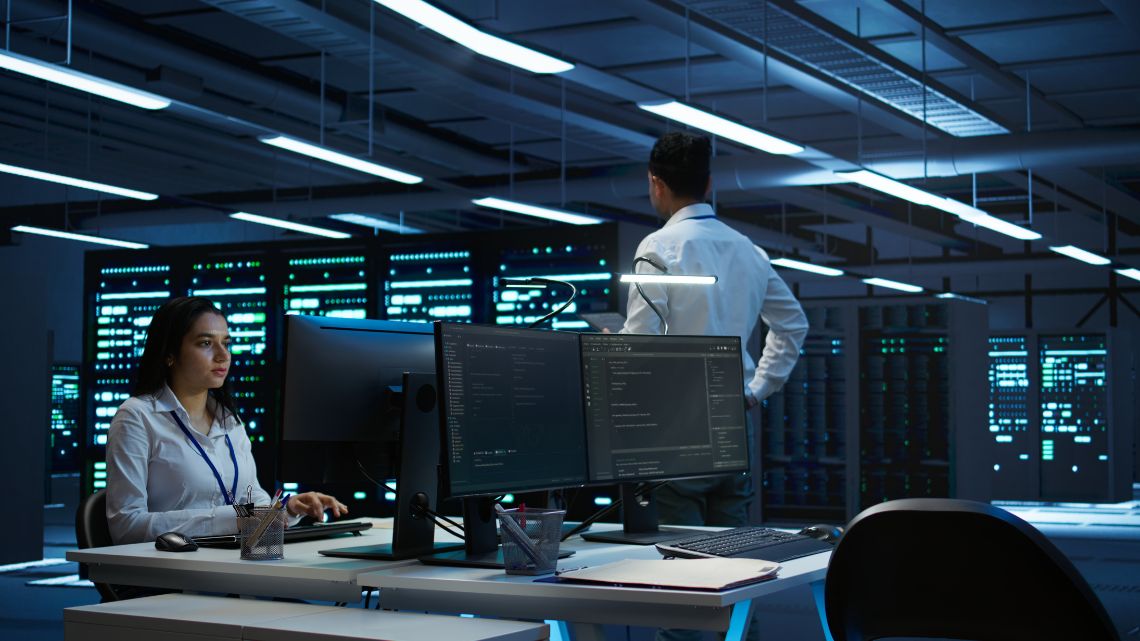
Data centers were once peripheral infrastructure, rooms filled with servers that supported business operations in the background. Today, they are mission-critical industrial assets. Cloud computing, artificial intelligence, streaming services, financial transactions, and public-sector systems all depend on data centers operating without interruption. Downtime is no longer an inconvenience; it is a systemic risk.
This reality has profound implications for the field of mechanical engineering. Unlike conventional industrial facilities, data centres are designed to operate continuously, often at high utilisation, with minimal tolerance for shutdowns or performance degradation. In this environment, mechanical systems are not auxiliary services. They are the physical backbone of digital reliability.
Continuous Operation Changes the Engineering Problem
Mechanical systems have traditionally been designed around duty cycles. Equipment runs, rests, cools, and is serviced on predictable schedules. Data centers invert this logic. Cooling systems, air handlers, pumps, fans, and backup infrastructure operate continuously, frequently under variable loads driven by computational demand rather than ambient conditions.
This shift fundamentally changes failure modes. Components are less likely to fail due to overload and more likely to degrade due to fatigue, wear, thermal cycling, and loss of alignment. Reliability becomes a function of how systems age under constant operation, not how they perform at peak capacity. Mechanical engineers working in data center environments must therefore prioritize degradation management over classical strength-based design.
Thermal Management as a Mechanical Discipline
Cooling is the dominant mechanical function in data centers, and it has become more complex as computing densities increase. High-performance processors generate localized heat loads that change rapidly with workload. This creates non-uniform thermal environments that challenge traditional airflow and heat rejection strategies.
Mechanical design must account for thermal gradients that induce expansion, contraction, and long-term deformation. Ducting, piping, and structural supports experience subtle movement over time, affecting alignment and increasing stress at joints and interfaces. These effects rarely cause immediate failure, but they shorten component life and increase maintenance risk. As liquid cooling, immersion systems, and hybrid thermal architectures become more common, mechanical engineers are increasingly responsible for integrating thermal performance with structural stability and serviceability.
Reliability Through Redundancy, and Its Limits
Redundancy is a defining feature of data center design. Mechanical systems are often configured with parallel capacity to ensure that no single failure interrupts operation. While this approach improves availability, it introduces new mechanical challenges. Redundant systems rarely operate under identical conditions. Differences in load sharing, startup sequences, and control logic can lead to uneven wear. Components that appear healthy on paper may degrade faster due to a subtle imbalance in operation.
Designing for redundancy, therefore requires more than duplicating equipment. It demands careful consideration of how systems interact over time, how transitions occur during maintenance or fault conditions, and how mechanical wear accumulates across parallel paths.
Vibration and Continuous Degradation
Data centers are dense mechanical environments. High-speed fans, pumps, and compressors operate continuously in close proximity to sensitive equipment. Even low-level vibration, when sustained over long periods, contributes to fatigue in fasteners, supports, and rotating components.
Unlike industrial plants, where vibration issues often trigger immediate investigation, data center vibration problems are frequently tolerated because they do not cause immediate functional failure. Over time, however, this tolerance translates into premature wear, misalignment, and unexpected component replacement. Mechanical engineers increasingly recognize vibration control as a lifecycle issue rather than a commissioning concern. Isolation, damping, and structural stiffness must be designed for long-term stability, not just initial compliance.
Maintenance Without Downtime
One of the defining constraints of data center mechanical design is the requirement for maintenance without shutdown. Systems must be accessible, modular, and replaceable under live conditions.
This requirement reshapes mechanical layout decisions. Valves, joints, filters, and bearings are positioned not only for optimal performance, but for safe intervention during operation. Clearances, lifting points, and isolation strategies become integral to design, not afterthoughts. Mechanical engineers are therefore designing for maintainability as a core performance metric. A system that performs efficiently but cannot be serviced safely under load is increasingly considered incomplete.
Control Systems and Mechanical Behavior
Modern data centers rely heavily on automated control systems to optimize cooling and energy use. While these systems improve efficiency, they introduce dynamic operating conditions that affect mechanical components. Frequent load adjustments, variable-speed operation, and algorithm-driven optimization can increase mechanical cycling. Components experience more start-stop events, variable torque, and transient stresses than in fixed-speed systems.
Mechanical engineers must now collaborate closely with control and software teams to ensure that optimization strategies do not inadvertently reduce mechanical lifespan. This integration reflects a broader shift toward system-level engineering responsibility.
Sustainability and Mechanical Longevity
Sustainability pressures are reshaping data center design globally. Energy efficiency, waste heat recovery, and reduced water usage are driving new mechanical architectures. These innovations often introduce unfamiliar operating regimes and materials.
From a mechanical perspective, sustainability is increasingly linked to longevity. Systems designed for repair, refurbishment, and extended service life reduce material consumption and operational risk. Engineers are being asked to design not just for efficiency, but for endurance. This emphasis aligns naturally with continuous operation environments, where replacement cycles are costly and disruptive.
Why This Moment Matters
The global expansion of data centers is accelerating. Facilities are being built in diverse climates, closer to population centers, and under tighter regulatory scrutiny. At the same time, computational demand continues to rise unpredictably. In this context, mechanical engineering decisions made today will define reliability for decades. The margin for error is narrowing as systems become denser, more automated, and more interdependent.
Engineering for the Long Run
Designing mechanical systems for continuous operation in data centers requires a shift in mindset. Success is no longer defined by peak performance or initial efficiency. It is defined by stability over time, predictability under variation, and resilience under constant use.
The most effective mechanical systems in data centers are not those that push limits, but those that manage degradation intelligently. They accept that nothing operates forever without change, and they are designed accordingly. As digital infrastructure becomes inseparable from economic and social function, mechanical engineering quietly determines whether the digital world remains reliably online.