
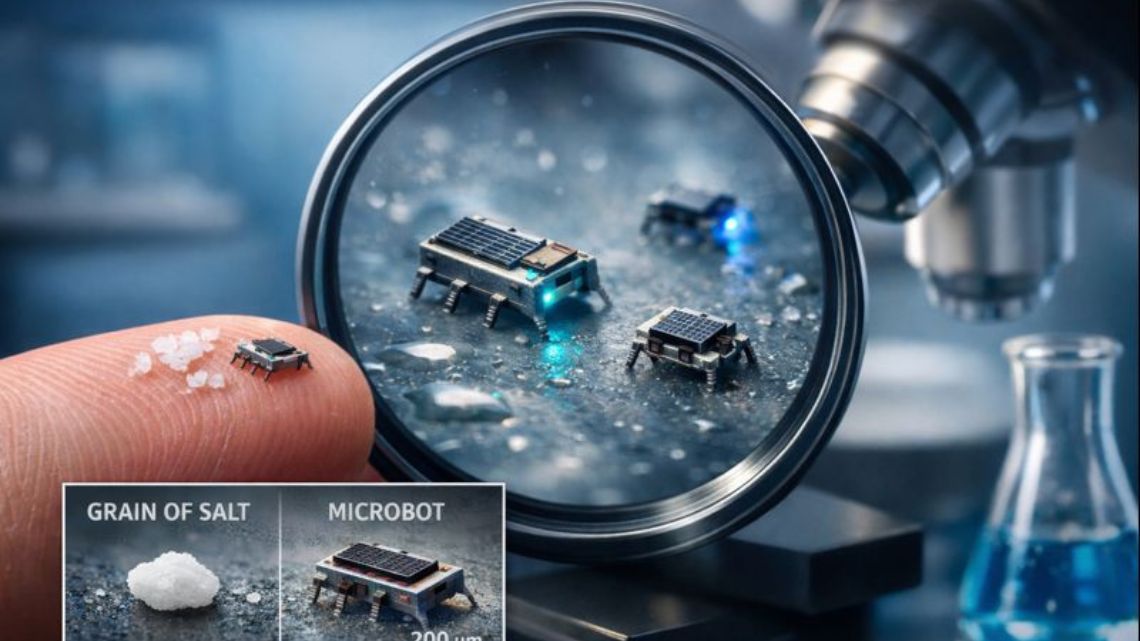
University of Pennsylvania and University of Michigan achieve 40-year goal: robots that can think, sense, and act at the microscopic scale, costing just a penny each.
After decades of challenges that limited progress in microscopic robotics, researchers at the University of Pennsylvania and the University of Michigan have created the world’s smallest fully programmable, autonomous robots. These microscopic robots—barely visible to the naked eye—can move through liquid environments, sense their surroundings, make decisions, and respond to their environment without any external tether or control. The achievement, published in Science Robotics and Proceedings of the National Academy of Sciences, represents a fundamental shift in what’s possible at microscopic scales.
Each robot measures approximately 200 by 300 by 50 micrometers, smaller than a grain of salt. To put this in perspective, they’re operating at the scale of biological microorganisms like bacteria and algae. Yet unlike those organisms, these are fully programmable machines with computers, sensors, and independent decision-making capacity. “We’ve made autonomous robots 10,000 times smaller,” says Marc Miskin, Assistant Professor in Electrical and Systems Engineering at Penn. That opens up an entirely new scale for programmable robots.
Solving a 40-Year Engineering Challenge
Building autonomous robots at this scale posed three main challenges: computing, sensing, and movement. How do you fit a computer, propulsion system, sensors, and power source onto a chip the size of a fraction of a millimeter? Traditional robots need processors to think, memory to store instructions, sensors to detect their surroundings, and motors for movement. At microscopic scales, these components are incompatible. Every millimeter of space is precious. Every nanowatt of power is a constraint.
The breakthrough came from merging two independent research efforts. Marc Miskin’s team at Penn engineered a propulsion system that generates an electrical field nudging ions in the surrounding liquid, which then pushes water molecules to move the robot. Unlike mechanical motors or moving parts, this system creates thrust with no moving components, making the robots extraordinarily durable. You can repeatedly transfer these robots from one sample to another using a micropipette without damaging them.
Meanwhile, David Blaauw’s team at the University of Michigan held the world record for building the smallest computer, a sub-millimeter processor designed to consume almost no power. When the two teams met at a DARPA presentation five years ago, they immediately recognized they had the missing pieces to each other’s puzzles.
Power and Programming
Getting these robots to work required solving an engineering nightmare: power management. The robots’ tiny solar panels generate only 75 nanowatts of power, over 100,000 times less than what a smartwatch consumes. Blaauw’s team redesigned conventional computer circuits from first principles, developing custom electronics that operate at extremely low voltages. They reduced the processor’s power consumption by over 1,000 times compared to standard designs. They even rewrote computer programming instructions, compressing what normally requires multiple commands into single, optimized instructions to squeeze the program into the robot’s tiny memory. “We had to totally rethink the computer program instructions,” says Blaauw, “condensing what conventionally would require many instructions for propulsion control into a single, special instruction to shrink the program’s length to fit in the robot’s tiny memory space.”
What These Robots Actually Do
The current generation of microbots carries electronic temperature sensors capable of detecting changes within one-third of a degree Celsius. This sensitivity enables them to move toward warmer regions or to monitor the health of individual cells by detecting subtle temperature variations that indicate cellular activity. The robots communicate their findings through an ingenious method: they perform what Blaauw calls a “waggle dance”—a series of programmed movements encoding information like measured temperature. Researchers observe these movements through a microscope and decode the data. It’s remarkably similar to how honeybees communicate with each other.
The robots are both powered and programmed using light pulses. Each carries a unique identifier, allowing researchers to load different programs onto individual robots. This means swarms of identical-looking robots can each perform different roles in a larger task, one monitoring temperature, another detecting pH changes, a third communicating data back to researchers. They can move in complex patterns, navigate coordinated groups at speeds up to one body length per second, and operate continuously for months on repeated light pulses from LEDs.
The First True Micro-Brain
To researchers’ knowledge, this marks the first time a robot at this scale has carried a complete computer system: processor, memory, and sensors all integrated into a sub-millimeter body. Previous microscopic robots were essentially remote-controlled devices requiring external control signals or magnetic fields. These robots genuinely think. They process information. They make decisions autonomously.
Applications and Potential
The applications are staggering. In medicine, swarms of these microbots could navigate through tissue, monitoring individual cell health as cancer develops or as drugs take effect. They could detect disease markers before symptoms appear. They could deliver medication with precision to specific cells while reporting back on their work.
In manufacturing, microbots could assemble microscale devices, constructing components for nanotechnology, electronics, or medicine at scales currently impossible to achieve. Imagine building circuit boards one molecule at a time, guided by autonomous microbots making real-time decisions about placement and connection. The researchers emphasize that current versions are just the beginning. Future iterations could store more complex programs, move faster, integrate additional sensors, or operate in challenging environments previously inaccessible to machines.
Remarkably, the robots are produced using standard microelectronics techniques, costing under one dollar each. At larger scales, the cost could drop to just a few cents per robot. This makes large swarms feasible, allowing parallel operation and experimentation without high cost.
Why This Matters Right Now?
Robotics has followed Moore’s Law for decades—getting faster, cheaper, and more capable at scales measured in centimeters and millimeters. But scaling down to microscopic dimensions required solving entirely different problems. The human body functions at cellular and microscopic scales. Many medical, manufacturing, and biological processes take place in environments that millimeter-sized devices simply cannot access. Finally solving the 40-year challenge of autonomous microscale robots, researchers have unlocked new ways for machines to interact with living systems and microscopic environments.
That’s not an incremental improvement. That’s a paradigm shift. The implications are still being understood. In five years, microrobots might be monitoring your health from inside your bloodstream. In ten years, they could be repairing tissue damage at the cellular level. In fifteen years, they might be standard tools in medicine, manufacturing, and biotechnology. For now, these microscopic robots are helping researchers explore and interact with environments once thought inaccessible. This marks the beginning of a new era for robotics and innovation at microscopic scales.